Elite Prospects 2026 Europe 2010-born final top 100 ranking



With the 2025-26 season coming to a close across the globe, it is time for our inaugural ranking of the best U16 hockey players in Europe.
Thanks to an expanded youth scouting staff, we were able to get boots on the ground for major tournaments such as the TV-pucken in Sweden or the Five Nations tournament in Czechia, allowing us to get plenty of live viewings on this 2010-born class. On top of that, our team logged hours upon hours scouting video throughout the season to identify, evaluate, and ultimately rank the top players in the age group.
While the general evaluation, grading, and ranking process was the same as for our WHL, OHL, QMJHL, and 2010-born USA rankings, there is one major difference: There is no single level to project these European prospects to.
The levels of North American minor hockey vary, but players can ultimately be projected to the same level of major junior hockey. That is not the case in Europe.
Most Russian players will move on to the Russian U18 league or the MHL; prospects from the German U17 or Swiss U18 leagues may move to Sweden. Some players have already played U20 or U21 hockey this season and are pushing for professional opportunities, and others may pursue the USHL or CHL. All are chasing professional careers, but the path – and even the definition of “pro level” – differs from country to country.
So what did we do?
We treated the process like a junior draft, whether it be the CHL Import Draft or a hypothetical draft for a league such as the Swedish U20 Nationell. The goal was to identify the best junior prospects and explicitly not to create an early NHL Draft ranking. The top players on this list are still the most likely to end up as NHL Draft prospects, too, but we generally prioritized current abilities and junior upside over pure size-based projections or other profiles that may have a better chance of reaching the professional level. As such, players with true high-end tools and question marks will rank higher than well-rounded ones without any special traits.
A final note: This list only includes players who were active in Europe (and all of Russia) during the 2025-26 season. European prospects who are playing in the United States were part of our ranking of the top 2010-born players in the USA.
With that out of the way, let’s dive right in. You can access a downloadable PDF of our ranking by clicking here.
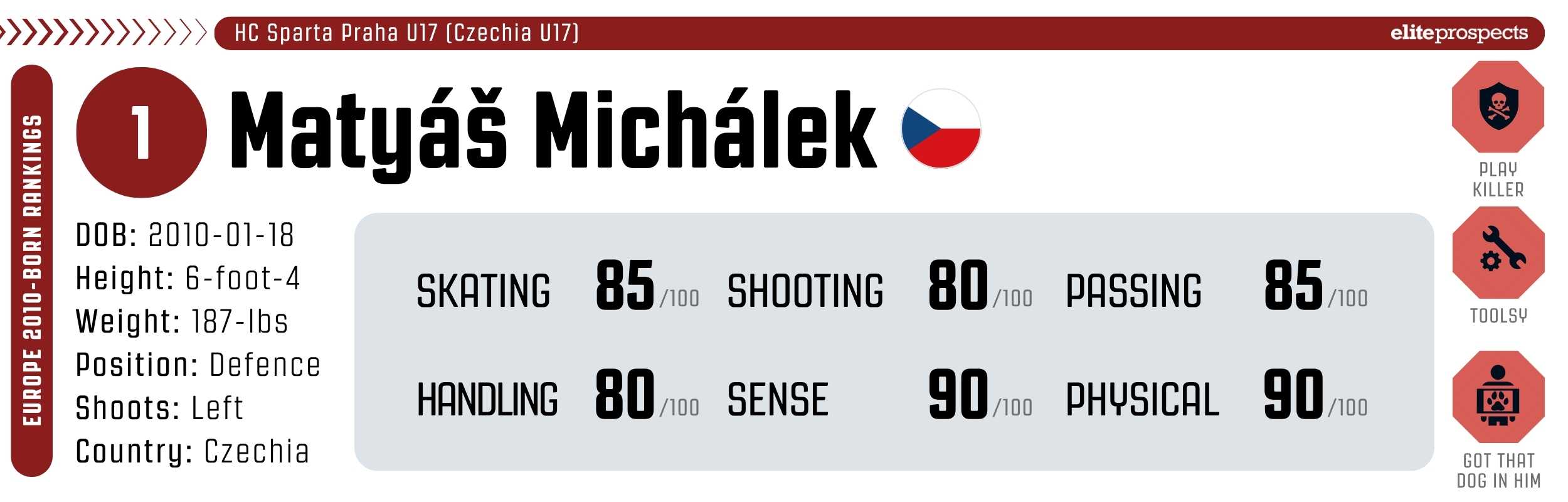
Matyáš Michálek started the season as a standout at the U17 Four Nations tournament in Plymouth and finished as a standout at the U18 World Championship in Slovakia. As a double-underager, he not only hung on, he played top-pair minutes in all situations and contributed impressively en route to a bronze medal. There are plenty of promising players in the 2010-born class, but in the end, Michálek was an easy choice for the top spot.
Already weighing in at 6-foot-4 and 187 pounds, Michálek is the prototypical, modern-day defenceman. He's big, moves extremely well, and has plenty of tools at his disposal. He's an excellent shutdown defender, using his mobility, long reach, and big body to kill plays. With the puck on his stick, he's calm, confident, and very smart, and he does a great job jumping in on rushes and activating in the offensive zone to provide offence.
Michálek is mature beyond his years. Watching him at the U18s, you wouldn't have guessed that he's a double-underager. A consistently reliable presence on the backend for one of the tournament's top teams. Even for a player like him, the jump to higher age groups can be challenging both in league and international play, but Michálek took it in stride and dominated every level. The 2028 NHL Draft is two years away, but there's no doubt Michálek is a top prospect in his draft class.
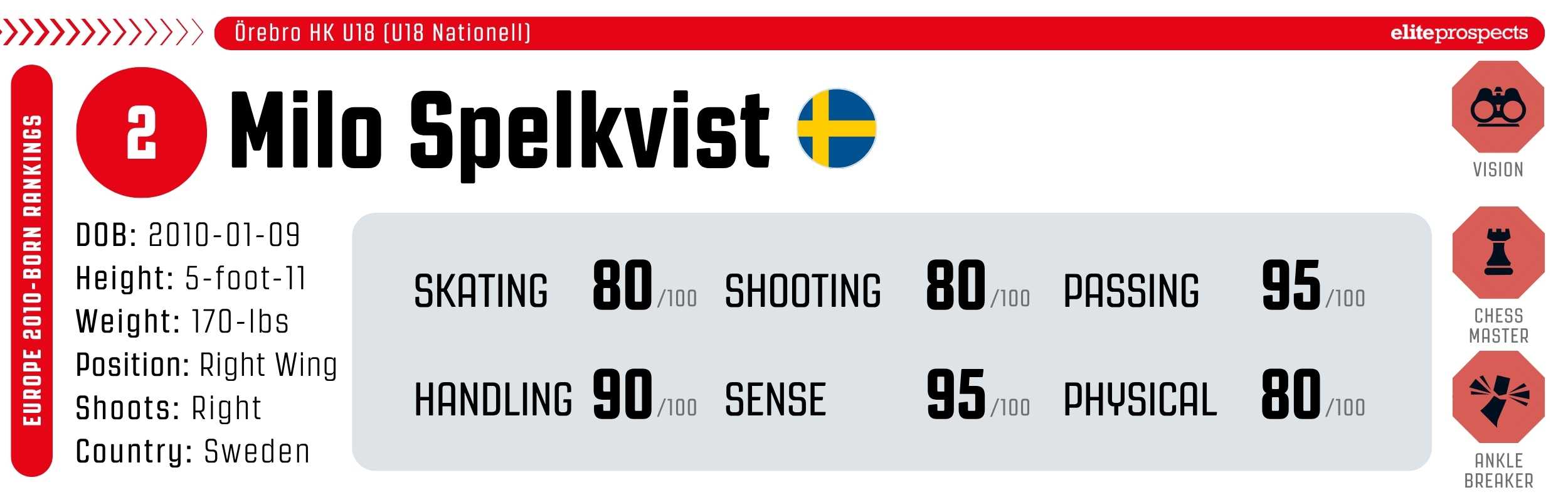
When our Swedish-based scouts put together their first regional ranking earlier this season, Milo Spelkvist topped the list. After months of extensive scouting from the entire European team, he’s still right at the top — ranked second among all 2010-borns. The dynamic Örebro winger left his mark early with standout performances at TV-pucken, not just maintaining his level but taking real steps forward as the year went on. With high-end offensive tools, he racked up 59 points in 35 U18 games (including playoffs) as an underager and added 18 points in 10 games with Sweden’s U16 team.
It’s the playmaking that really sets Spelkvist apart. He’s got soft but quick hands, deception through his body and feet, and a mind that processes the game at top speed — allowing him to anticipate, manipulate, and break down defences. He’s not just a distributor, either; Spelkvist is just as dangerous finding open ice in the slot and beating goaltenders with quick, accurate finishes. One-on-one, he’s unpredictable, with a knack for pulling off moves that catch defenders off guard and break the pattern.
What’s most impressive is how he’s accelerated as the competition has stiffened. Spelkvist’s rapid learning curve and development suggest he’ll be one of the most exciting offensive talents at the junior level — already a standout in Sweden’s U18 circuit, and poised to make noise internationally as the bar rises. There’s still plenty of time until the 2028 draft, but Spelkvist looks like a first-rounder already.
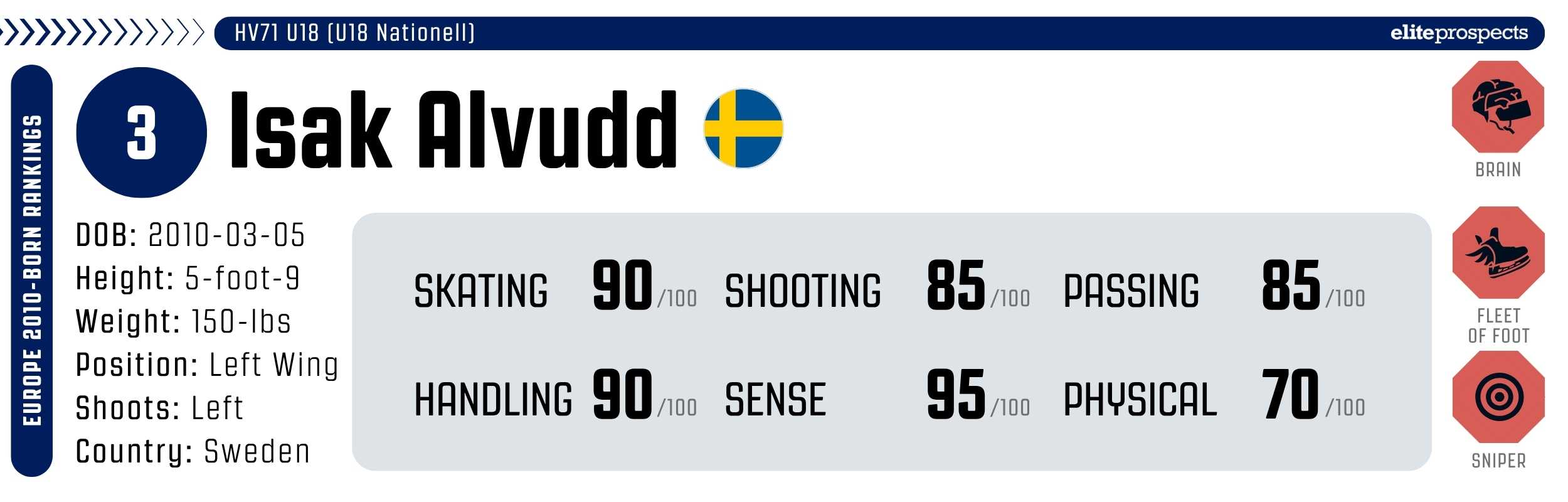
Isak Alvudd isn’t your typical undersized, skilled forward who gets knocked for lack of physical tools. Sure, his grade there is a touch lower, but if he had more size, it’d be right up with the rest — he’s that highly regarded. What really sets the HV71 winger apart is his competitiveness, backing up his outstanding tools. Alvudd wins races with his speed, but he also wins the next battle by initiating contact, balancing on his edges, and escaping pressure with a quick burst.
That’s not the main reason he’s ranked so high, though. It’s his offensive toolkit that makes him stand out. With elite hockey sense, he’s a constant threat — always dangerous, always reading the play. Averaging over a point per game in U18 as an underager on a team that was no more than average, Alvudd learned to shoulder responsibility early.
The shot is his go-to, and he’s a true finisher. He can score from the flank with a quick release, but his speed and sense also put him in positions where he's all alone, showing time and time again that he can finish with real skill. His vision allows him to find the pass when it’s the better option, and he’s just as effective as a playmaker. The common thread is his accuracy — whether it’s a pass or a shot, he consistently finds the mark. Alvudd is a truly special player, and we’re betting he’ll keep beating the odds, no matter his size.
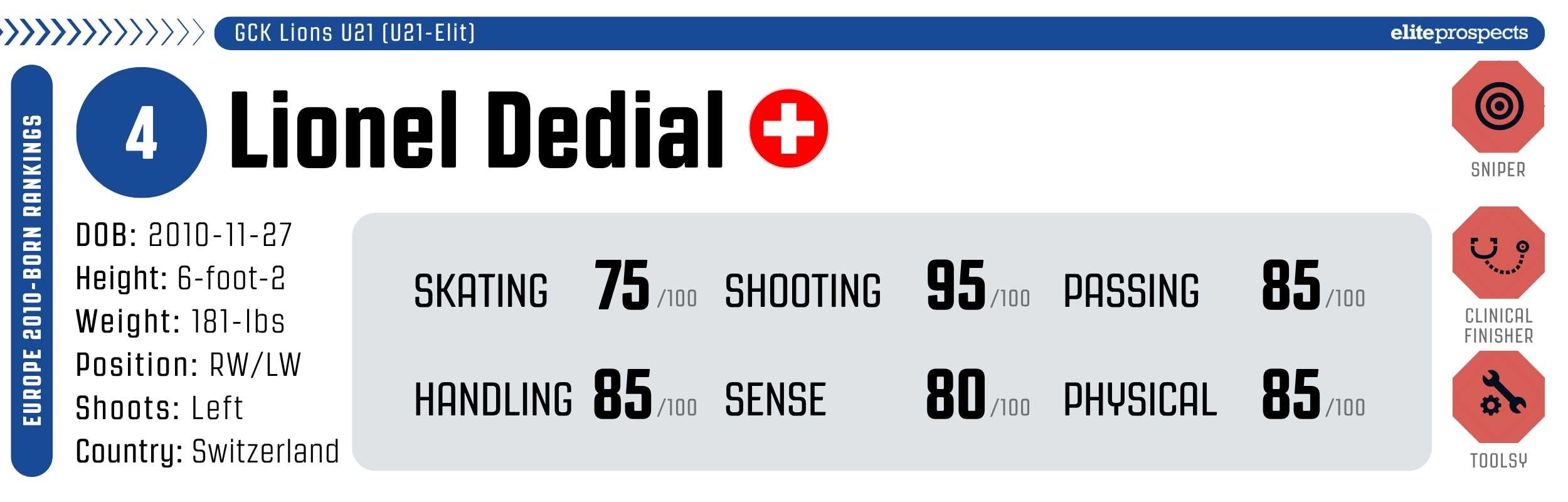
If you ask people in the know in Switzerland, many will tell you the federation has a real problem staying competitive, struggling to bring up enough high-level prospects to the pro ranks. While that may be true, they certainly don't have to worry about the very top end of talent. Coming up behind 2009-born top prospect Jonah Neuenschwander is 2010-born Lionel Dedial.
Neuenschwander played in the U18 and U20 World Championships and several professional games in his 15-year-old season — Dedial did none of that. Still, watching Dedial play, it's hard not to draw the comparison. A big forward with an elite wrist shot, Dedial lit up the U18 and U21 circuits in Switzerland this season, and he was excellent in games with the U16 and U17 national teams. He is one of just two players in this class to receive a 95 shot grade, but he's by no means a pure shooter. Time and time again, he's displayed high-level vision and passing skill in our viewings as well. Combined with his pro-level frame, that makes him an extremely well-rounded player with high-end pro upside.
Dedial's skating was the biggest question mark heading into the year, and it still was at the midway point of the season. However, the more we watched him, the better his skating looked. The mechanics might still not be perfect, but he's fast, explosive, and very rangy as a puck carrier. He's got all the tools to become a first-round pick in 2029.
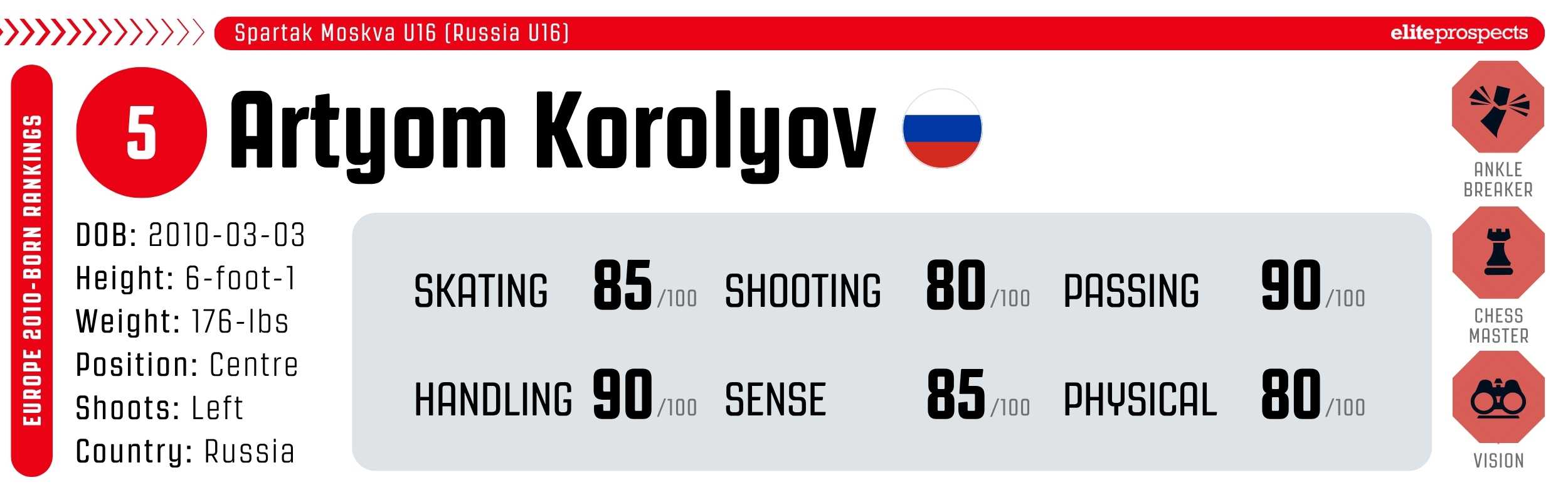
Few in this age group can match Artyom Korolyov's level of dynamic skill. The 6-foot-1 Russian centre is outstanding at breaking down defences on his own, blending excellent touch with deception on his edges and changes of pace to manipulate defenders. He carves out space on the inside with remarkable ease. Under pressure, he finds ways to escape — sometimes thanks to a perfect first touch or the way he sets up before receiving the puck, other times by occupying multiple defenders with his hands and edgework before bursting away while maintaining full control.
Korolyov is a puck magnet and the focal point, consistently dazzling with playmaking that creates scoring chances through anticipation and manipulation. While he isn’t as dangerous as a finisher, he still offers dual-threat potential, largely because he consistently gets himself into prime scoring areas.
There are others at this level who are more active and generally show a more consistent defensive game. Still, Korolyov has shown impressive peaks in this area as well, creating turnovers with his anticipation, applying strong back pressure, and landing hard, well-timed hits in open ice. Having pretty much everything required to emerge as one of the absolute top prospects from Europe heading into his draft a couple of years from now, Korolyov is a special player.
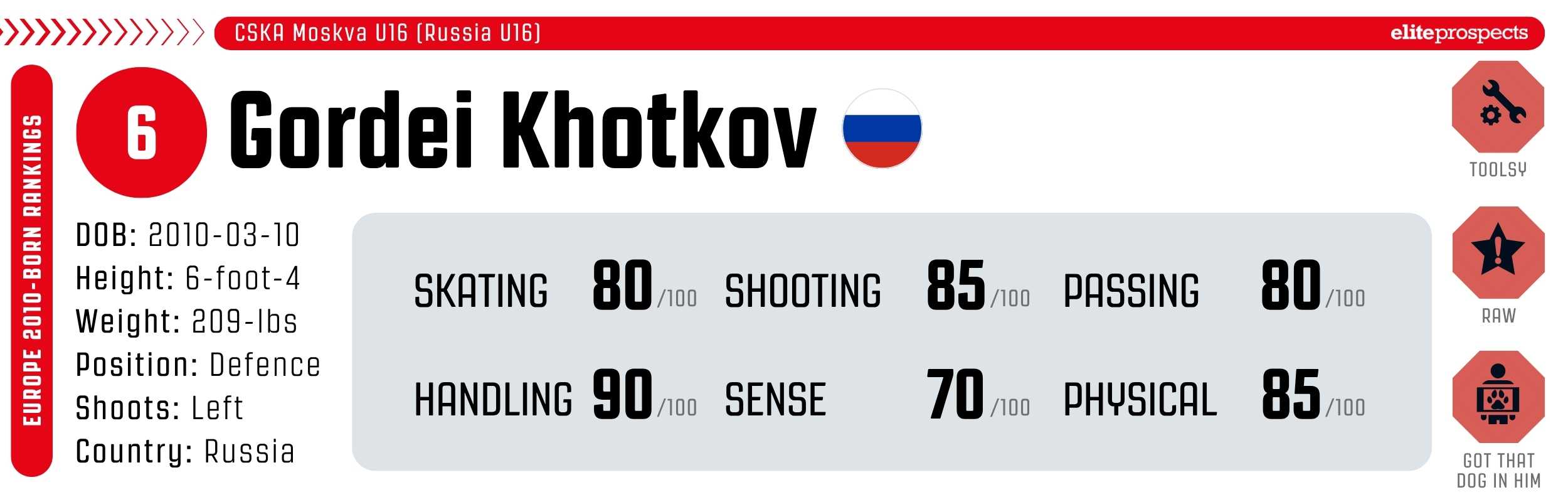
There is a certain "boom or bust" vibe in Gordei Khotkov's game, but the more we watched him this season, the more enamoured we were with the boom potential. Khotkov is the type of defenceman who makes you think "defenceman" might not be the right term to describe his position — perhaps "back" is more accurate. He plays from the back end, but playing offence is often at the top of his mind, which isn't necessarily what you'd expect when you see the 6-foot-4, 209-pound giant hit the ice.
Khotkov's game revolves around constant activation. He'll carry pucks out himself, jump in on rushes off the puck, and constantly activate inside the offensive zone. There are times when his feet look a bit heavy, as you'd expect from a player like him, but then he'll explode off the blue line, open up his hips, dangle around two or three opponents, and make a play. A quick, rangy puck handler with plenty of deception, he can fire heavy shots on net or find teammates with last-second cross-zone passes. The offensive upside is incredible.
Khotkov had some support among our staff to be the highest-ranked Russian player in this class — the upside is that special. But there's the bust potential, too, and that mostly comes on the defensive side of things. The tools are all there to figure it out, but Khotkov's defensive sense was our biggest question mark. He can get a little lost in the defensive zone, miss hit attempts, and wander about. He also isn't a punishing physical presence (yet), rather one who'll use his reach and outmuscle players in the corners and net-front. His future as an NHL Draft prospect hinges on figuring these things out — but for now, he's still one of the most promising prospects in this age group.
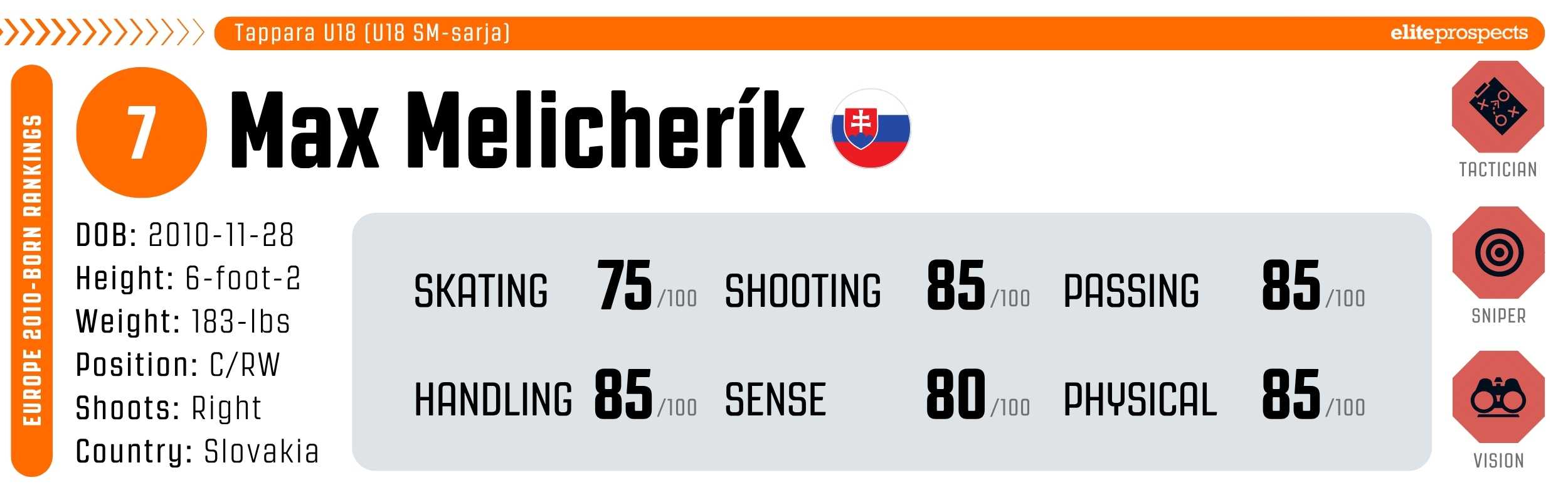
Max Melicherík is the most promising Slovak in the 2010-born class, and it's not particularly close. The 6-foot-2 forward led the Finnish U18 league in scoring among U16 skaters by a wide margin, in addition to shining internationally across three different levels, capping off the season by appearing in a single game at the U18s as the youngest player in the entire tournament.
What makes Melicherík particularly intriguing is how his game could develop in a number of different directions over the next two years. He has the handling skill, dual-threat flashes, and really impressive smarts around the net-front as his main offensive assets — get him the puck around the slot, and he's going to reward you with offence. Especially when tasked to play up a level internationally, he showed flashes of a higher-end power game, too, having the frame and puck protection skills to drive through contact.
At the moment, skating looks like Melicherík's weakest tool, but it's unlikely to make much of a difference, especially given his output already looks fine most of the time. At times, his motor and defensive effort graded on the inconsistent side, but his size and strength also allowed him to make an impact when he put in the work. Not eligible until the 2029 NHL draft, he's on track to become a potential first-round pick.
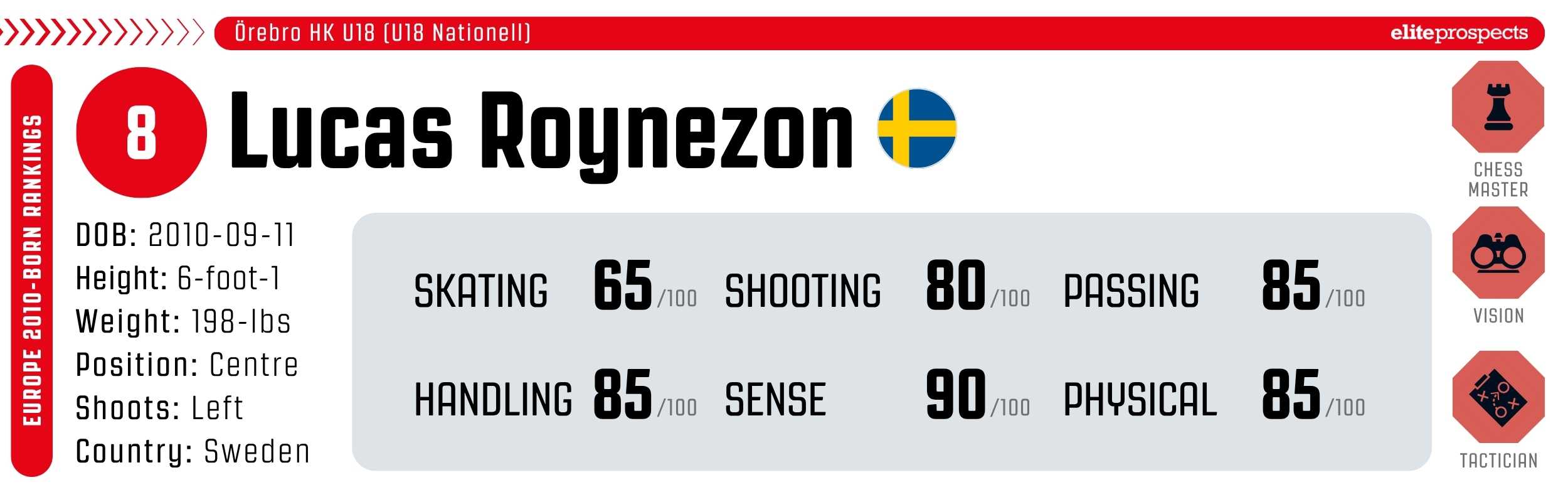
The top U16 scorer in U18 Nationell history isn’t Lucas Raymond or Alexander Holtz anymore — it’s Lucas Roynezon, the first 2010-born to suit up for Sweden’s U17 team, the best Swedish forward in his age group, and already a record-breaker. Roynezon’s hockey sense stands out; he finds soft spots, makes smart plays with minimal touches, and thrives in tight spaces, slipping passes through traffic or getting shots off under pressure.
What really sets him apart is his anticipation and unselfishness. He’ll pass up a good look to set up a teammate, and he’s tough to move in net-front battles, always competing in the hard areas. As the season went on, his two-way game took clear steps forward. When the scoring dried up in the playoffs, he didn’t start cheating; he began to play an even more impressive two-way game.
The one question is his skating — stride and mechanics — but so far, Roynezon has found ways to stand out against older competition. That intelligence and adaptability point to a bright future at the junior level and beyond.
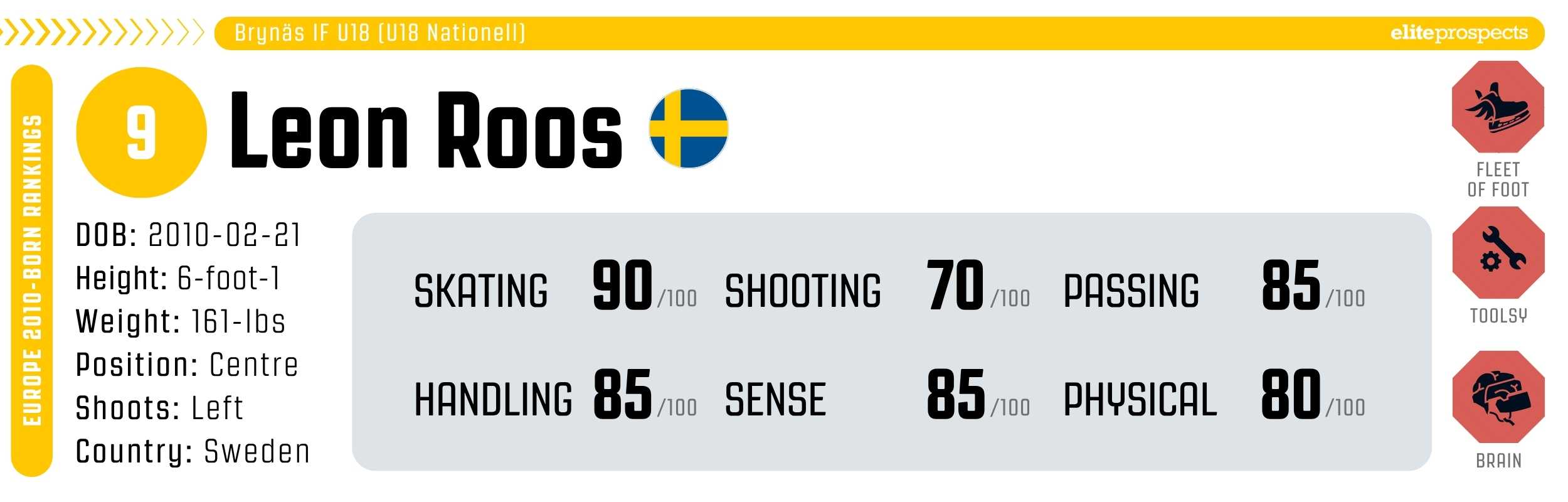
Leon Roos dominated early with a strong start to the season, and after a mid-season dip, he finished just as impressively, leading all U16 players in U18 playoff scoring and closing out with a strong showing for the national team. With smooth skating and silky touches, along with high-end processing, Roos boasts some of the most dazzling tools in this age group.
Dictating tempo at both ends of the ice, few underagers in U18 Nationell matched the impact of Brynäs’ dynamic skater this season. He pulls away from defenders or slips inside with sharp directional changes, using his stride to create separation and his patience to wait out pressure. Comfortable holding the puck through contact, he protects possession until the right passing lane opens, threading passes to the flanks with precision. As a finisher, his ability to find open ice and time his movements allows him to get free in dangerous areas, hinting at even greater scoring upside down the line.
With the national team, offensive consistency sometimes wavered, but flashes of high-end skill were unmistakable. He also showed impressive defensive play, with excellent reads and careful tracking, often winning pucks and quickly turning play up ice. With his toolkit, Roos is one of the most intriguing prospects in this group and projects to be one of the top Swedish prospects heading into his draft year.
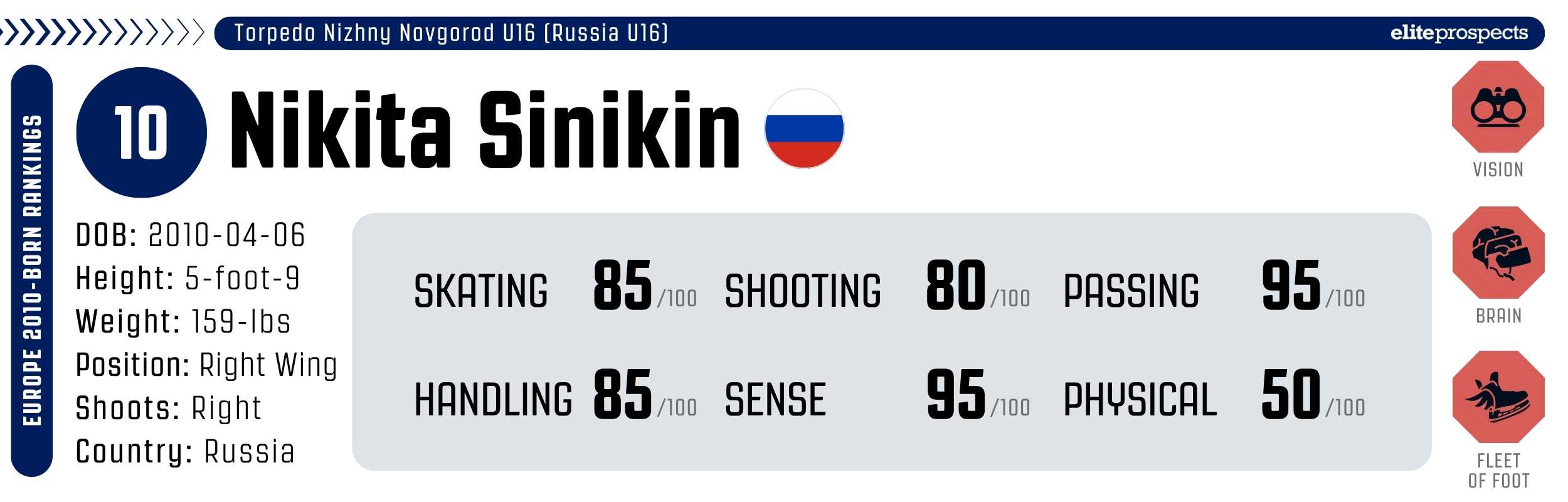
Nikita Sinikin may have dropped to 10th overall on this list, but his offensive tools and upside are among the very top. Coming in as one of just two players with a 95 passing grade and one of three with a 95 sense grade, Sinikin's playmaking has excited our scouts all season.
It's not just the pure passing vision, it's the way he thinks the game ahead of his peers. Sinikin knows his next move long before he receives the puck, using his awareness and reads to define his first touch, where he goes next, and where he wants to move the puck. He doesn't just deliver tape-to-tape passes; he moves pucks into space with perfect timing, leading his teammates into the right spot rather than just finding them where they are. When he's in the right spot himself, he also has the shot to beat goaltenders.
The biggest hurdle for Sinikin's projection is his size, and perhaps his style that still very much resembles a junior game. On the bright side, he's shown enough physical flashes and the willingness to go where it hurts, even throwing occasional hits. At the same time, however, those commendable attempts weren't always successful even at the U16 level – it will only get harder and harder to make it work once he moves up to the MHL and beyond. Still, it was impossible to ignore the tools and current abilities of this high-end offensive player.
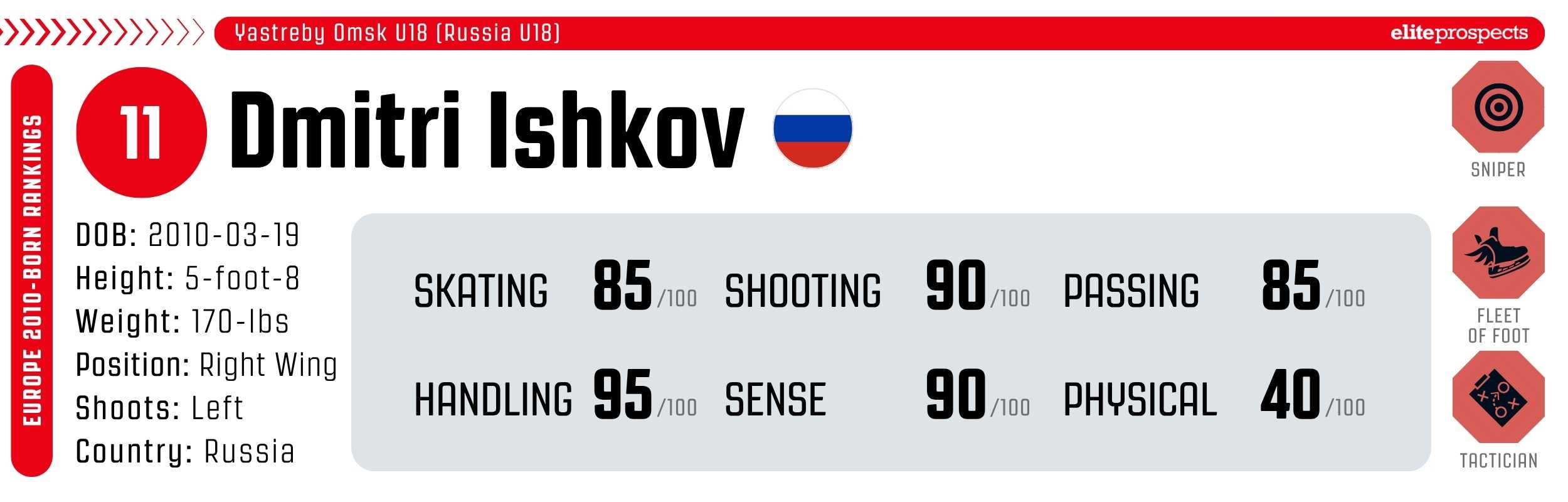
Like his countryman Sinikin, Dmitri Ishkov is an elite offensive player whose biggest question marks are his size and physical game. While that may be true, there's no doubt about his high-end tools.
Ishkov spent the majority of the season playing for Omsk's U18 team, where he put up half a goal per game and a total of 37 points in 28 games while occasionally dominating with the U16 squad. He's a quick, agile skater with quick hands and a high-end shot, but strong playmaking moments as well. He often thinks the game much quicker than his opponents, allowing him to exploit holes in coverage with quick give-and-go plays to generate scoring chances and odd-man situations. But he isn't afraid of just attacking defenders one-on-one, either.
While his compete level is usually high, he doesn't have the necessary physical skills to allow him to translate his game to the next level without making some changes. He can get stuck on the perimeter and be easily outbattled along the walls by bigger opponents. With that said, his tools are simply too good to be lower on him. If he can grow a couple of inches or at least develop his contact skills and inside drive, the sky is the limit for Ishkov – he's got all the tools.
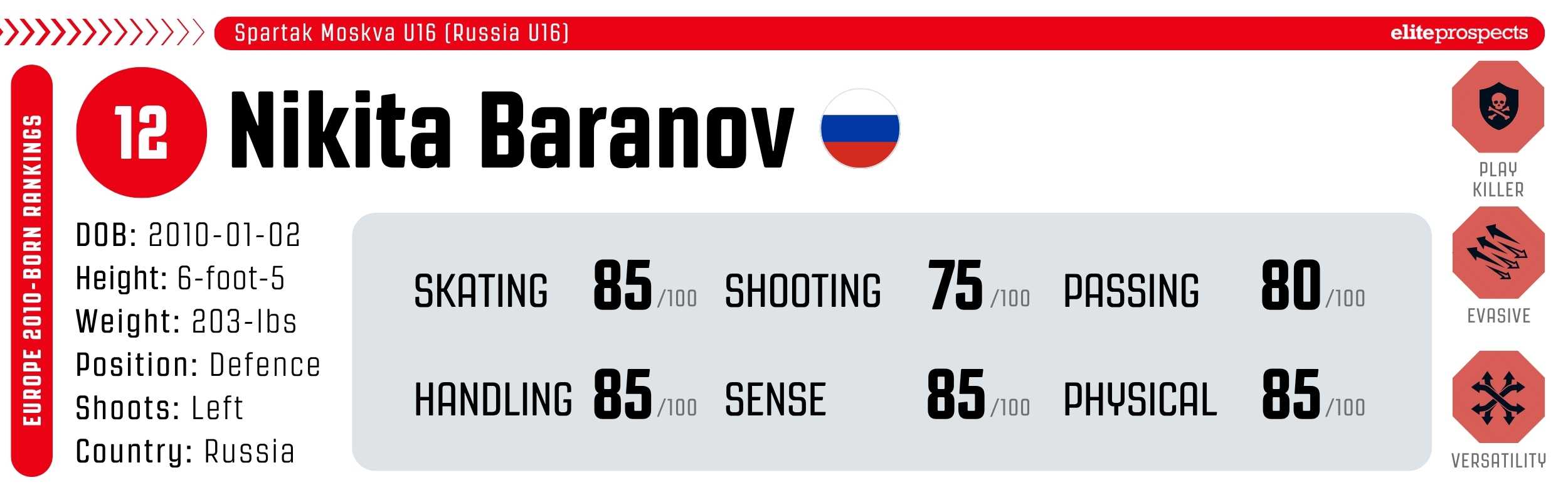
Rounding out a trio of Russians in our top 12 is Nikita Baranov. There isn't much separating him and sixth-ranked Khotkov — both are big bodies, mobile, and pack plenty of skill — save for raw, exciting upside. While Khotkov thinks offence first, Baranov is a steady defensive presence first, and an offensive contributor second.
At 6-foot-5 and 203 pounds, Baranov has a pro-ready frame, and he moves extremely well with it. Quick, smooth, explosive. He does a great job shutting down rushes and is a consistent impact player in his own end as well. He makes good reads to be in position and smothers opponents along the boards with his long reach and strong frame. A bit more aggressiveness and urgency would increase his impact, but his mature, calculated approach already brings a lot of value.
What gives Baranov true high-end upside as a future NHL prospect is how he combines his steady defensive presence with puck-moving and offensive upside. He's extremely evasive, not only for a big guy, frequently displaying high-end escapability with his quick hands and feet, allowing him to break the puck out reliably. Inside the offensive zone, he often flashed the necessary tools to activate and make plays off the blue line, even if the output isn't always there. Still, between him and Khotkov, Baranov may be the safer bet as a high NHL Draft pick.
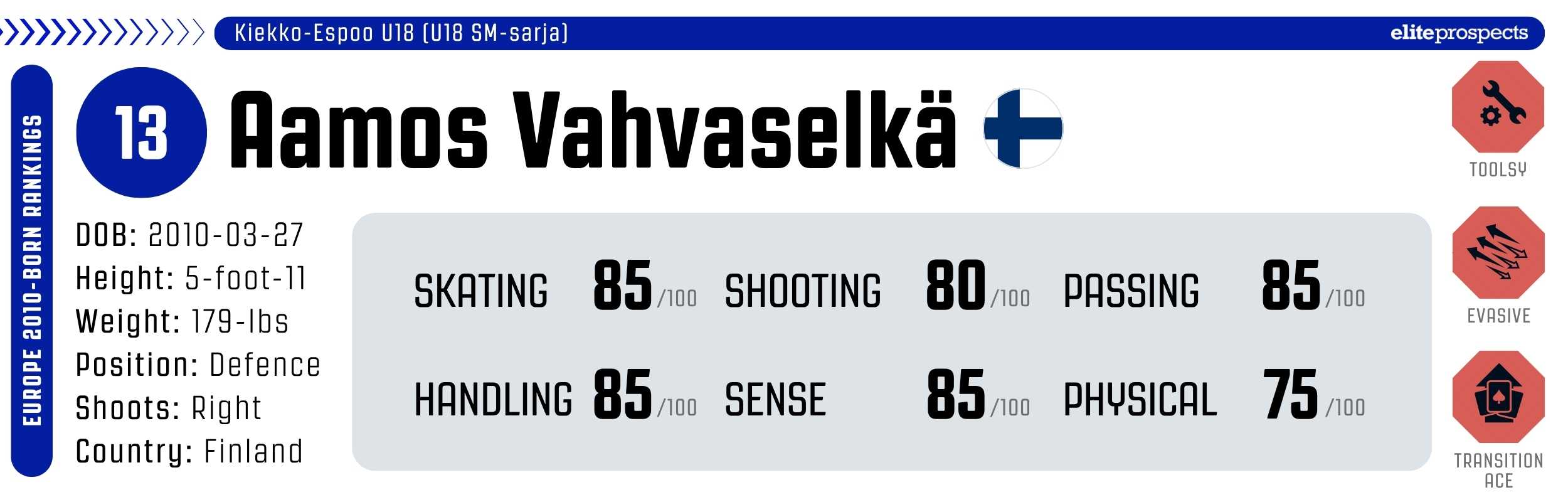
For now, Aamos Vahvaselkä has separated himself from the rest of the pack among Finnish talent in this age group. He was among the more dynamic forces from the backend in the U18 league and was consistently the most impressive part of the U16 national team, finishing with 14 points in 12 games across all international events.
The makings of a strong two-way, all-around play-driver are all there. Vahvaselkä is mobile, able to explode past pressure through his first steps, and dish impressive feeds in transition. He plays a high-octane style, joining all of the possible rushes but also showing creation skills through his vision and manipulative flashes, in addition to quarterbacking a power play through a natural feel for the game.
Vahvaselkä's defensive game might lack some refinement, but the building blocks are all there. He added more physicality to his game over the course of the season, outworking and out-leveraging attackers off pucks along the boards and occasionally laying out opponents with thunderous hits when defending the rush. Between the tools and the reads, there's not much lacking from Vahvaselkä's projection aside from a bigger frame. He could be a first-round calibre prospect in two years.
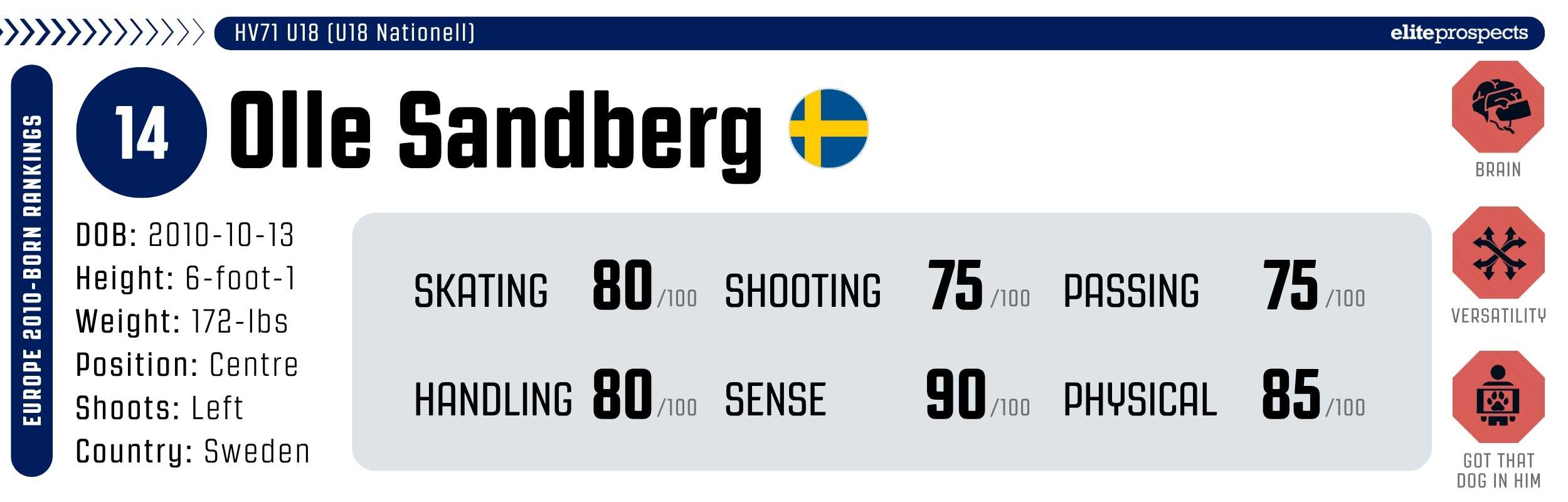
A powerful, smart, and competitive 200-foot centre with offensive upside, Olle Sandberg brings just about everything you want in a player to build around. His game is anchored by strong awareness on both sides of the puck — he owns the middle of the ice, shutting down opponents and quickly turning defence into offence. With his big frame and competitive playing style, he engages in battles all over the ice and has a particular knack for coming out on top. He doesn’t shy away from being a bit nasty, often bringing an opponent with him to the penalty box.
There isn’t quite the same offensive pop here as with some of the other top forwards, but both his floor is high. With his intelligence, he’s often a threat in transition, using good timing and smart reads to attack with pace. He’s a versatile passer, able to execute under pressure and adapt to different situations, excelling with agility, hip pocket use, and other techniques to open up lanes. At his best, the way he can win battles and create offence off the forecheck and out of the corners is very similar to that of top 2026 NHL Draft prospect Alexander Command.
Going forward, Sandberg should try to be more of a factor in play-driving, carry the puck more often, and use his big frame in the interior to generate more scoring chances. All in all, one of the most projectable centres in this ranking. As a late birthday, he’s got a long runway until his draft year in 2029.
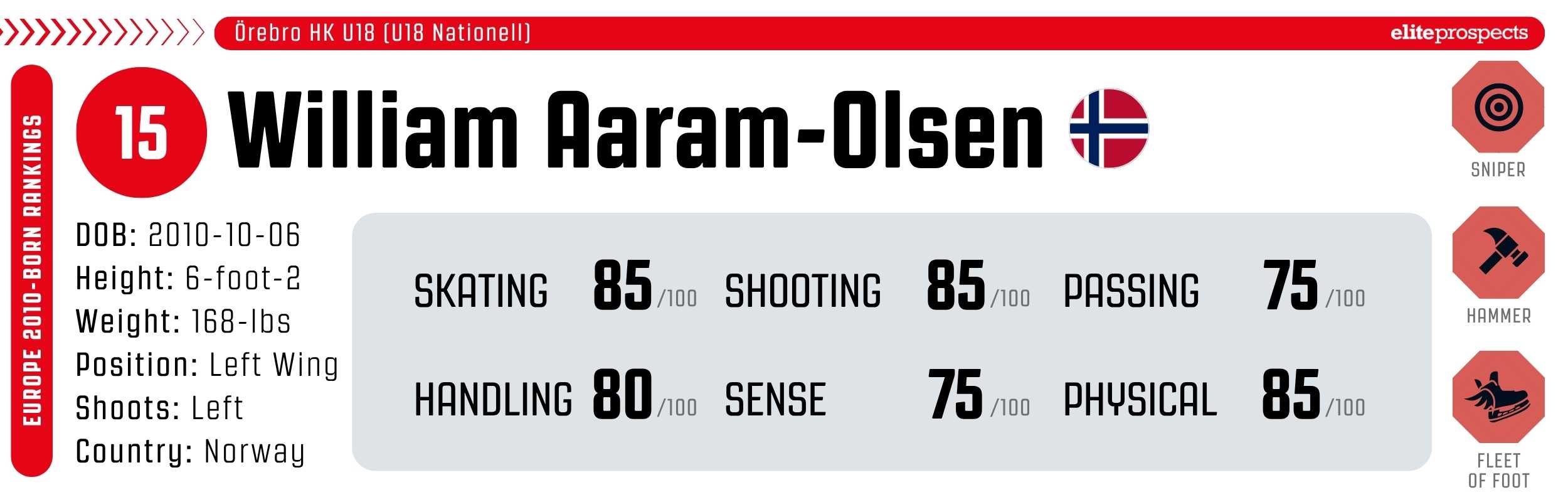
One of the biggest risers in this group, William Aaram-Olsen capped off a highly productive season. The Norwegian standout was one of the most entertaining and prominent players in the U18 playoffs — especially among 2010-borns. The 6-foot-2, October-born winger showed plenty of flashes of handling skill, but projects best by playing a more straightforward, north-south game as a goal scorer with a mean streak. He finds open space well, is always available as a shooting option, and he displayed the ability to finish through traffic with a defender on him.
Throughout the season, he impressed with his physical play, backing up his offensive touch and using his strength to create chances. Pinning opponents against the wall with a relentless forecheck to regain possession, he isn’t shy about throwing his weight around. This year also saw clear development in his skating, allowing him to fly down his wing and threaten in transition more than before.
Aaram-Olsen is the top Norwegian 2010-born player and will be a force in U18 next season, projecting as a winger with a strong blend of skill, work rate, and size. On top of that, he is not eligible until the 2029 draft, which gives even more runway to improve for the skilled and gritty forward.
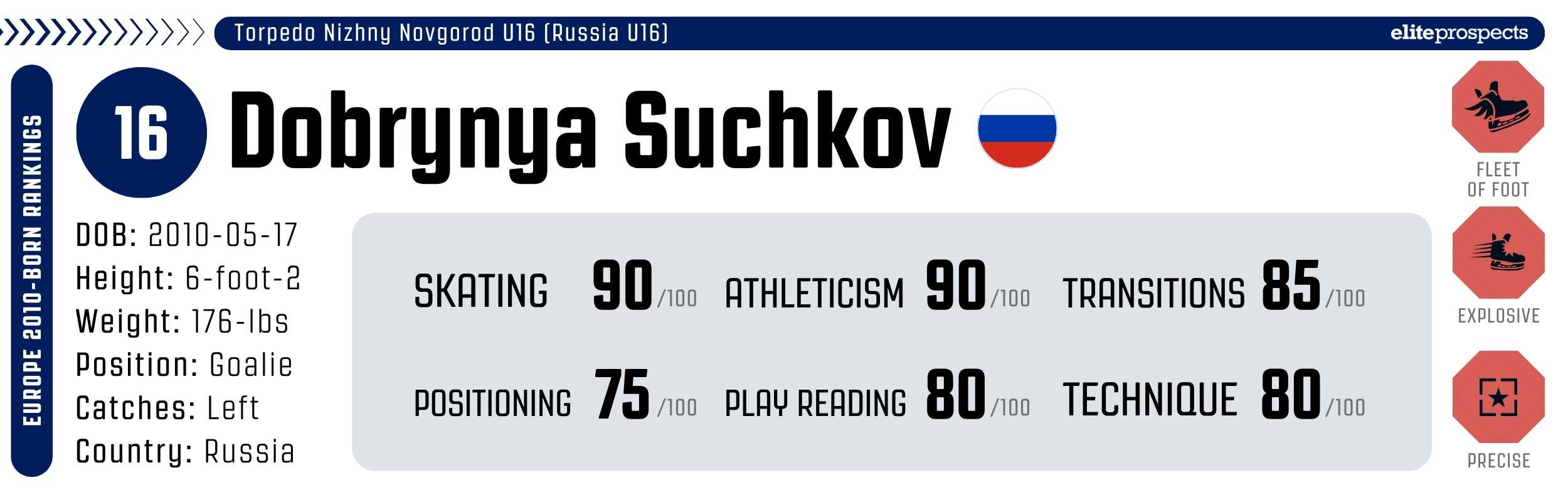
Dobrynya Suchkov is the clear top goaltender in this class right now and is drawing strong comparisons to top 2026 NHL Draft prospect Dmitri Borichev. Suchkov isn't the tallest goalie, but he's an excellent skater and athlete. Extremely quick and explosive, but already very precise and calculated, too. Through league play and international competition, we had no bad viewings of Suchkov all year, and there was no real threat for him to lose the top goalie spot.
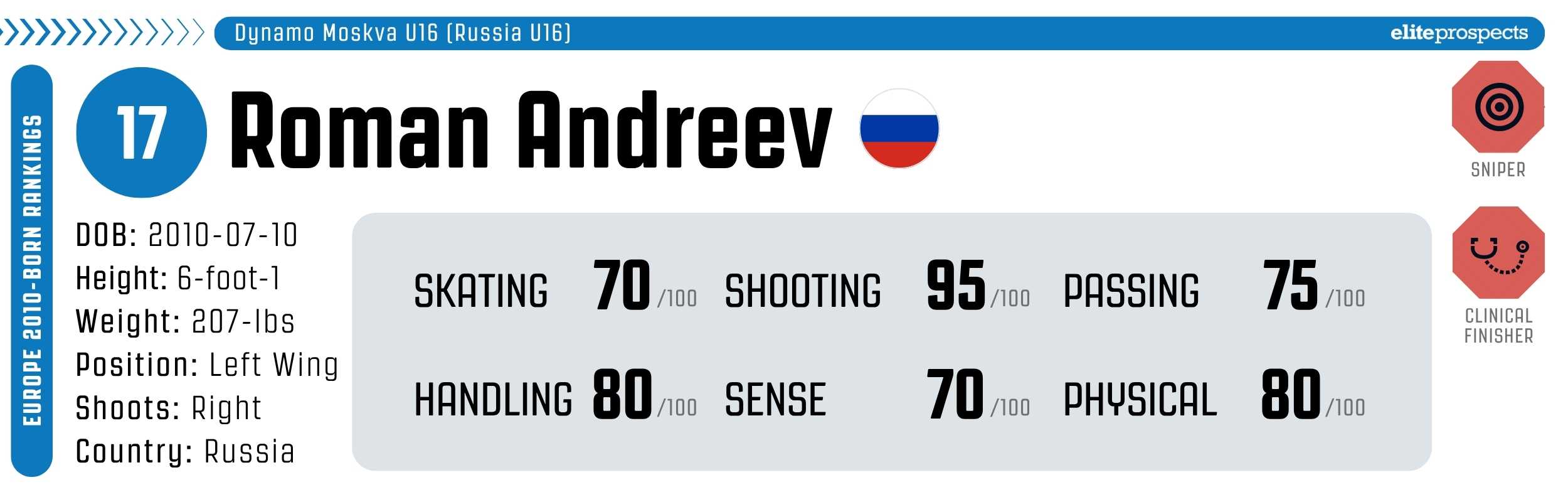
One of just two 95-rated shooters in this class, Roman Andreev is an elite goal scorer. The flashes have been high-end all season. He's a big body with good hands, bringing plenty of power forward upside, and flashed playmaking upside as well. He had support among our staff to be ranked a fair bit higher, but his footspeed, sense, and inconsistent physical play kept him behind some of his peers from other countries. Still, the upside is legit, and he could easily climb up the list for his NHL Draft season.
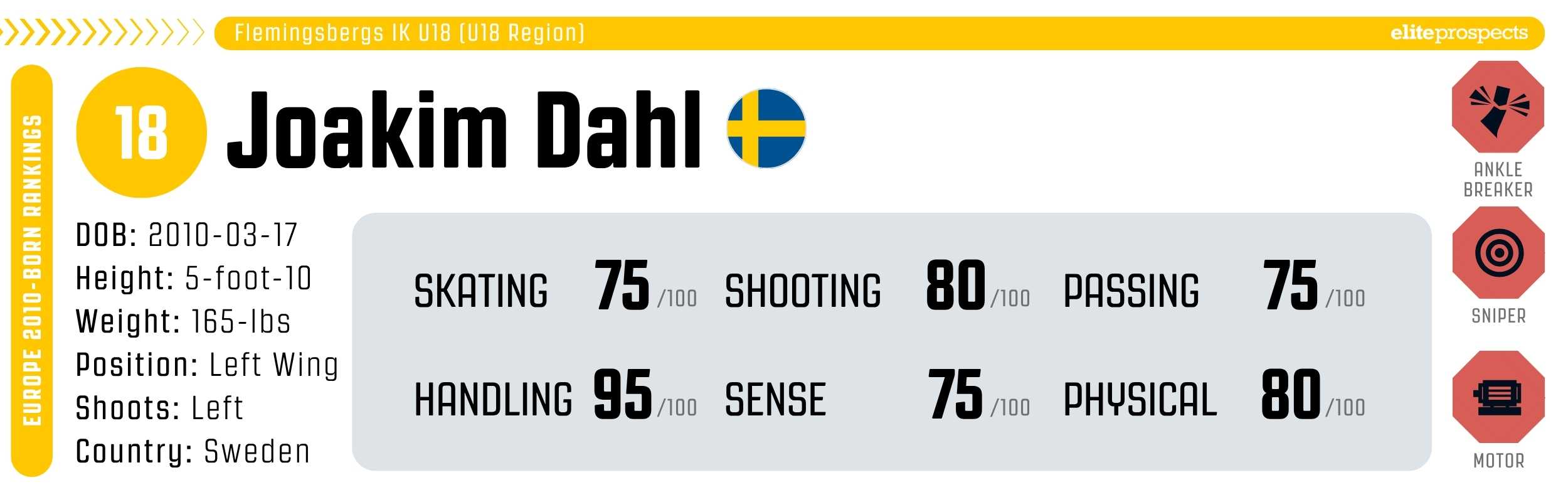
Joakim Dahl put together nothing short of a standout season. The Stockholm-born winger, now heading north to join Brynäs, delivered at every level he played. At his best, his offensive skill set matched anyone’s — powerful, yet agile, with a smooth touch on the puck. Dahl’s reach and ability to handle the puck in motion force defenders to stay alert; he adapts on the fly and attacks with real intent. What really sets Dahl apart is how his offensive game is anchored by a relentless motor and fierce compete. He’s physical in battles and never shies away from contact, making him a handful in tight areas. That combination of skill and drive suggests he’ll continue to make an impact as the competition ramps up. Don’t be surprised if he’s among the top players in U18 next season.
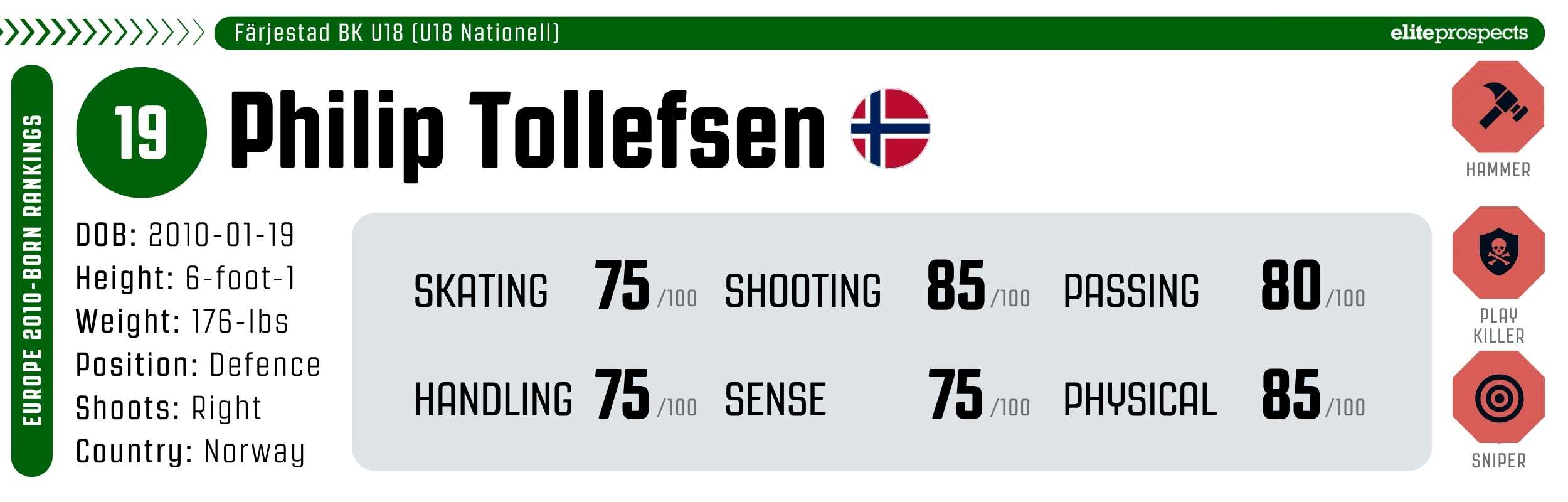
For some, it’s the booming shot and heavy hits that stand out first with Philip Tollefsen. But there’s more beneath the surface. This season, he took real steps forward as a two-way defender, capping it off with a strong showing at the U18 Worlds — killing plays with aggressive defending and pinning opponents along the boards. His puck play didn’t stand out as much at that level, but with his club team, he flashed plenty of skill as an underager in U18 Region and Nationell. With that mix of physicality and skill, Tollefsen looks built for higher junior levels — and he’s definitely one to keep an eye on as his game continues to round out.
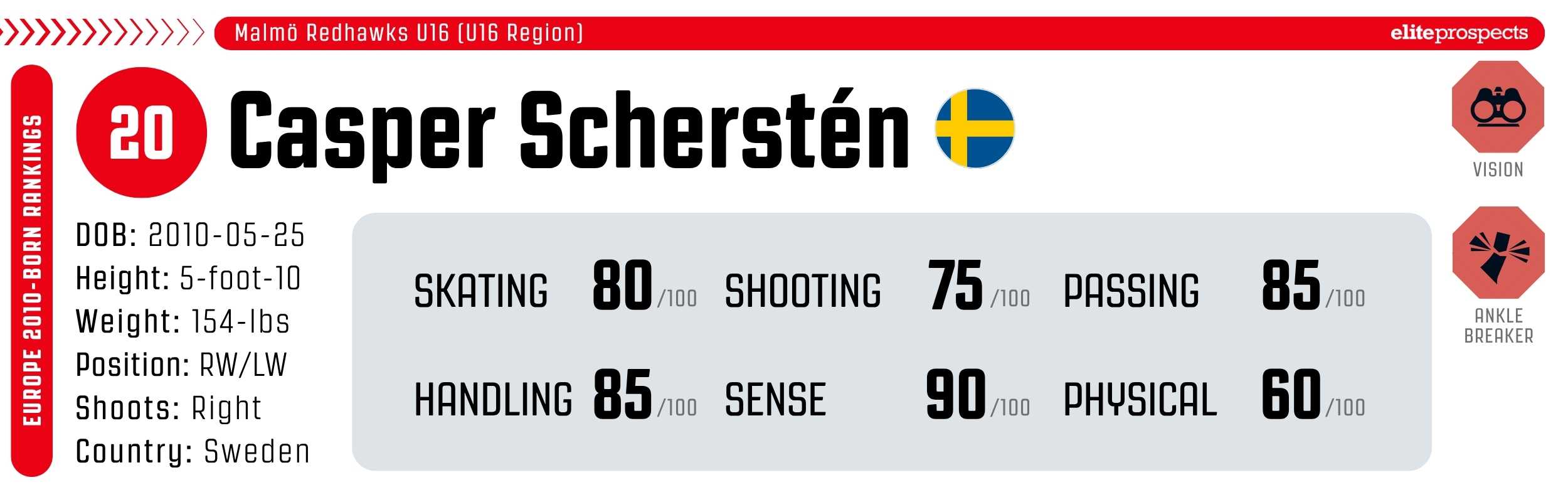
Few players grabbed our attention at TV-pucken quite like Casper Scherstén. His playmaking stood out for the way he manipulated defenders and created space, often making high-end passes look routine. He started the season on fire, only to be sidelined for a few months, but managed to work his way back and earn a spot with the national team. While he didn’t quite hit the same heights after returning, there were still flashes — quick reads, threading pucks through seams, and finding teammates in dangerous spots. Scherstén’s vision and awareness with the puck are clear strengths, but he’ll need to add more physical presence and consistency away from the puck to reach his full potential. There’s a bit more uncertainty with his projection compared to the very top of this group, but when he’s on, his upside is as high as anyone’s.
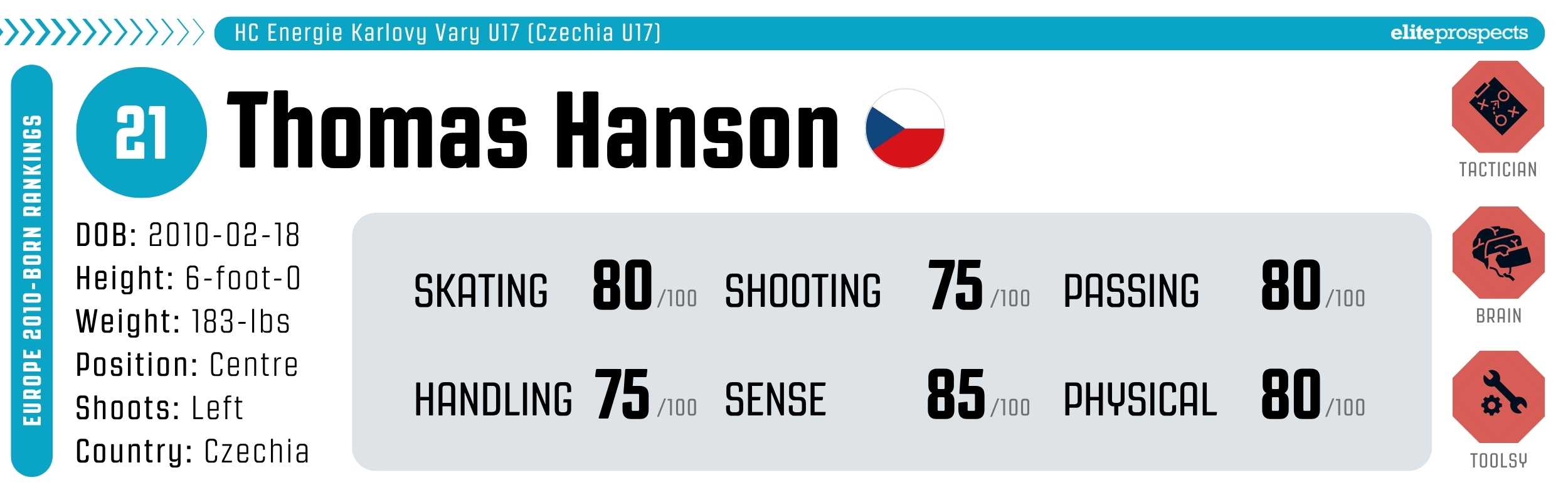
We liked Thomas Hanson in our international viewings this season, but his league play with Karlovy Vary was where he showed true high-end upside. A 200-foot centre with good size, Hanson is very toolsy, though it's his high hockey sense that consistently allows him to impact the game. He can contribute in a variety of ways, can make plays off the rush, off the cycle, around the net, and on the man advantage — he's constantly in a position to create danger. He's still a bit raw, but the pro upside is real. Hanson is our top-ranked Czech forward, and in the end, it wasn't particularly close.
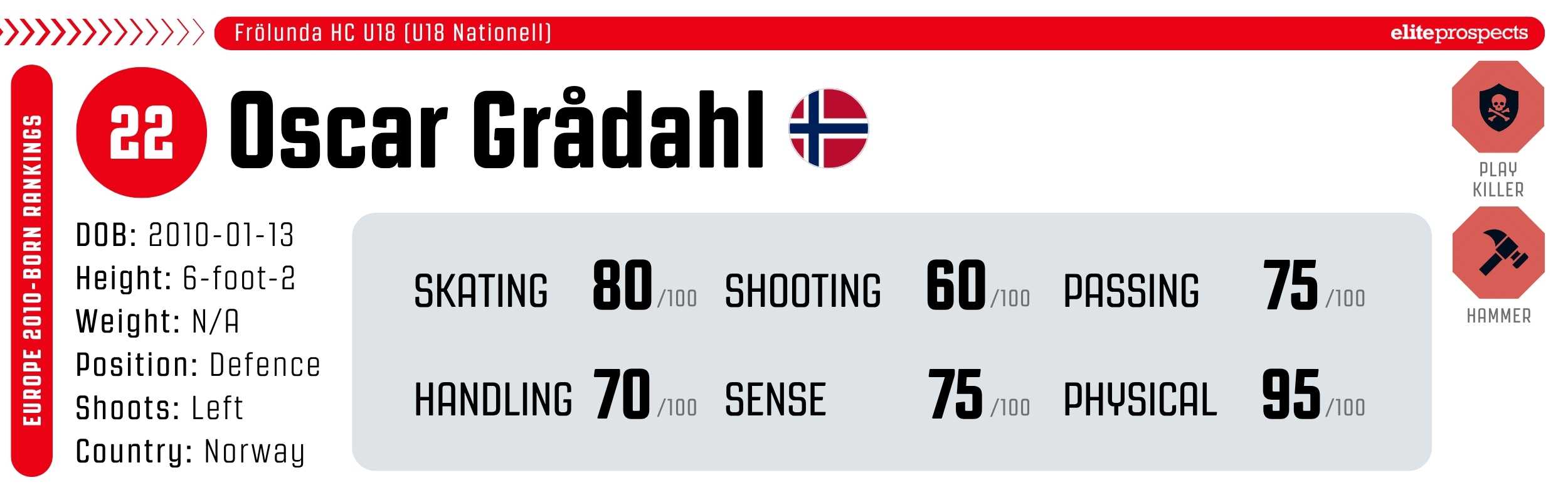
Among underagers in Swedish U18, few matched the steady presence Oscar Grådahl brought all season. The Norwegian defenceman locked down a spot on Frölunda’s blue line early and never looked back. What set Grådahl apart from most 2010-borns was his efficient, no-nonsense style — always in the right spot, consistently shutting down plays, and earning the highest physical grade in this group. As the year went on, he started to show more with the puck, still a safe puck mover but adding willingness to take initiative and create advantages for his team. Grådahl projects as a reliable defender at higher levels, but continued growth with the puck will be key if he’s going to round out his game and become a true two-way presence.
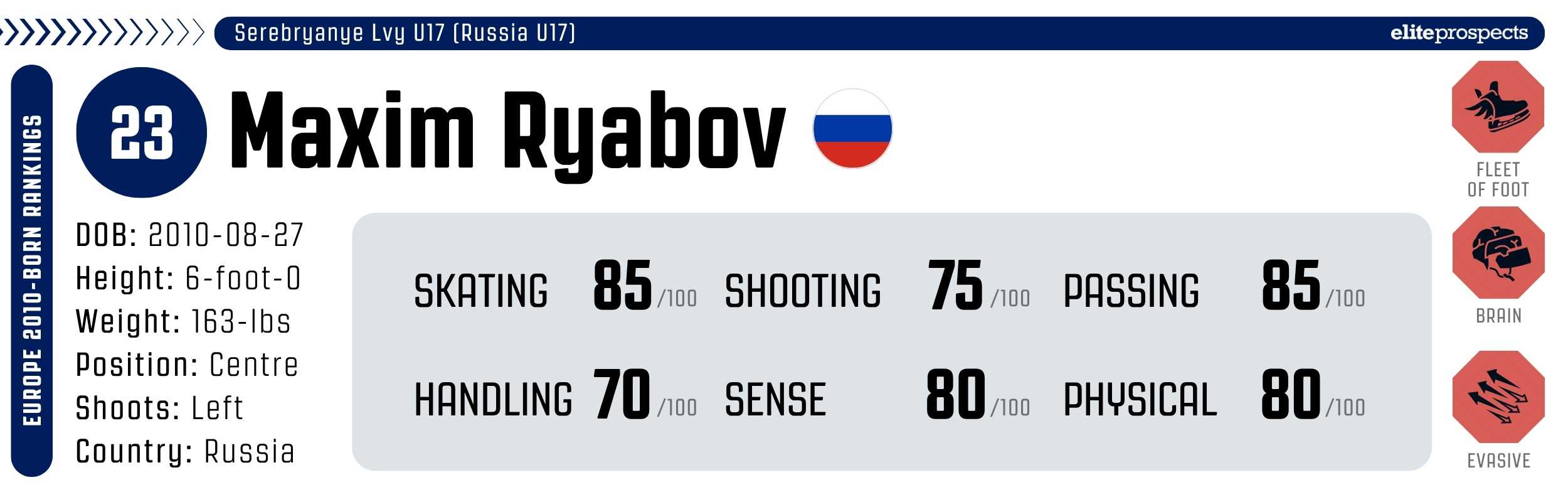
Maxim Ryabov brings a strong combination of size, skating ability, contact skills, and offensive tools, which has made him a high-impact centre all season. He plays with a lot of energy with and without the puck, can impact the game as a powerful puck carrier, a slick playmaker, and as a scorer. He's proven his abilities in league and international play, and projects as a high-level MHL player as early as next season.
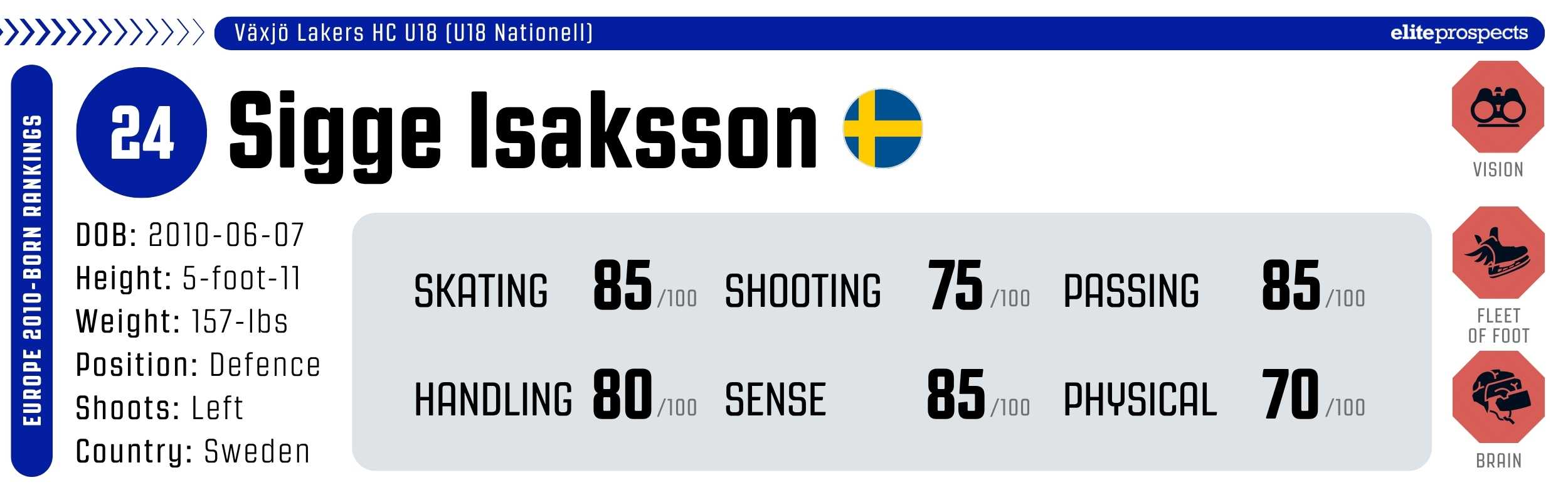
Deservedly named the top 2010-born Swedish defenceman this season after a remarkable year, Sigge Isaksson caught attention from the get-go and continued to stand out ever since. He’s among the very best at executing long-range passes, slicing through defensive lines and creating offence from the back end. Not long ago converted from centre, he brings an extra edge when joining as a trailer, using his instincts to step into the slot and pose an offensive threat. Time and again, Isaksson excelled with his reads — breaking up plays, intercepting passes, and threatening in transition. While his vision and offensive instincts are high-end, becoming more projectable will require adding strength and physical skill behind that excellent brain.
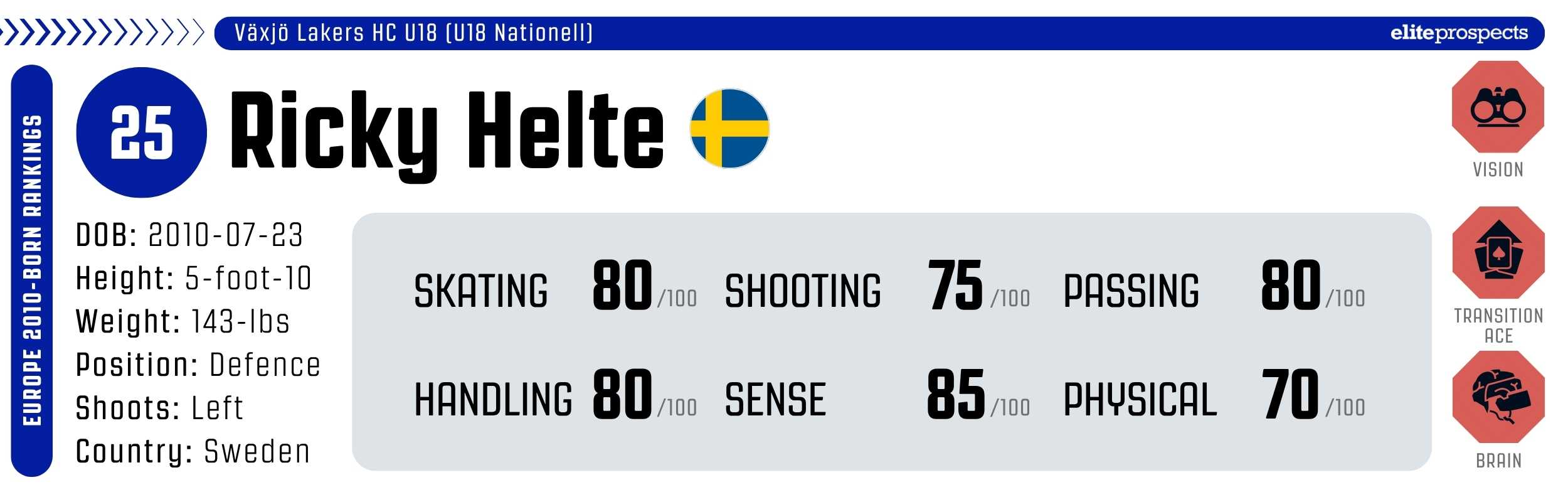
Ricky Helte, another Växjö Lakers defenceman, boasts some of the best hockey sense in this age group and truly shines with his offensive reads. There were plenty of flashes of manipulation — using his hands, feet, and upper body to draw in pressure before slipping a deft pass or creating separation with a burst of speed. Helte’s puck play is outstanding, whether shaking off a forechecker before breaking out or activating in the offensive zone, breaking in from the half-wall. Defensively, it’s more highs and lows, as is common for most defencemen at this age. Helte doesn’t have size on his side, but compensates to some extent with his reads and aggressiveness. It’s promising that he battles and even shows a bit of a mean streak. The short-term view is that he will be one of the most exciting 2010-born blue liners in Swedish U18 hockey next season.
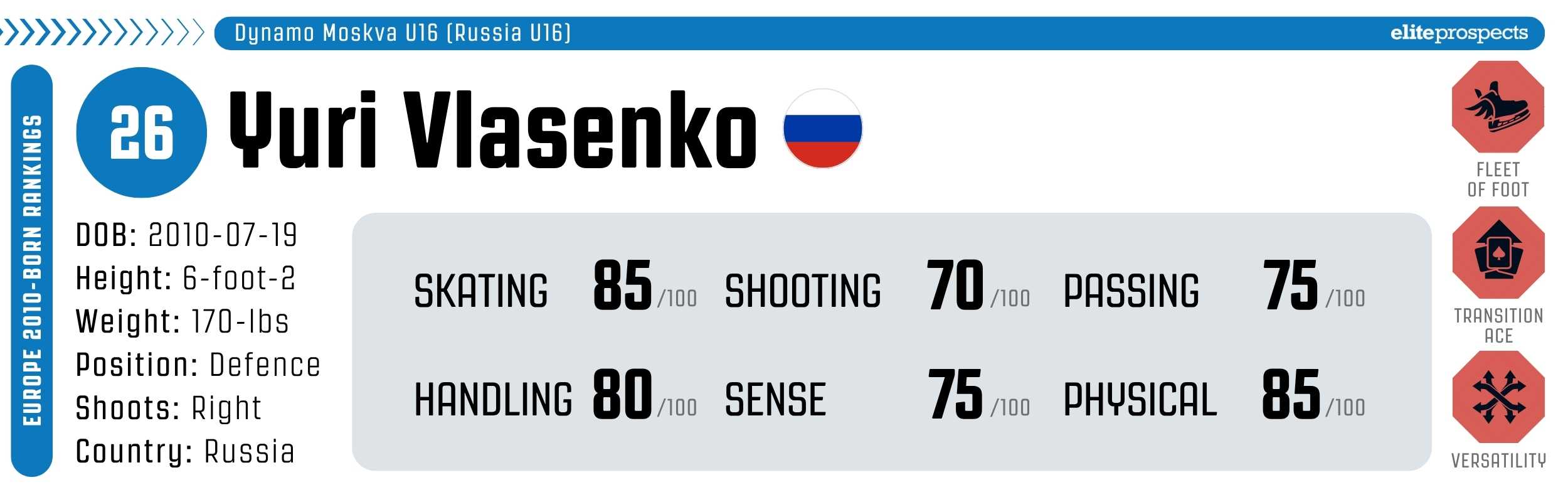
Big, smooth-skating, right-shot defencemen are always in high demand, and Yuri Vlasenko is just that. A quick, mobile skater with strong gap control and defensive stick work. He's strong in transition both as a carrier and a passer, and while the offensive numbers won't jump out at you, we've seen enough flashes in the offensive zone to believe in higher-end two-way upside. A very promising prospect for the MHL, but with legitimate pro upside as well.
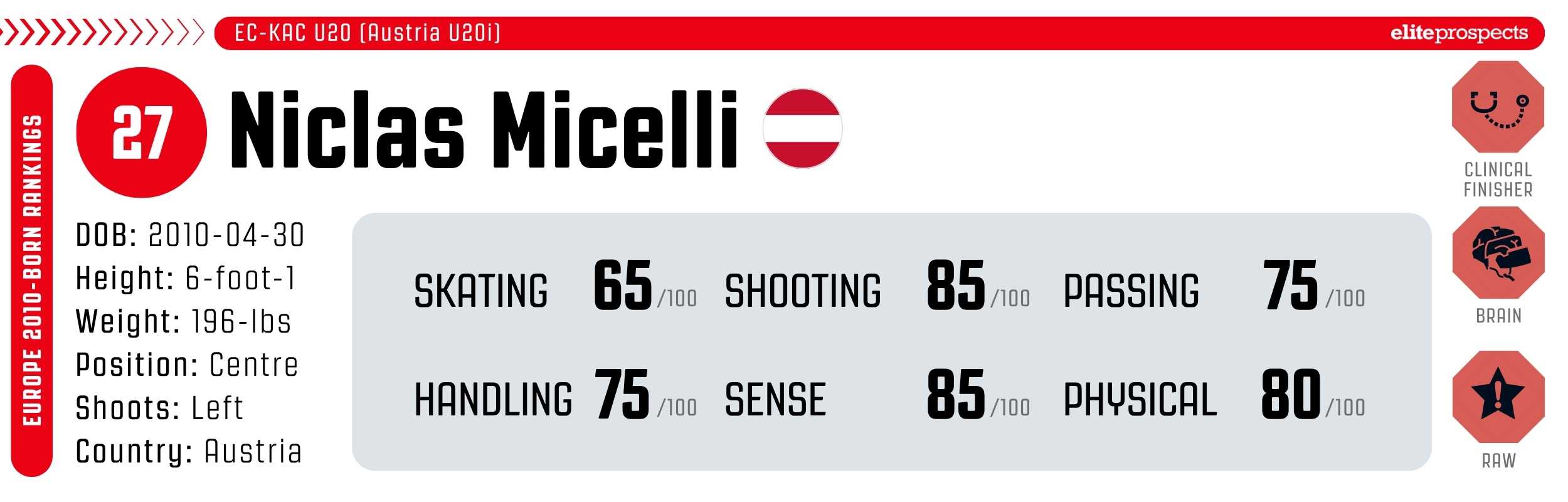
Playing in Klagenfurt in the same junior hockey program as Marco Kasper back in the day, Niclas Micelli had a fantastic season. While most players on this list spent the year at the U18 level or below, Micelli was a point-per-game scorer in the Austrian U20 league, and he represented Austria at the U18 D1B World Championship. A goal-scoring centre with great hockey sense and a pro-level frame, he had no issues playing against older opponents. His ability to improve his skating may ultimately determine his upside.
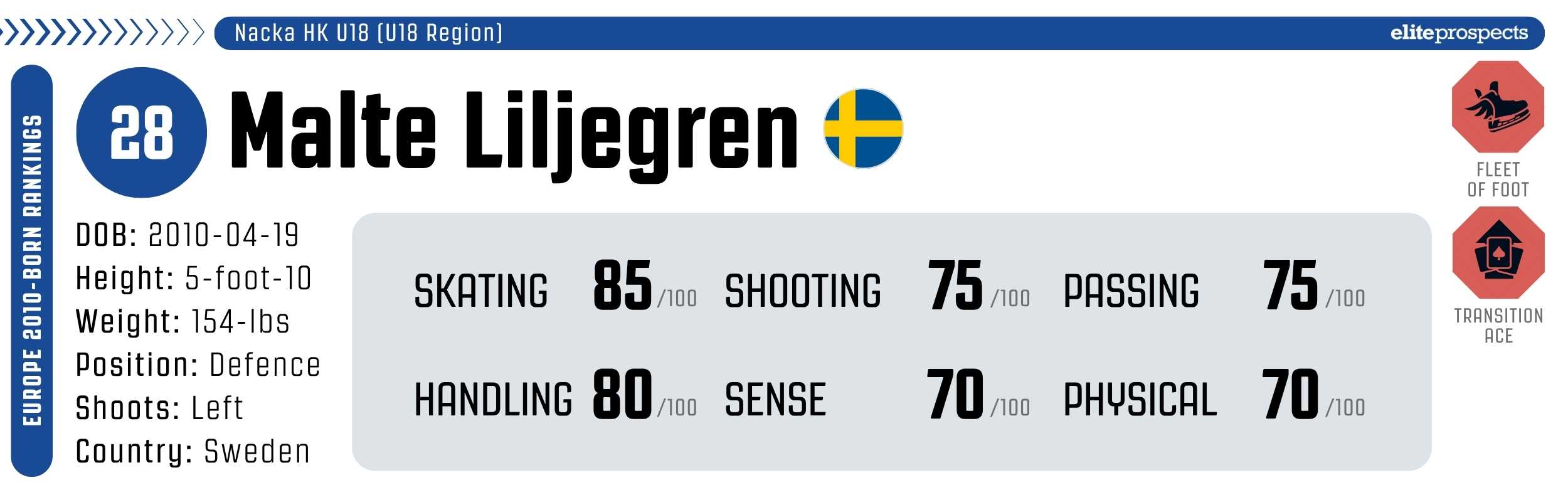
Within our group, there are some who consider Malte Liljegren the top Swedish 2010-born defenceman. At the very least, there’s consensus that he’s among the sharpest in this group at transporting the puck, flying up the ice with speed, and there isn't much separating him from Isaksson and Helte, ranked just a few spots higher. While his movements can be a bit erratic and inconsistent, he uses very quick feet and hands to create space for himself. The Stockholm-born defenceman is heading west to Karlstad, with his development set to continue at Färjestad — one of Swedish hockey’s premier clubs. There’s a strong chance we’ll see him quickly refine his game and emerge as a well-rounded two-way defenceman.
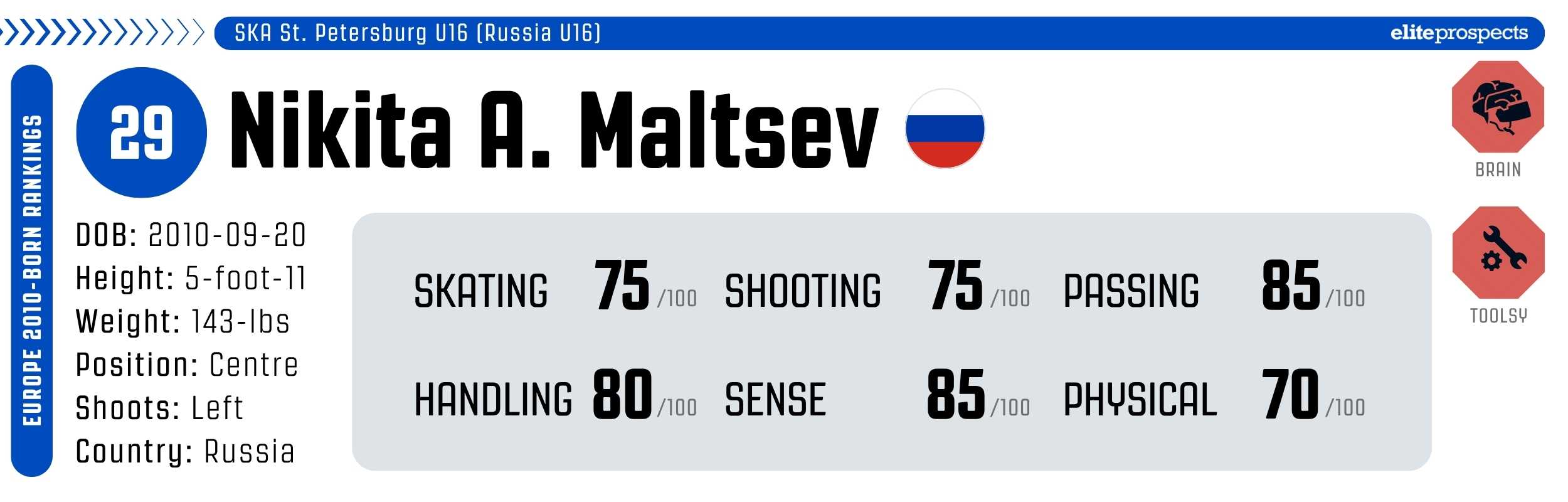
Nikita A. Maltsev impressed our staff with his high-level playmaking ability. He combines strong hockey sense on and off the puck with very good puck-handling and passing skill. While his skating mechanics are generally strong, he isn't the quickest or paciest mover, and his physical abilities have room for improvement as well. As a late birthday and 2029 NHL-eligible, he's got enough time to develop in those areas, and we like the tools enough to bet on the upside.
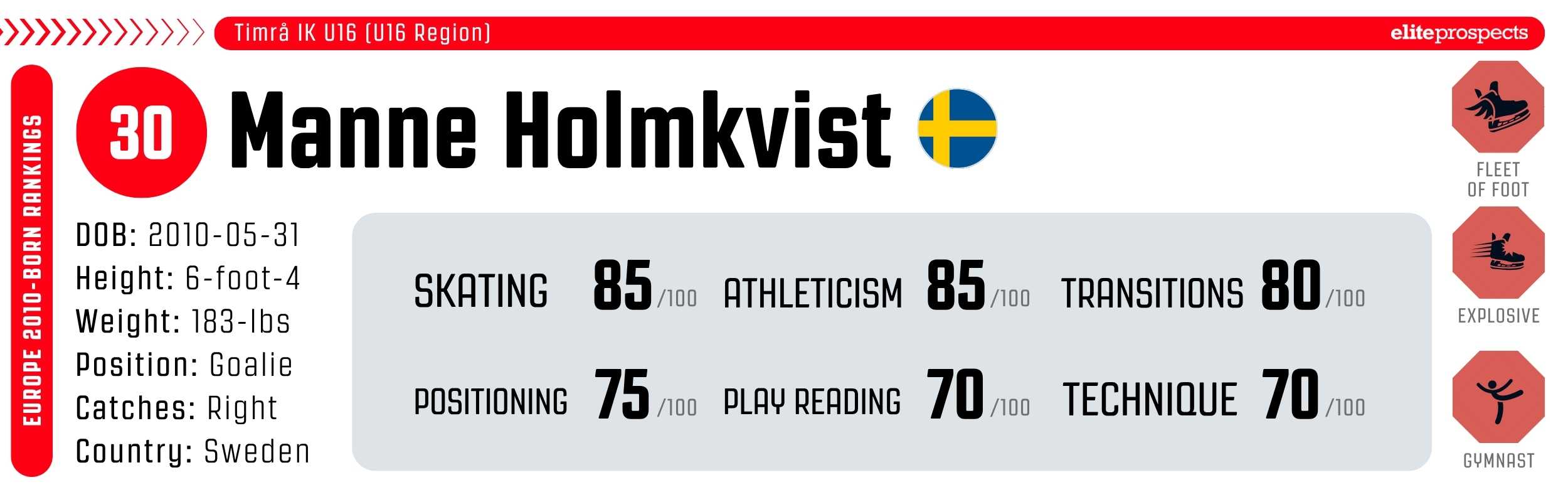
Manne Holmkvist is our second-ranked goaltender, narrowly edging out his countryman. While not quite at the same level as our top goalie Suchkov, Holmkvist possesses similar strengths: Excellent skating ability paired with high-end athleticism. He also brings a pro-level frame. Play reading and technique have room for improvement, but we believe in his ability to grow and mature in these areas. Holmkvist appeared in just one game with the Swedish U16 team this season, but was a consistent standout in league play and with Medelpad at TV-pucken.
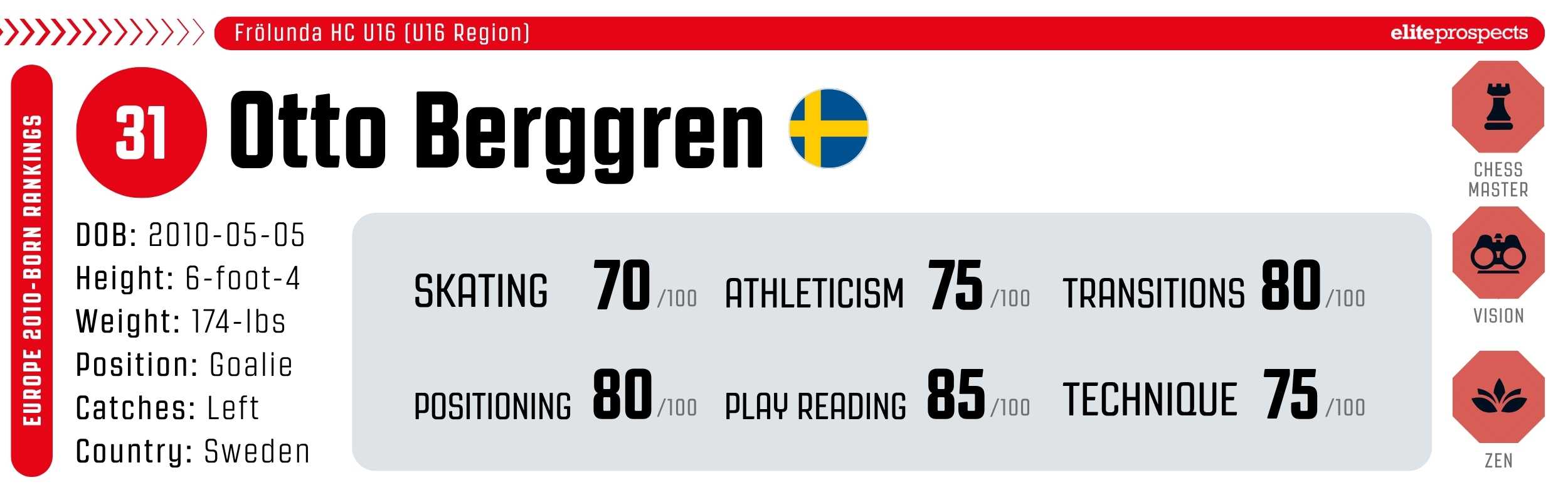
Otto Berggren was the No. 1 goalie for Sweden's U16 national team this season, and it's easy to see why. For a 15-year-old goaltender, he's extremely advanced and polished. The best play reader among goaltenders on this list — the only one receiving an 85 grade —, he is very positionally sound as well. His technique isn't quite at the same level yet, but it's already strong as well. There's a good chance that Berggren will continue to start games for Sweden at the U17 and U18 levels, and we like his upside enough to scratch our top 30, but he comes in just behind the more athletic, better-skating Holmkvist.
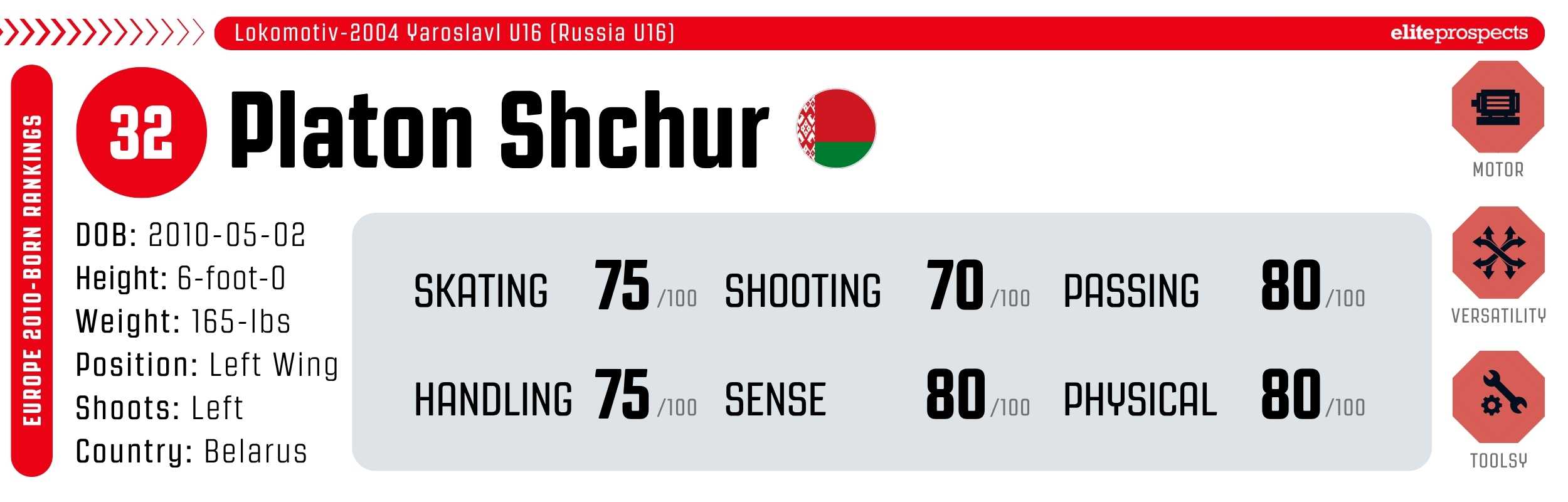
Platon Shchur is our highest-ranked Belarusian-born player. Throughout the season, he was the engine that kept Lokomotiv-2004's offence running, whether it be at the U16 or U17 level. A dual-threat with strong physical skills and plenty of dynamic flashes, he possesses real power forward upside — all while providing consistent value as a two-way player.
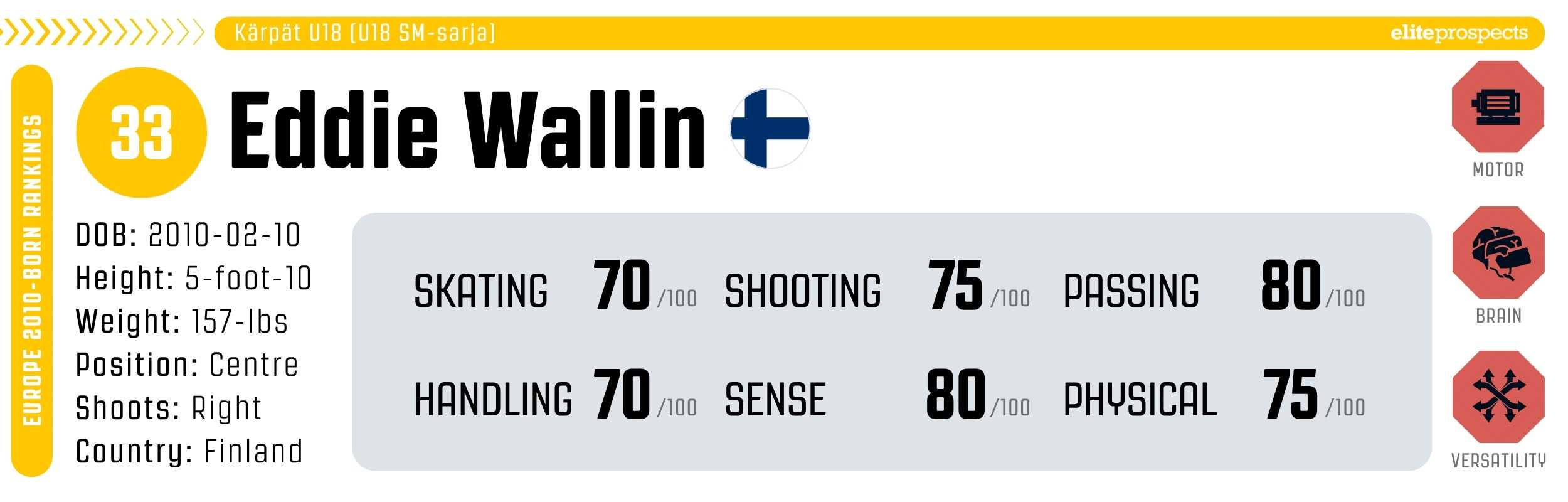
Both in league and international play, Eddie Wallin was often the heart and motor of his line. A centre with strong habits and consistently notable work rate, he drives results on both ends of the rink and flashes strong playmaking ability through his vision and deceptive qualities. Improving the mechanical foundation would help to launch his projection to the next level — but in a weaker class of Finns, he currently stands as our top forward prospect.
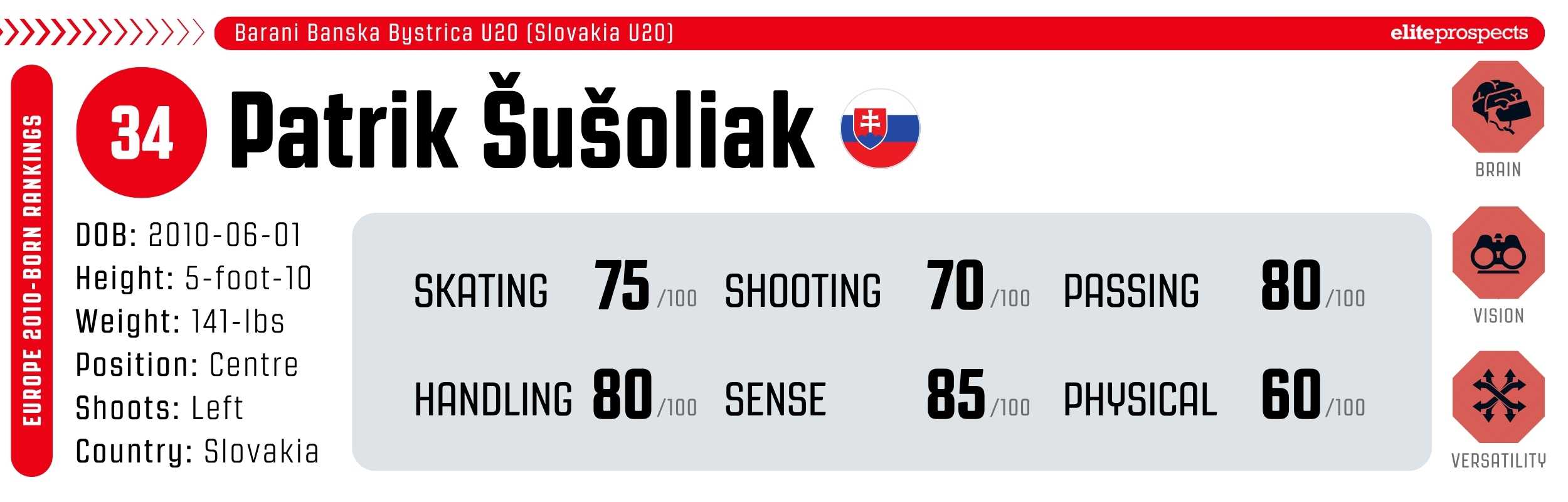
An impressive season by any measure for Patrik Šušoliak, who led all 2010-born players in points in the Slovak U20 league and ranked third in U18 play, despite only appearing in a third of the games. He also earned a call-up to the U17 national team, in addition to averaging more than two points per game with the U16 national squad. Šušoliak is a functional, smart offensive player rather than a flashy creator. He excels with quick processing and adaptability to create advantages, but also has the vision to execute high-end playmaking backed up by soft hands. Beyond his ability to rack up points, he fits the mould of a clever two-way player — competitive, breaking up plays with anticipation, and showing notable maturity for his age. His size may hurt his centre projection long-term, but for now, he’s the second-best 2010-born Slovak.
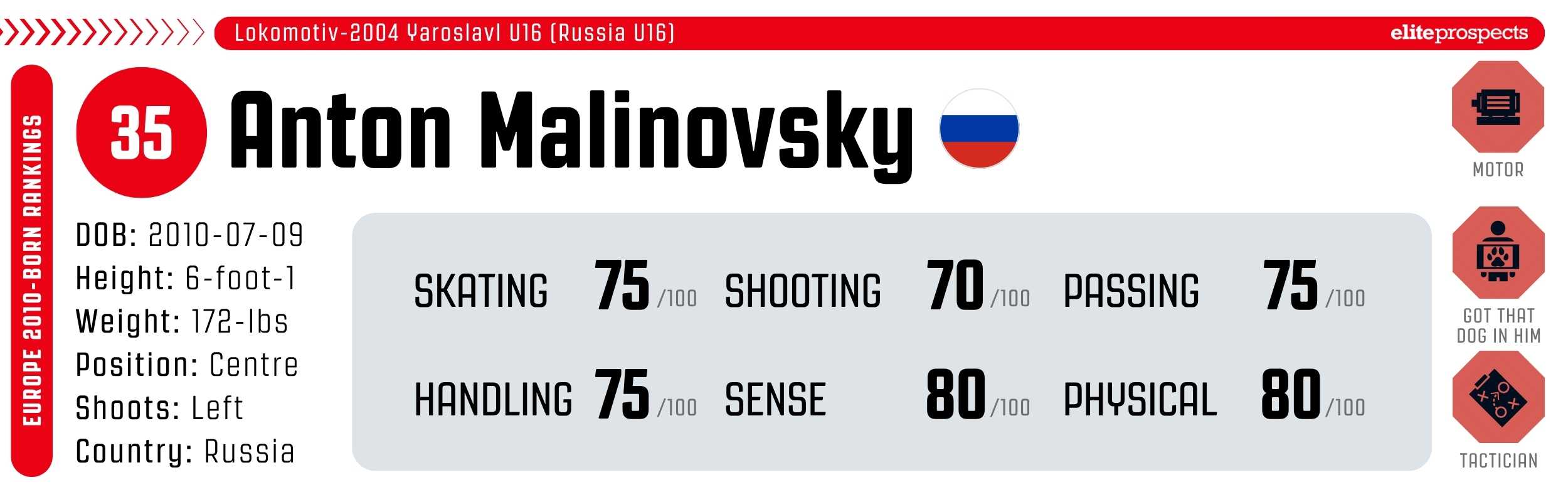
A highly intelligent two-way player, Anton Malinovsky provided consistent value for his teams at both ends of the ice. He has a big frame with strong physical skills. Combined with a reliable motor, that made him a constant threat to opponents. While he did have plenty of tool flashes, with deception, handling skill, and passing upside, the raw tools might not be the biggest drivers of his success. As such, it will be interesting to see how he'll adapt to higher levels, but we like the projectability.
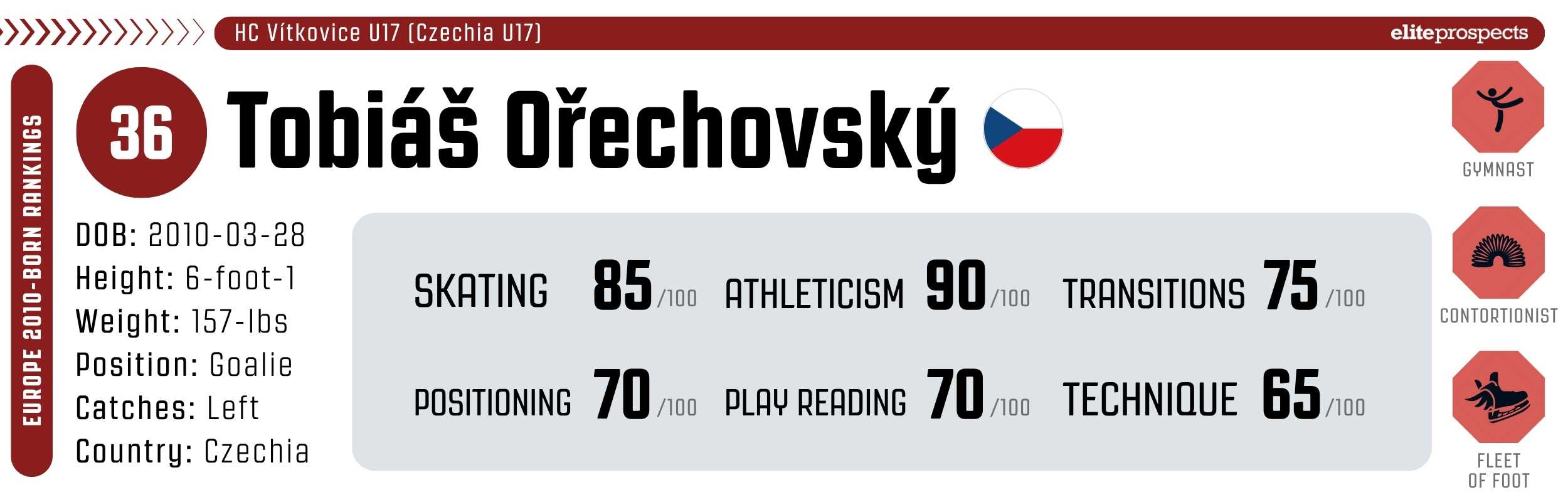
Tobiáš Ořechovský was a late riser on our list. His play this season was inconsistent, and he was just okay in international play at the February Five Nations tournament. However, our staff really likes his raw tools. One of the best skaters and athletes among goaltenders in this age group, Ořechovský has great upside — if he can improve his positioning, play reading, and technique. Ultimately, that was enough to claim the top spot among Czech goaltenders in this class.
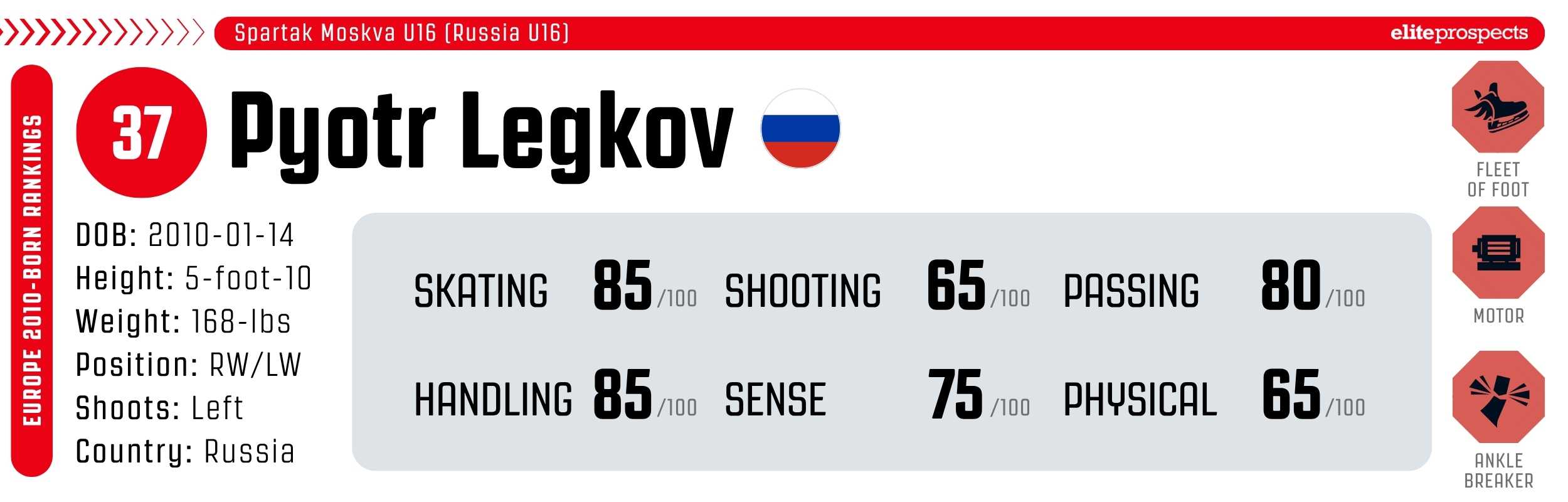
Pyotr Legkov was one of the most consistent players we watched all year — you always know what you're going to get with him. A very quick skater who constantly keeps his feet moving and loves to play with the puck on his stick, he wants to move the play up ice and fearlessly attacks opponents one-on-one. His lack of size may hurt his upside, and he could add more variability to his game to make it more translatable to the pro level, but for now, he projects as a higher-end junior forward.
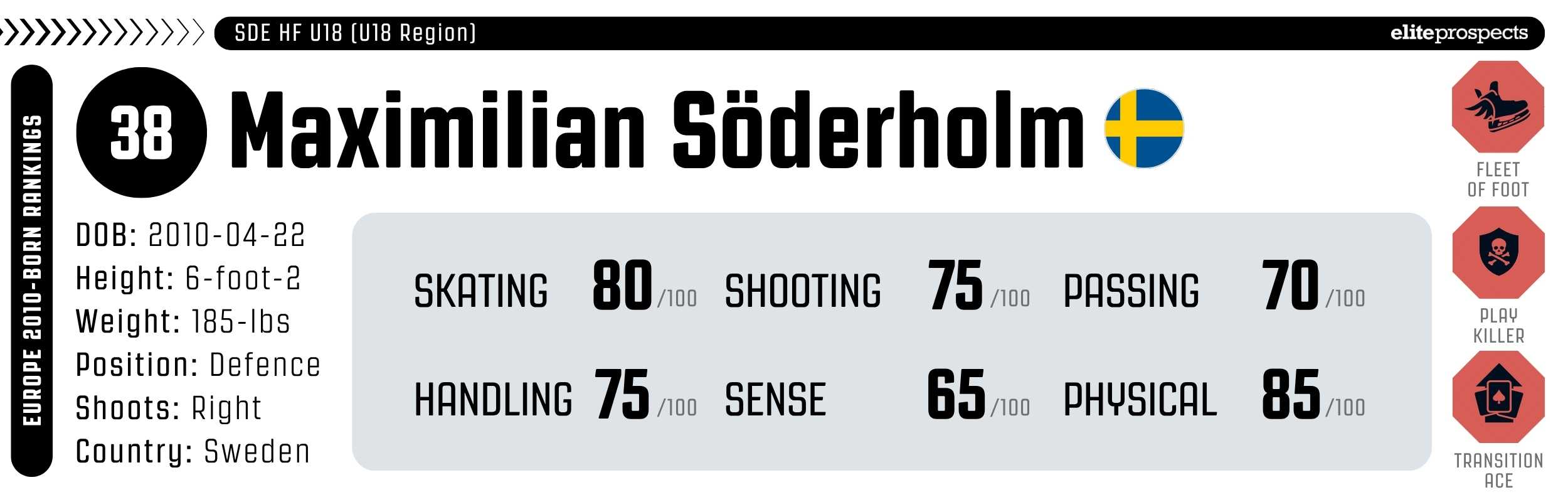
A big, right-handed defenceman who can play with pace — what’s not to like? Maximilian Söderholm has the potential to develop into one of the top blueliners in this class. He brings two-way ability and all-around value, showing breakout skills both as a passer and with some deception on carries. While he’s yet to become dynamic at the blue line, he still chips in offensively. There’s physical upside as well, with his big frame and aggressive playing style. He may be a bit more projectable than the three Swedish D-men ranked ahead of him, but he isn't exciting with the puck. Söderholm will take the next step, moving to Djurgården in U18 next season.
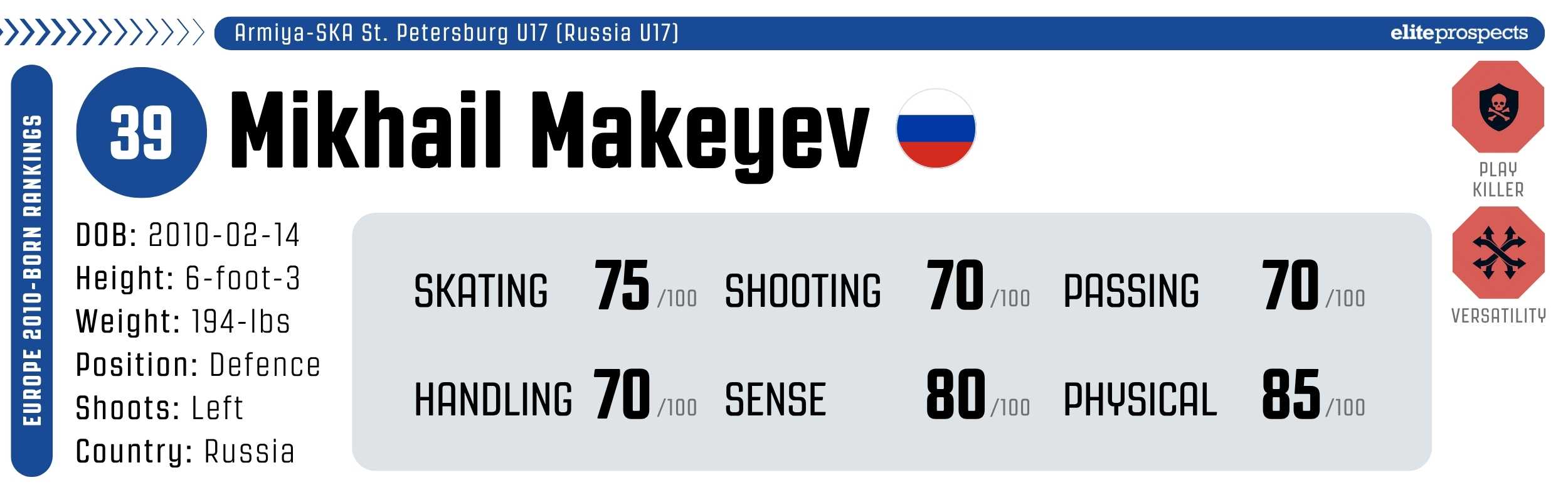
Some players are more effective than their raw tools would suggest, and Mikhail Makeyev is one such player. He's a big body with good physical strength and solid mobility, making him a steady defensive presence. However, he also contributes with the puck — which often comes down more to a willingness to make plays rather than high-end tools. If the tools come along over the next couple of years, he could develop into a high-level two-way player.
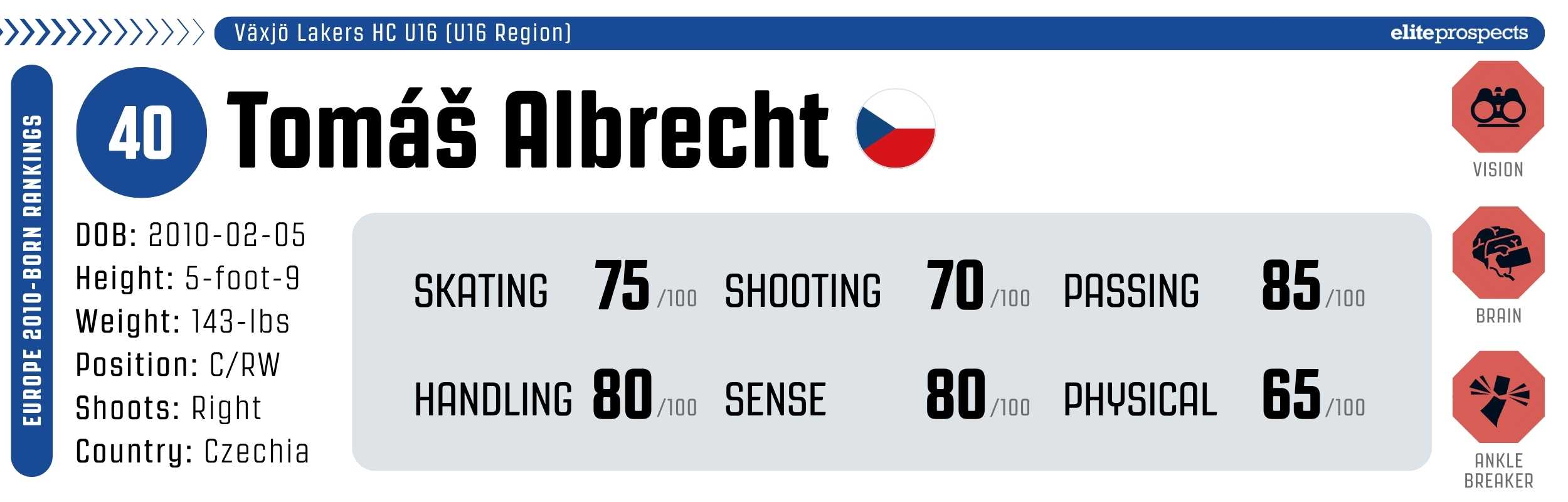
Tomáš Albrecht didn’t need big numbers to make an impression this season. Even with modest production in 11 games for the Czech national team and just a handful of U18 appearances with Växjö, he displayed impressive skill with the puck. Throughout the campaign, Albrecht took notable steps, adding more manipulation to his game and handling the puck well in motion, consistently finding ways to create space for himself and openings for others. With a bit more strength and a better knack for handling traffic, his offensive ceiling in this age group is among the highest.
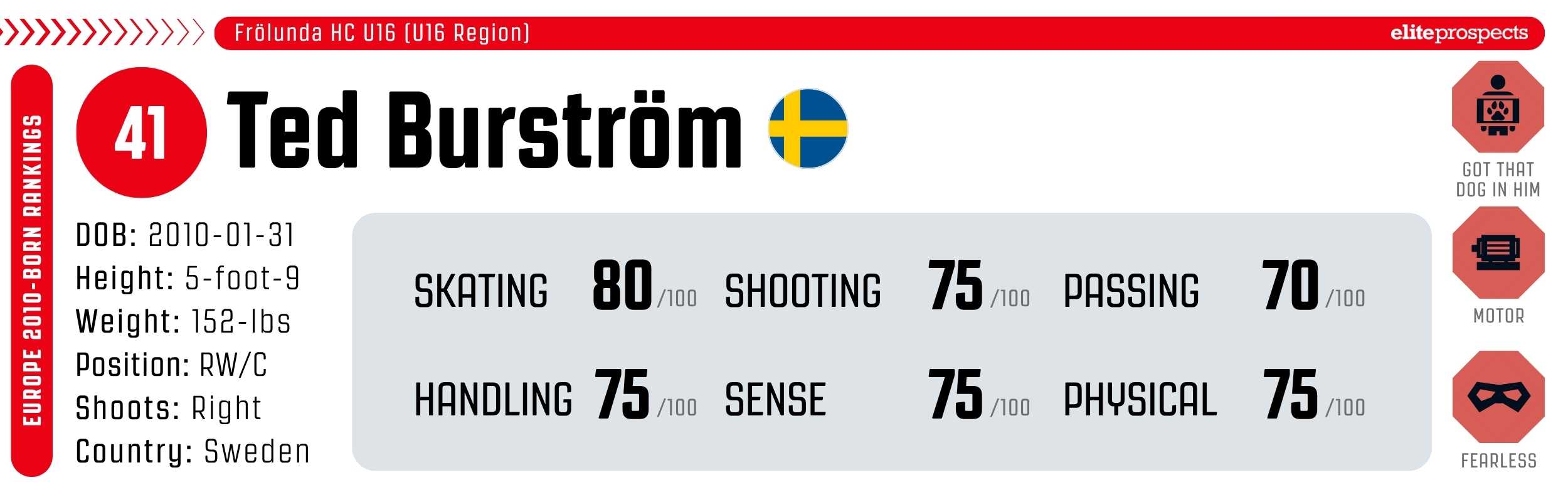
Right from the start, Ted Burström caught our eye with his unmatched competitiveness. Whether facing weaker opposition or competing internationally, he always gives 100 percent. His tenacious playing style features excellent physical skills, initiating contact and cutting through hands, and he brings slightly above-average tools in both passing and shooting, especially his ability to make plays in traffic. With a projectable playing style, it’ll be interesting to see how much more he can add as he continues to grow and whether he can unlock another level of offensive play.
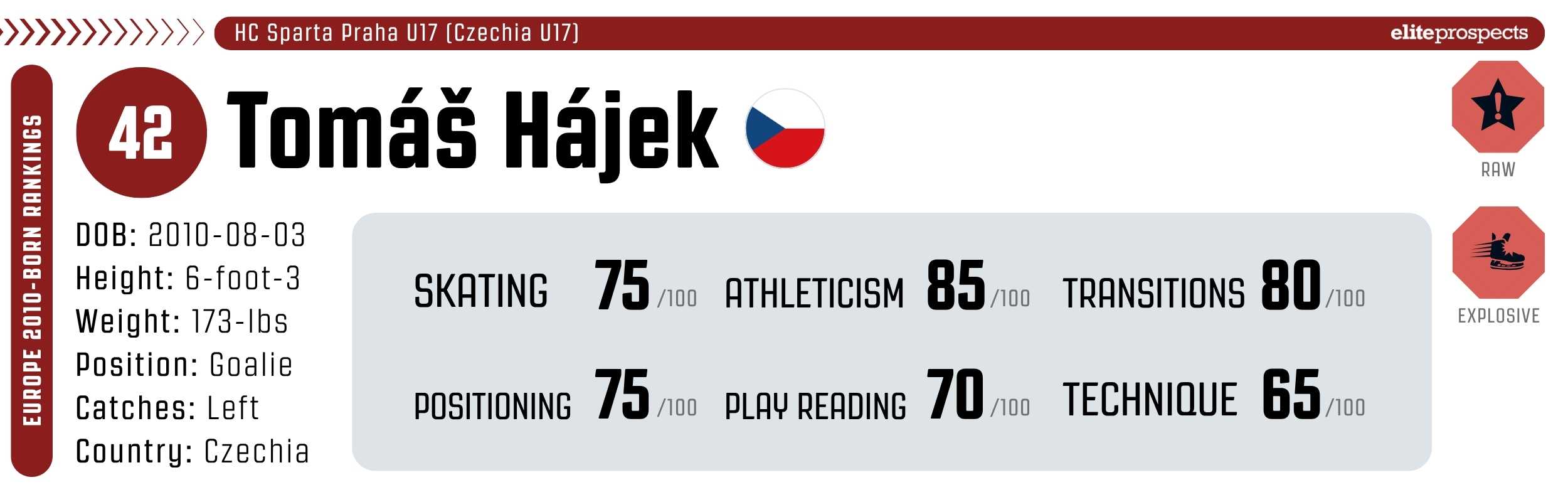
At his best, Tomáš Hájek can take on anyone and look like one of the top goaltenders in this class. He's big, athletic, and highly explosive. However, he's also inconsistent. Depending on who you ask and which games they watched, our staff were somewhat conflicted about Hájek's tools and upside. With that said, we did agree that he has the raw athleticism, enough skating skill, and play-reading flashes to believe he will continue to play a role with Czechia's national teams going forward, and he could very well end up as the best Czech goalie in this age group.
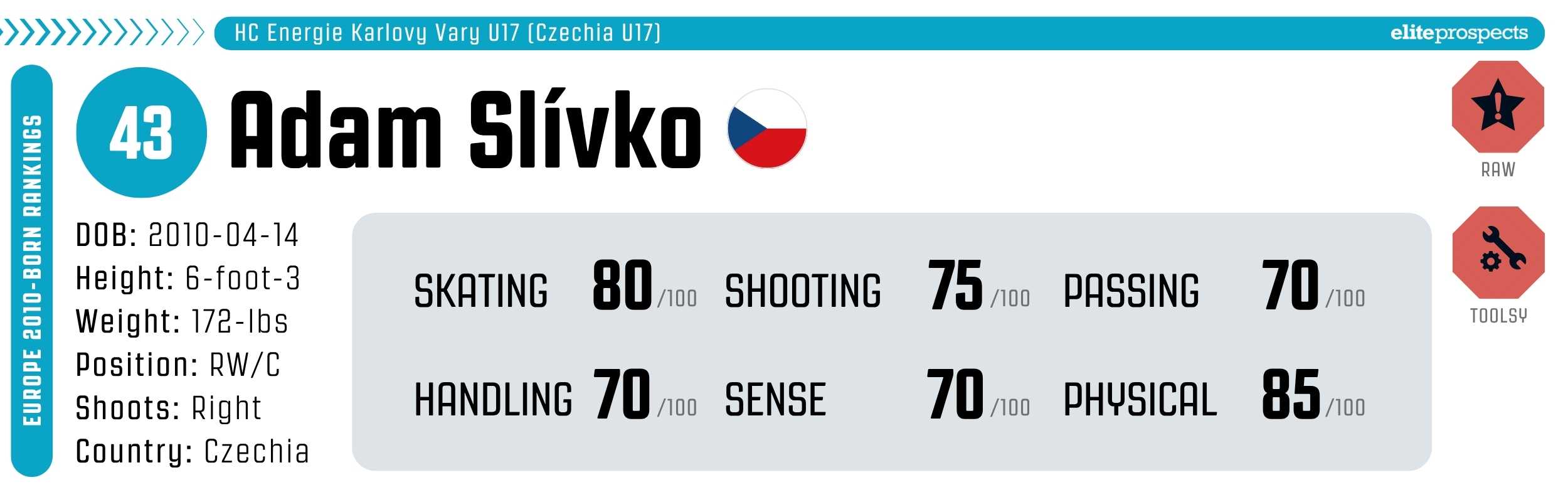
In the ranking process, we explicitly decided we wanted to value current abilities and tools over pure size-based projections. There's simply too much uncertainty at this age to bet on players developing something that isn't there. Adam Slívko, however, is a bit of an exception. Spending plenty of time on the wing of our top-ranked Czech forward Hanson, it was hard to miss Slívko and the upside he brings. A tall, lanky winger, he makes it too easy to believe in his ability to develop into a high-level power forward. He's tall, but a very quick skater, lean but already able to outmuscle opponents and protect the puck, and he showed enough creative ideas with flashes of execution to believe in him. The tools didn't show consistently enough to actually grade them higher than we did, but don't be surprised if Slívko takes some big strides next season.
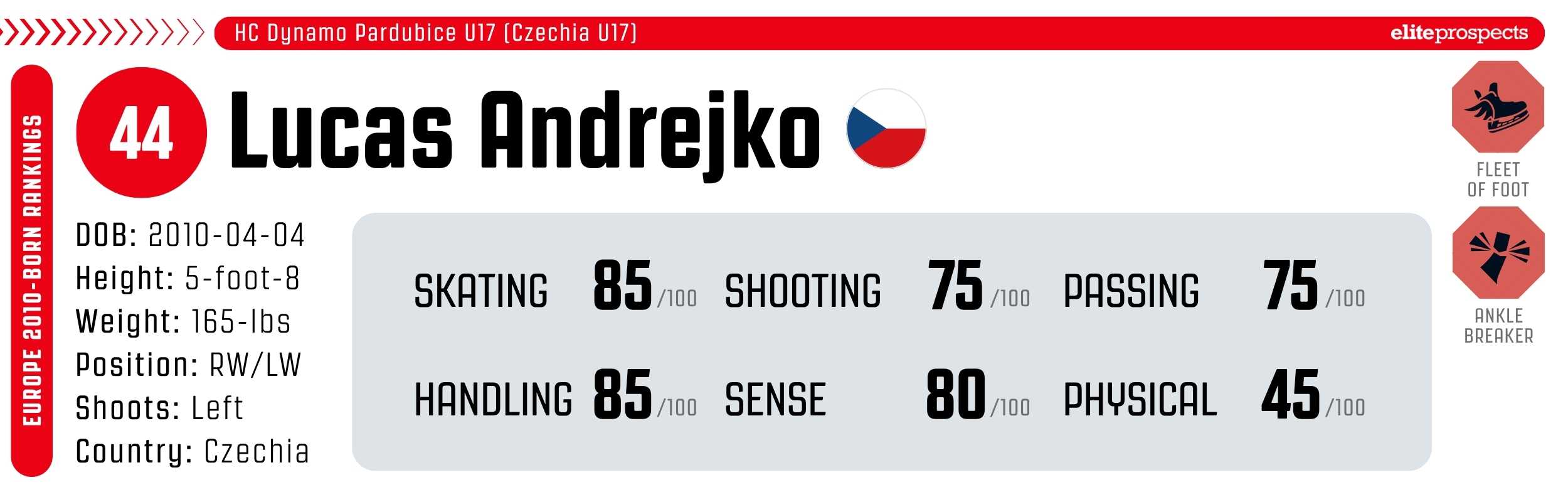
While Slívko's ranking might go a bit against what we set out to do, fellow Czech winger Lucas Andrejko is a great example of valuing current abilities over long-term pro upside. Andrejko had an incredible start to the season, putting up 16 goals and 33 points on a 10-game streak, and while he cooled down just a little bit after that, he still finished as the highest-scoring U16 player in the Czech U17 league with 1.81 points per game. The skill is undeniable, and he's a high-level skater. However, he's undersized, still very much a junior-style player, and his physical skills are just okay — the upcoming season will be very important to determine how far he'll be able to go.
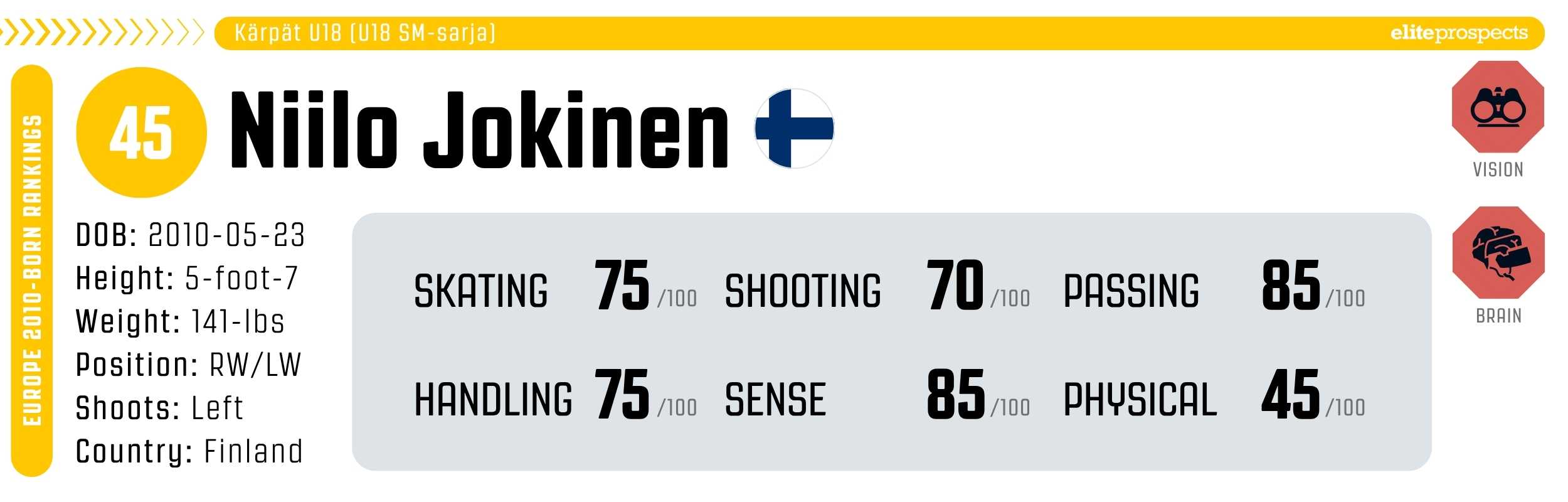
Like Andrejko, fellow undersized winger Niilo Jokinen was among the hardest players for us to rank on this board. Named the MVP of the annual Pohjola camp last fall, the talent level is undeniable, as his highs as an offensive creator — particularly through his playmaking — were the highest among all Finns in his age group. On the other hand, he was very much hit-or-miss across our viewings this season, and the diminutive frame and lack of contact skills also didn't help his stock — and would've likely dropped him further if we were ranking based on NHL projection. The skill and sense highs give him boom potential; he just needs to be able to put everything together. With an 85 sense grade, he's got a true high-end tool.
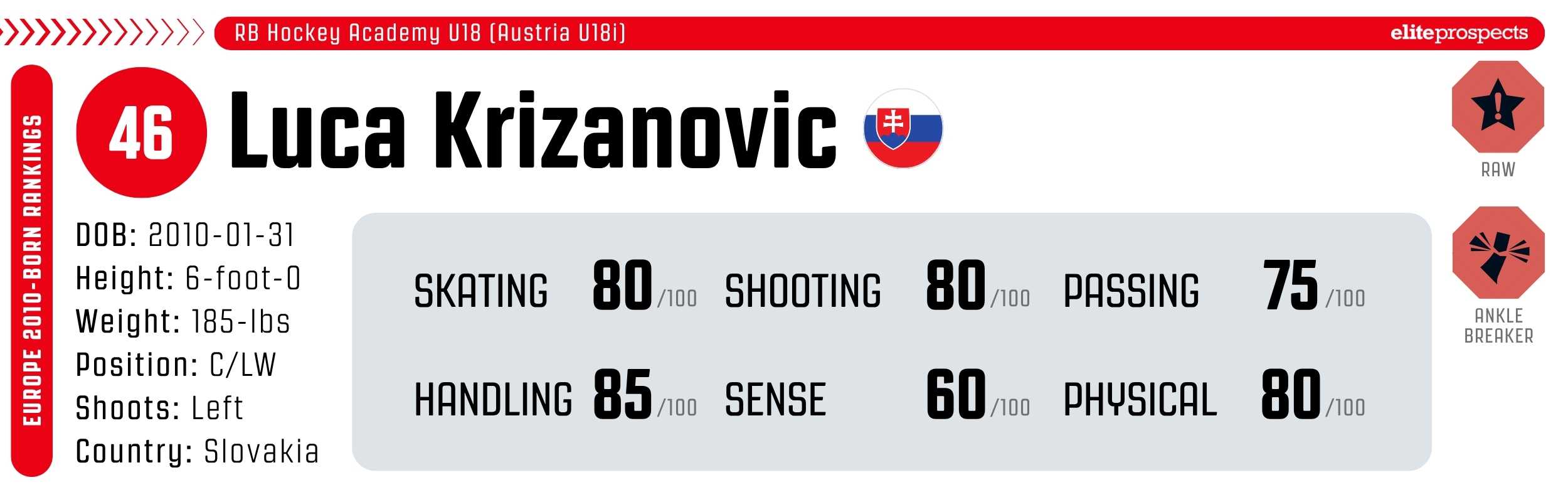
A year ago, Luca Krizanovic was a strong candidate to be the best Slovak 2010-born player not named Melicherík. Today, he's still close, but he's got one thing holding him back. The tools are all there: He's got good size, is a powerful and mobile skater, possesses quick hands, some passing skill, and a quick, hard wrist shot. However, his hockey sense has consistently looked like a real problem. Krizanovic dominated the relatively low-level Austrian U18 league, but especially in international play, his sense issues became evident, as he often struggled to find the right plays and turn input into output. The tools could make him a first-half NHL Draft pick, but only if the sense starts coming along.
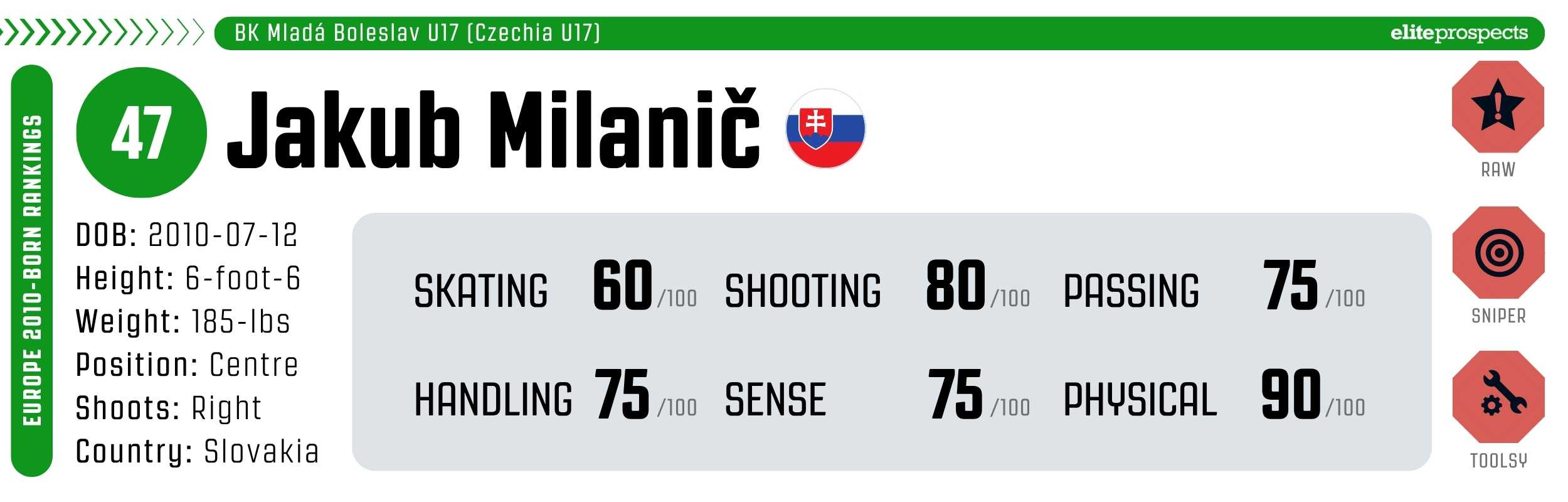
Like Krizanovic, Jakub Milanič is a toolsy player with one thing holding him back. The positives first: He's massive — a lanky 6-foot-6 centre with plenty of room to fill out his frame —, a good handler, flashes passing skill, can snipe pucks past goaltenders, and plays a fairly responsible two-way game. But, as is often the case with bigger players, his skating is a real weakness right now. At the U16 level internationally and the U17 level in league play in Czechia, it hasn't been too big an issue, but it could be the difference-maker in determining if he will end up as a fourth-line grinder or a mid-six two-way pivot at the professional level one day. The upside is high, and the pro projectability is real.
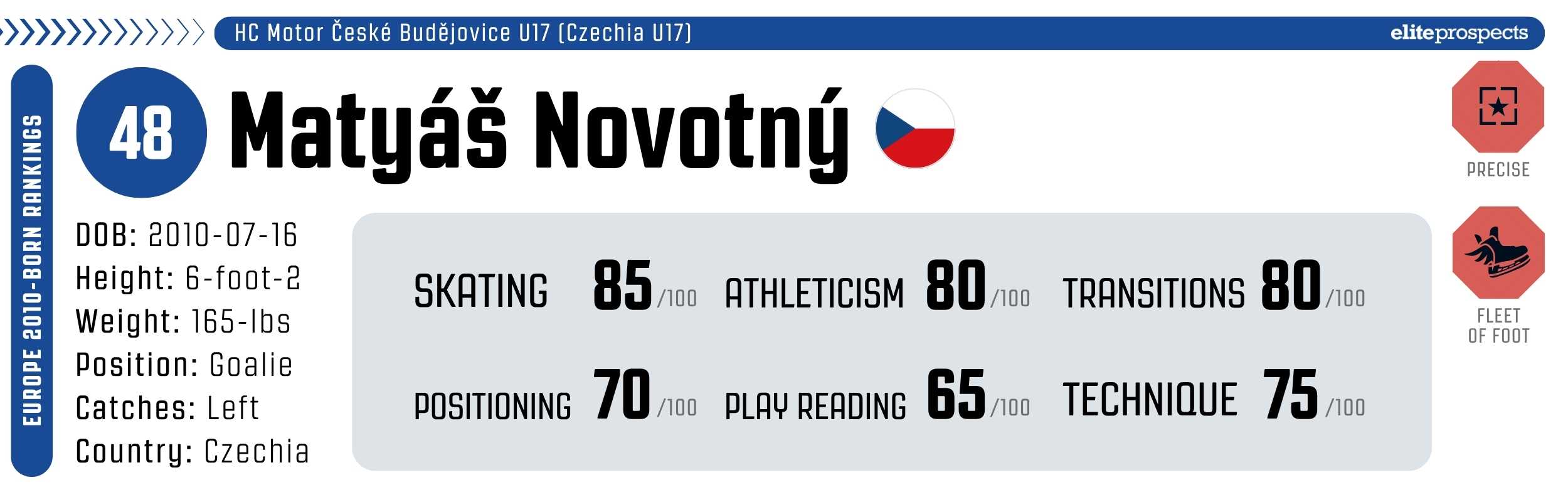
Matyáš Novotný rounds out our group of Czech goaltenders who made the list. He was excellent in U17 league play this season, appeared in four games with his U20 team and held his own there as well, and he was Czechia's No. 1 goalie for the U16 team this season. A strong skater with fairly advanced technique, he should get more starts at the U20 level next season and has a real shot at keeping his No. 1 status with the national team. For this list, though, we valued his national team rivals' athleticism-based upside a little more highly.
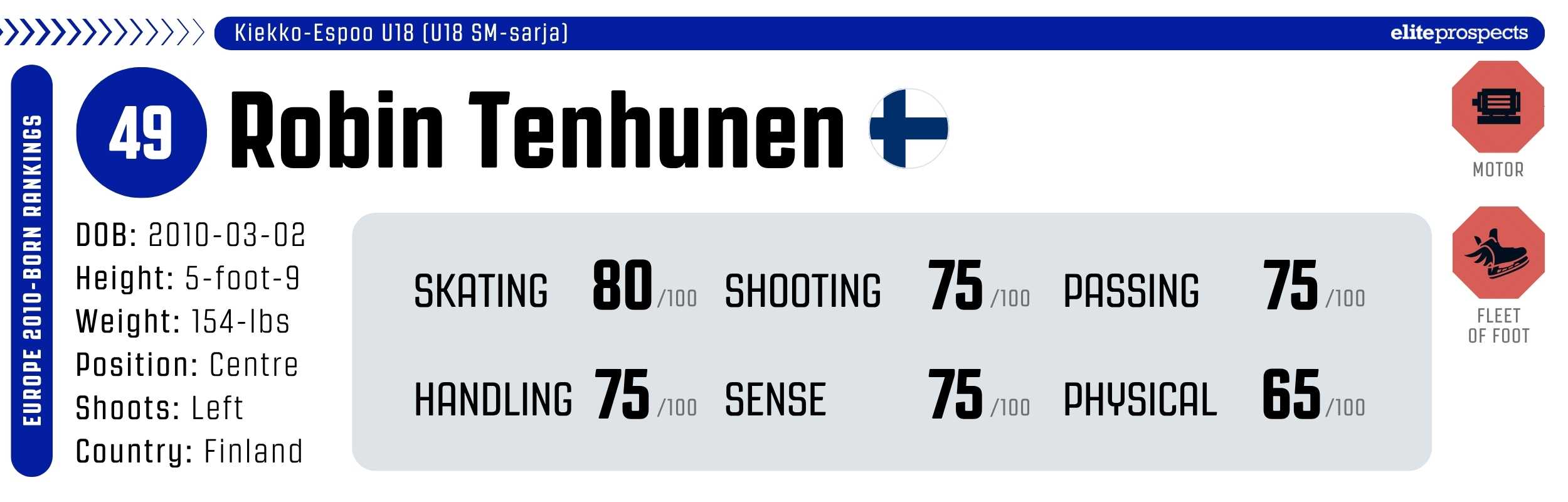
Pace is the name of the game for Robin Tenhunen. A quick and nimble skater, he plays an inside-driven and tenacious game, never letting his smaller stature preventing from engaging on the forecheck and throwing his weight around. Already cracking the point-per-game mark at the Finnish U18 level, he regularly flashes creation upside, too, capable of chaining his skating and handling skill with playmaking reads. He's got the tools to become an even more dynamic attacker in the future, too, and has the motor and habits to become a reliable defensive contributor at further levels.
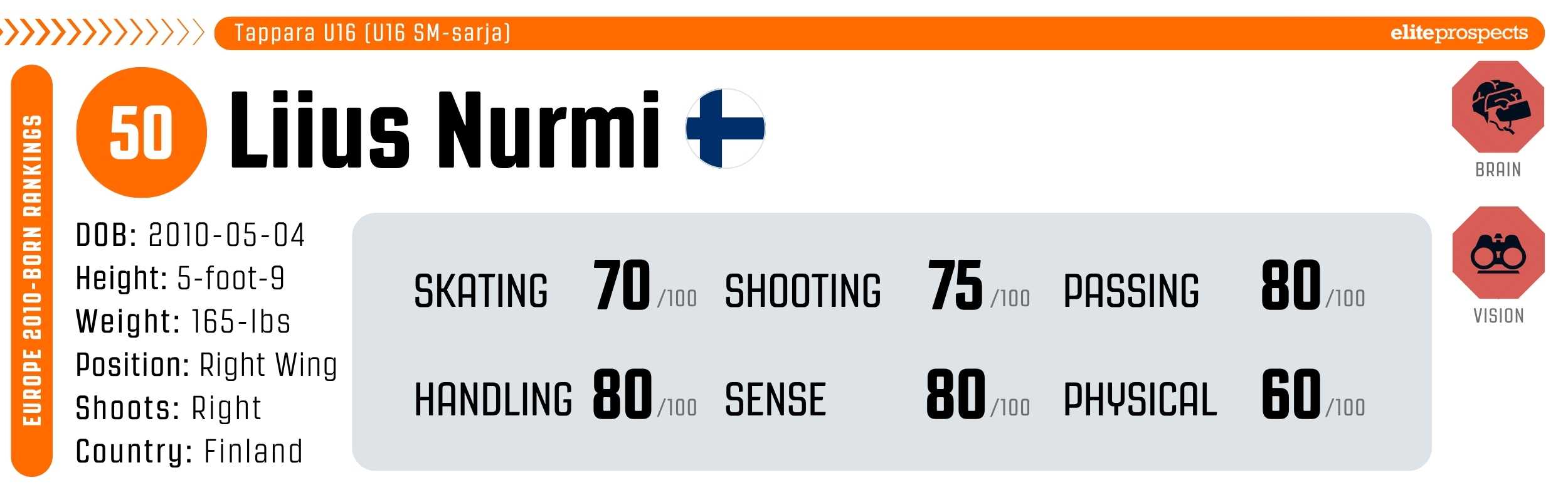
Liius Nurmi's natural talent and feel for the game allowed him to adapt instantly when he moved from the U16 ranks to the U18 level, immediately making an impact through his creation instincts, vision, and raw skill. Less physically developed than many of his peers, he could be a bit of a slow burn, especially as an injury cut his season short in January, but the long-term upside is tantalizing, especially if he adds more pace and quickness as a skater — and hopefully grows a bit, too.
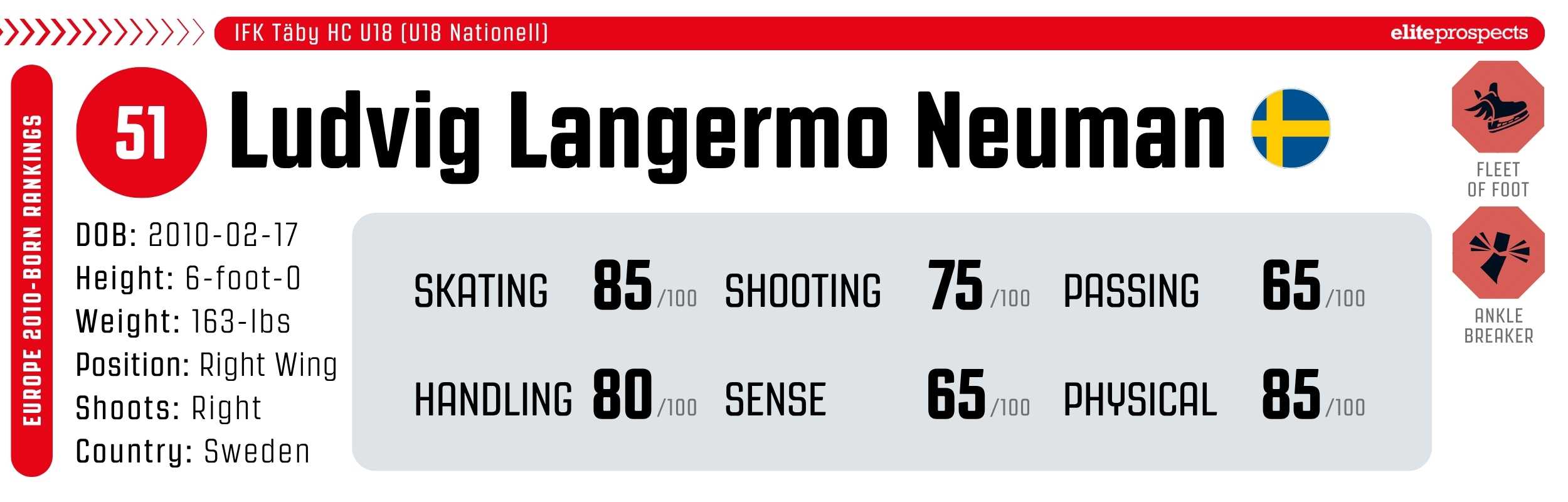
Ludvig Langermo Neuman's season was highlighted by some standout moments, where his blend of speed, size, and puck skill made him a threat. While his most impressive performances came in U18 Region play, his impact with Sweden Team 16 was more limited, often taking on the role of a power forward who flashes potential rather than consistently driving play. With his club, Langermo Neuman demonstrated a broader offensive toolkit, finding ways to influence the game. Looking ahead, his physical attributes and offensive instincts suggest he could emerge as a top-line contributor, though there’s also a strong foundation for him to develop into a reliable, hard-nosed winger who thrives in high-intensity situations.
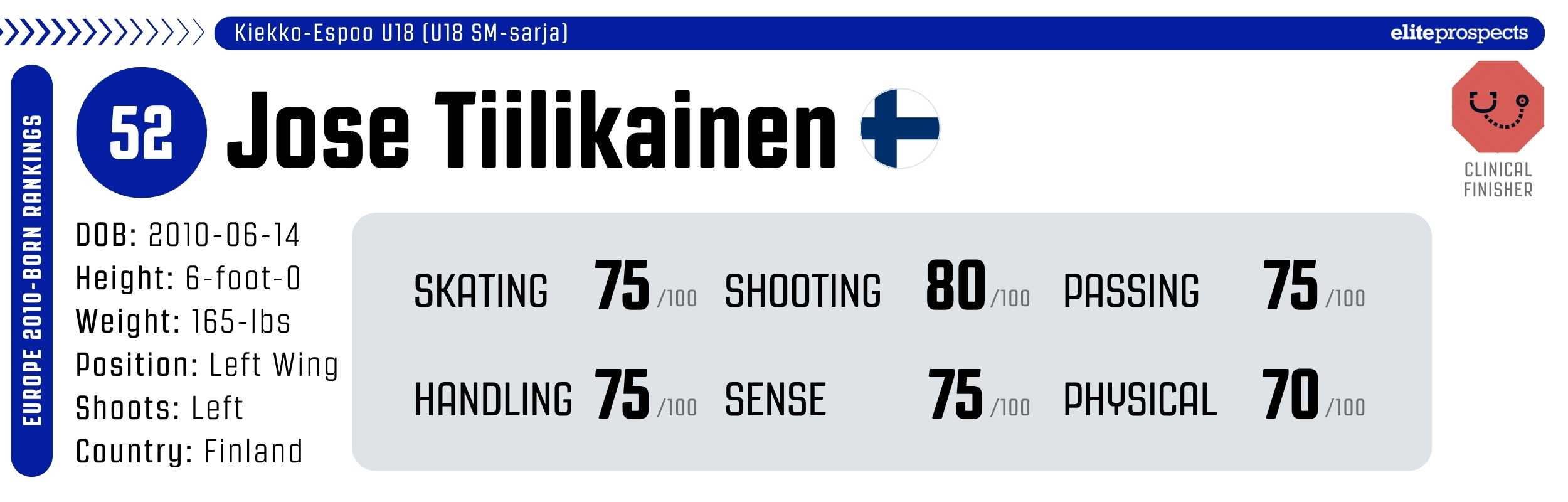
The most productive part of Finland's U16 team across this past season's events, Jose Tiilikainen grades well across the board. His finishing talent comes through as his best asset and makes him a threat on the power play, but he's also got his off-puck instincts, playmaking flashes, and solid mechanical foundation going for him. As his shift-to-shift consistency and defensive game improve, he has the makings of a well-rounded winger for the NHL draft in two years.
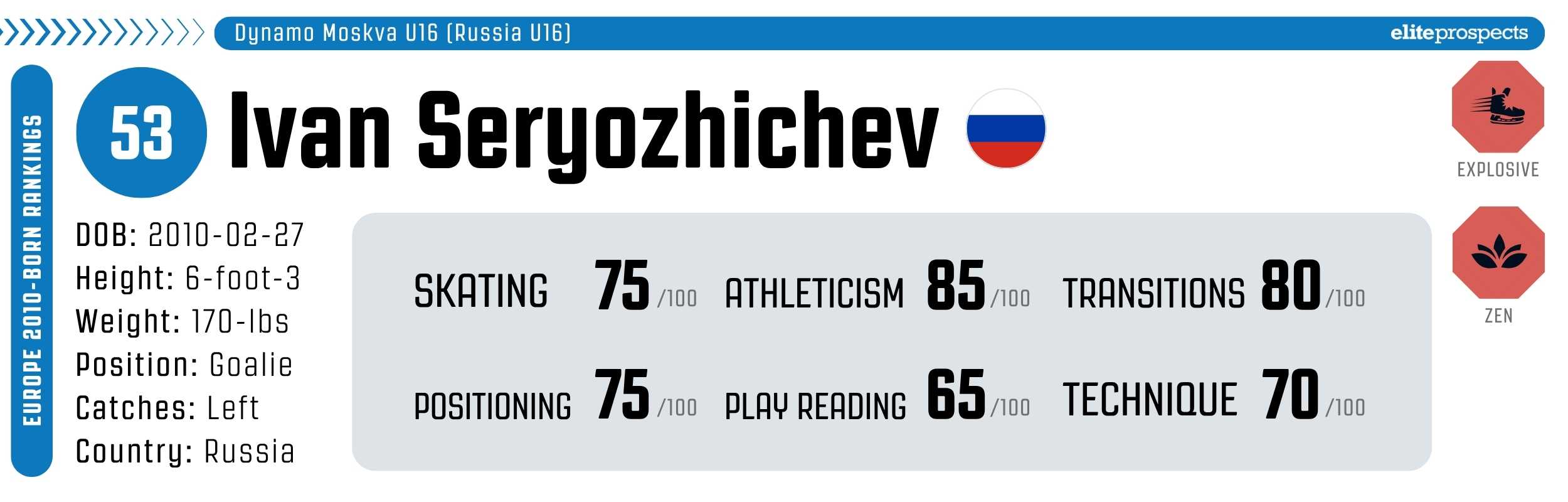
Our second-highest-ranked Russian goaltender, Ivan Seryozhichev is right up there with the Czechs and Swedes on this list. He has room for improvement in his play reading and technique, but his explosive athleticism excites us. His butterfly and post transitions were a frequent standout attribute in our viewings.
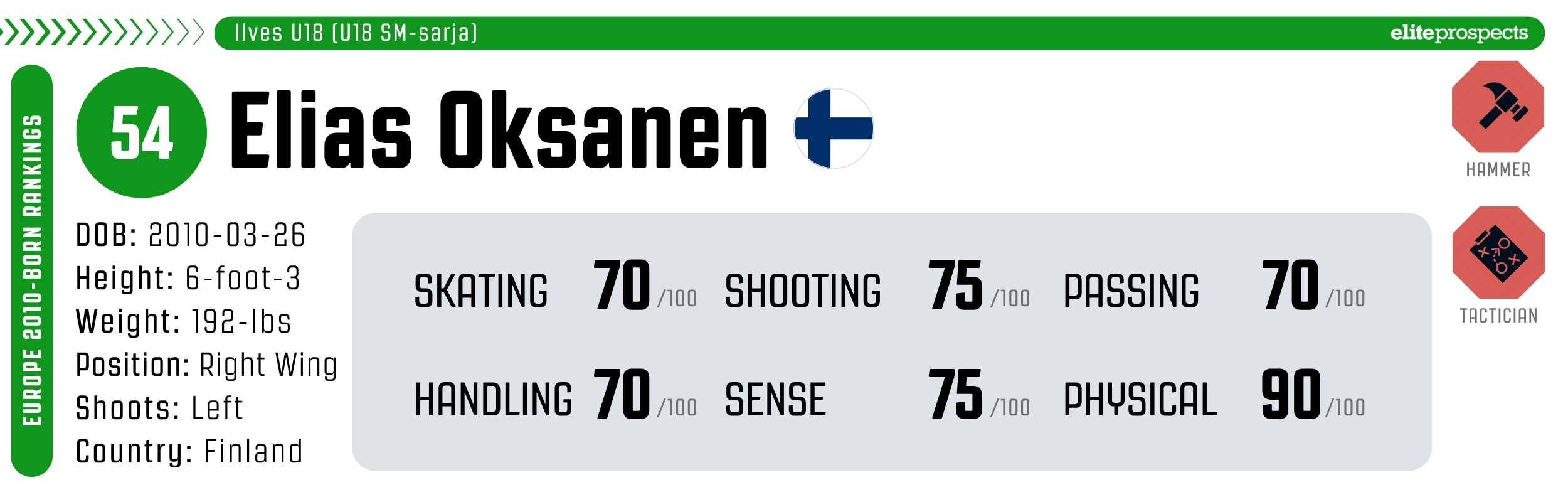
Captaining Finland's U16 team at multiple events, our team found Elias Oksanen's power forward profile appealing viewing after viewing, with there being some support for a higher placement on this board. His size and contact skills alone made him a tough customer for the vast majority of defencemen he played against, but he also has intriguing net-front smarts, flashes of 1-on-1 ability, robust connection habits, and a solid enough set of feet under him. Adding more creation skills in the upcoming years would add further upside to his projection.
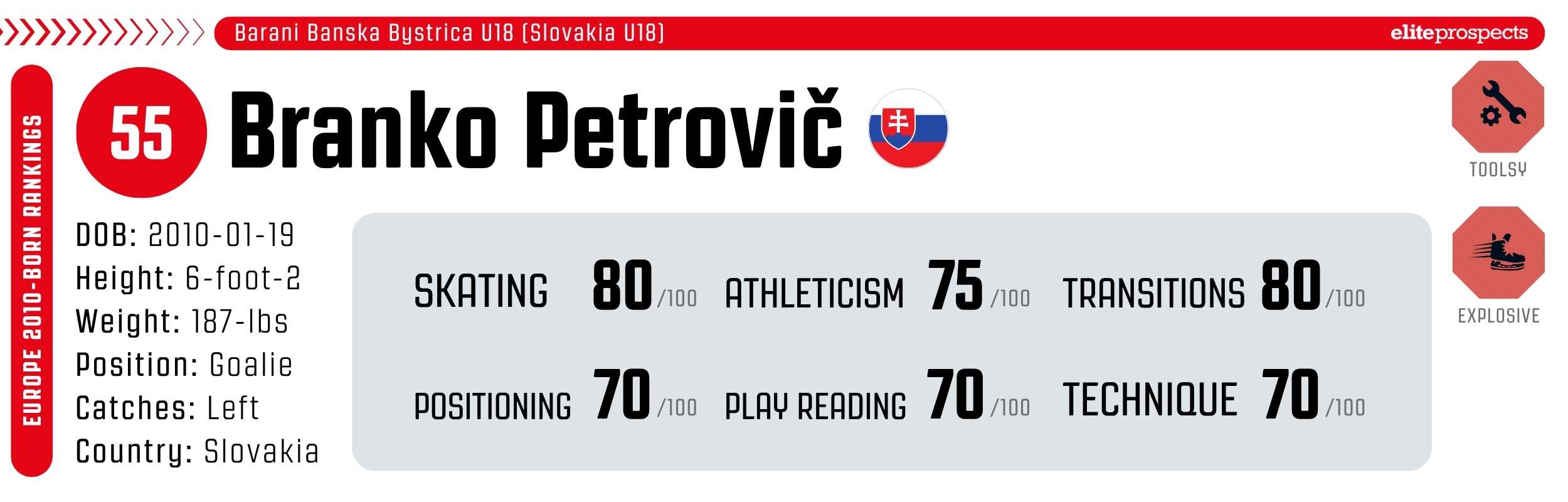
Slovak national team starter Branko Petrovič rounds out the run on goaltenders in the 30–60 range. A strong skater who does a great job using his feet to make quick, small adjustments to stay in position. Perhaps not an elite athlete, but we couldn't spot any crippling weaknesses either. A toolsy goaltender with the potential to follow in the footsteps of the many Slovak goaltenders who became impact players in North America in recent years.
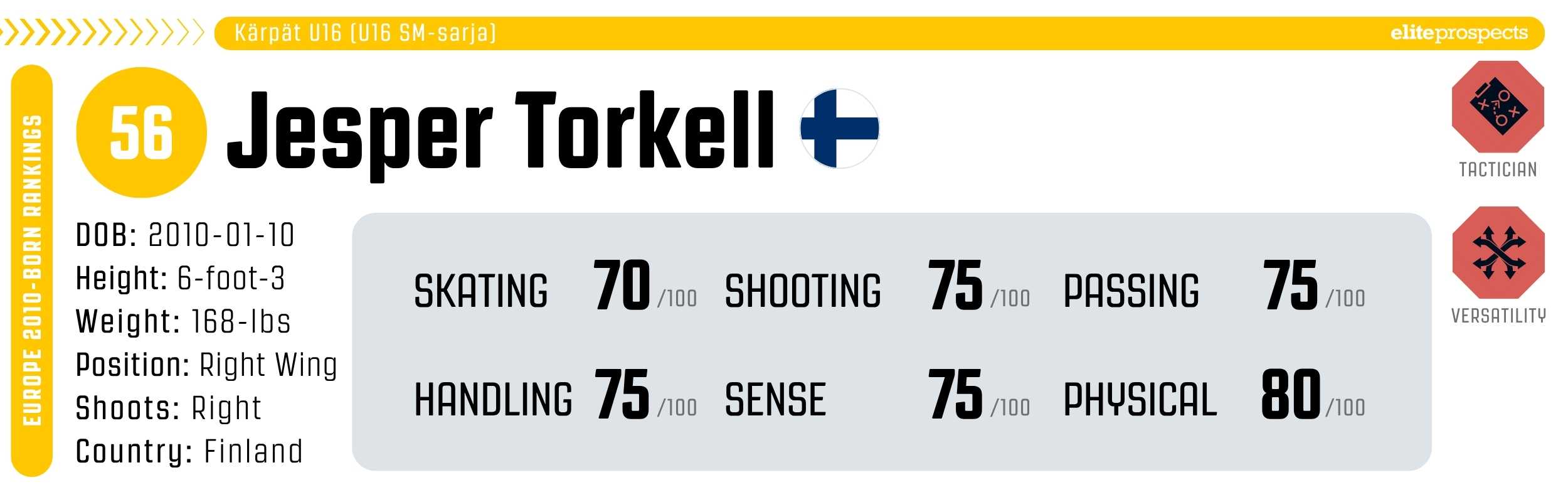
Jesper Torkell was a top-end creator for Kärpät's U16 team this past season, playing a huge part in their run to a league championship. Also having promising flashes internationally, Torkell is a smart operator with a 6-foot-3 frame but plenty of runway for further physical development. He facilitates others in the offensive zone and transition, then crashes the slot just in time to finish the sequence. There's a clear drive to get inside with the puck, too. There's a solid chance he becomes a top-six regular for this group of Finns over the next few years.
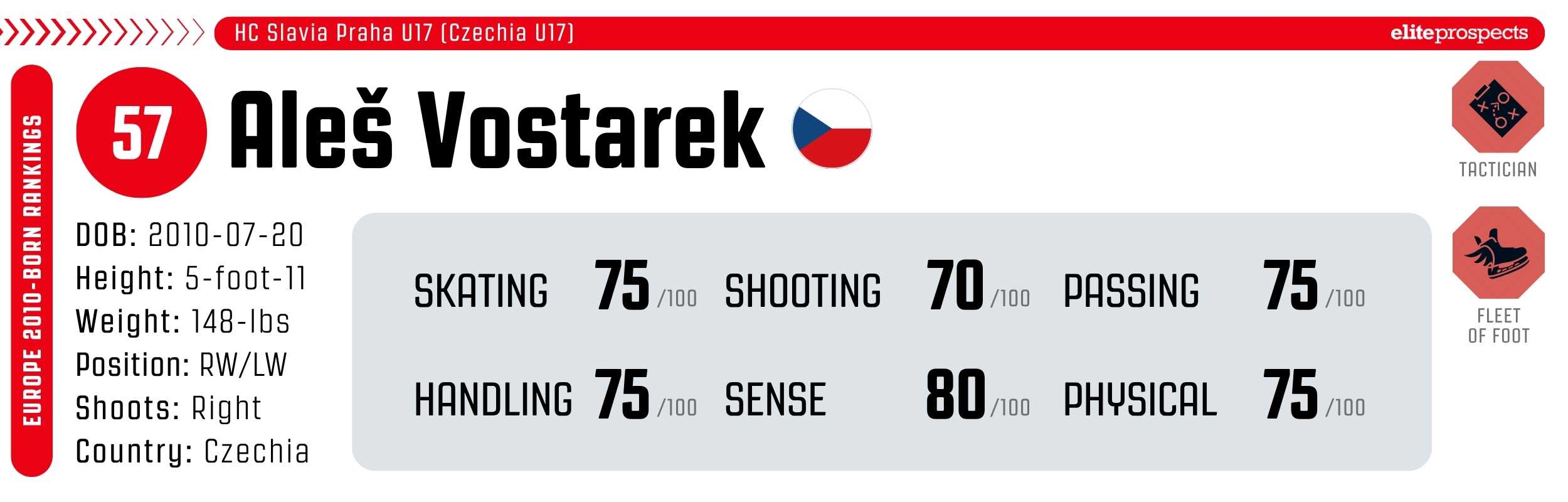
An undersized winger, Aleš Vostarek brings dual-threat upside, as evidenced by his 30 goals and 55 points in 43 games in the Czech U17 league this season. While his goal-scoring ability has been excellent, the shot isn't necessarily his biggest strength. Rather, he uses his off-puck sense to be in the right spots and put pucks in the net. He's leaving the Slavia organization for Liberec, who have a strong track record of developing young talent, which could give Vostarek another boost.
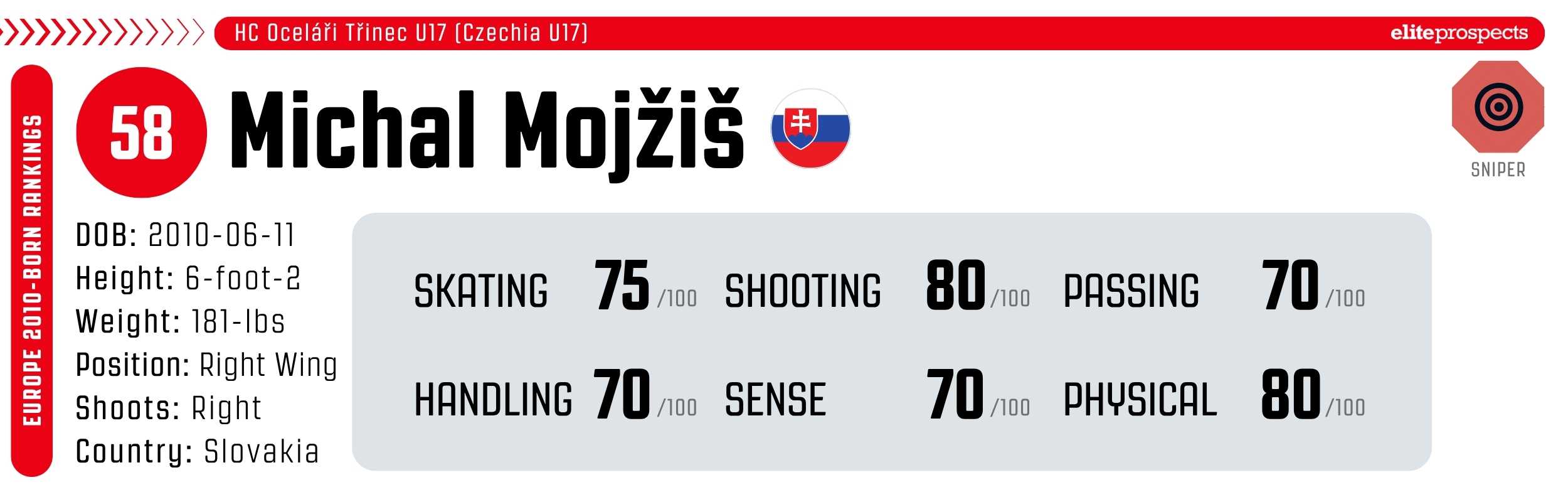
Michal Mojžiš was a very consistent player across our viewings this season. The 6-foot-2 winger's game revolves around his size and shooting ability, along with solid skating. Throughout the season, we felt that physical maturity played a fairly large role in his success, and that advantage will shrink as he moves up levels. However, he showed enough upside as a straight-line attacker with a good shot to believe in his pro potential.
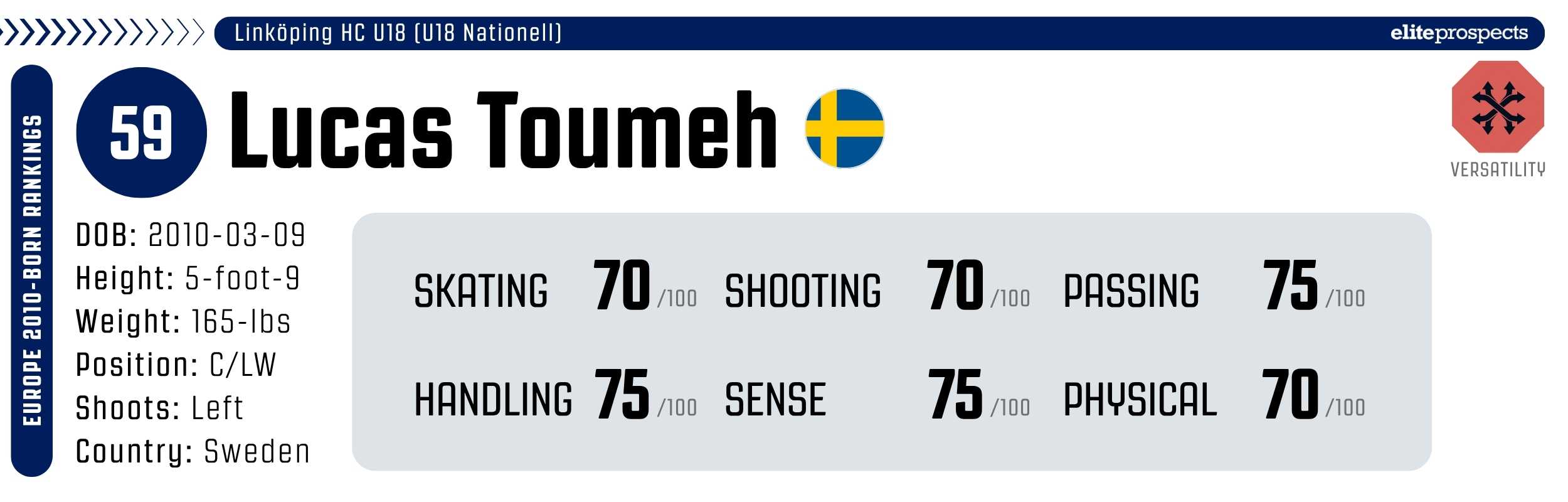
At his best, Lucas Toumeh is a hard-working winger who stands out for his playmaking and offensive instincts. He uses his whole body to deceive defenders — slippery and smooth with the puck, creating space and making things happen even in heavy traffic. When he brings that skill together with real competitiveness, he’s a difference-maker on the wing. At times, he was among the best single-game performers on Sweden's national team as well. While inconsistency in his approach has been holding him back, we hope that will iron out with time. With a full U18 season already under his belt, Toumeh looks set to be a cornerstone for Linköping next year.
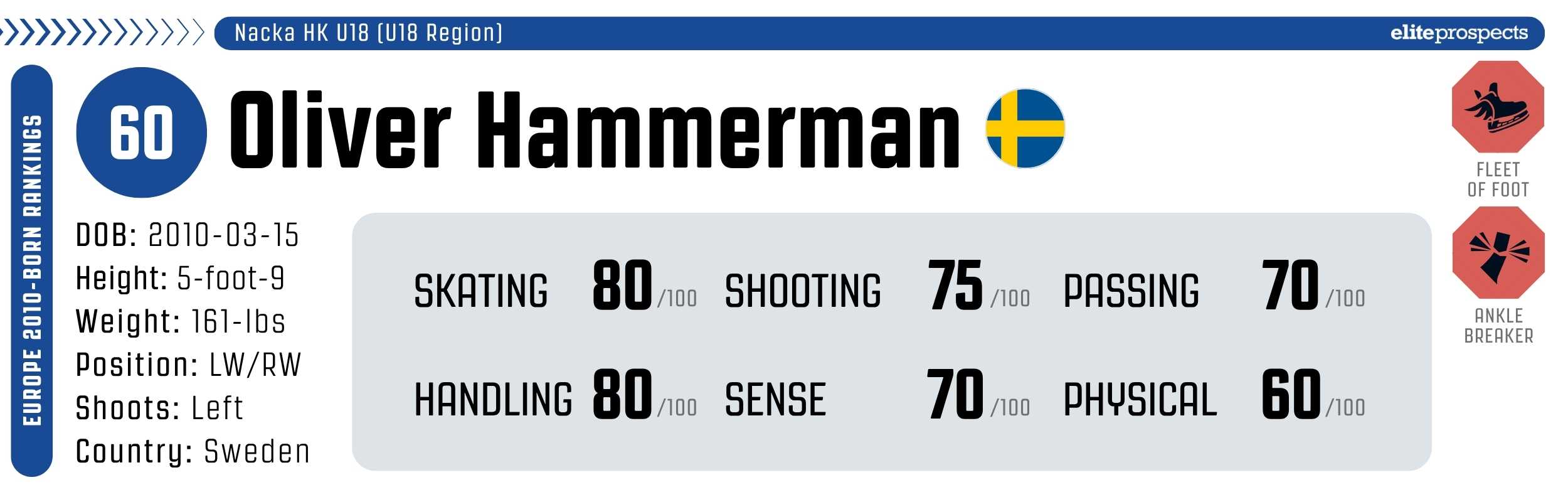
With eight goals in ten games for Sweden's Team 16, Oliver Hammerman quickly established himself as one of the top Swedish point producers in his age group. Now set to join Frölunda — one of the country’s premier talent developers – he’ll be tested against the best, and his progress will be closely watched. Hammerman’s offensive upside is clear: he’s a strong skater with explosive acceleration, using his speed and puck skills to challenge defenders and create separation. There were signs of inconsistency in his compete level with his provincial club, but the move to Frölunda should give him the structure and competition needed to find greater consistency and take the next step in his development.
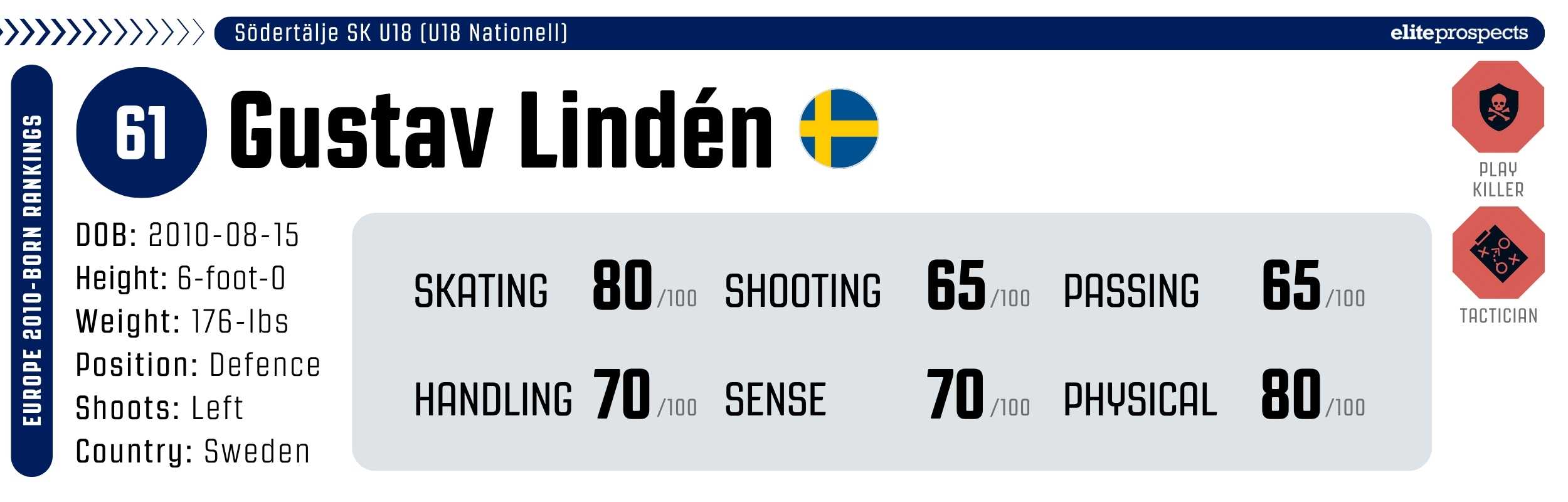
Rarely flashy but always reliable, Gustav Lindén brings a very steady presence to the blue line. Tall and mobile, he stands out for his positional awareness and ability to defend the rush with a solid stick and a willingness to throw a hit. There’s a bit more physicality to his game than the average. With the puck, he often chooses the safer play, doing much of his best work quietly. Handling is decent, with occasional flashes of breakout ability, but high-end moments are rare. He’s likely to remain a steady presence and contend for a national team spot next season.
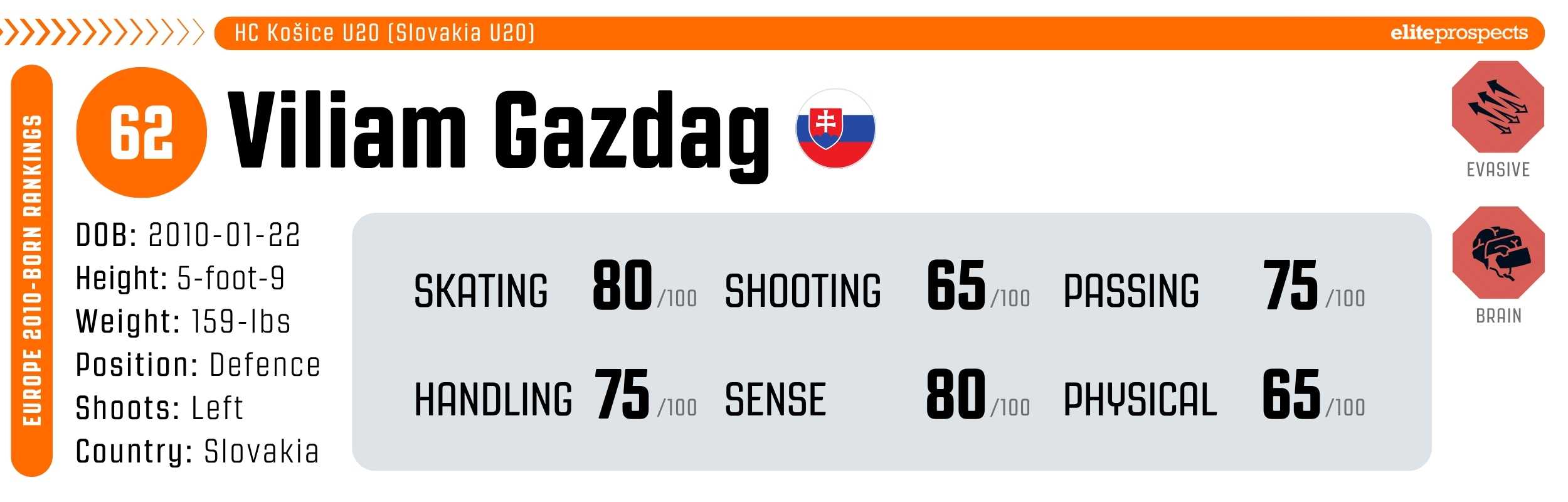
While it was another Slovak 2010 defenceman who got a shot with the U17 national team in April, it's Viliam Gazdag who's established himself as the top Slovak defenceman in this age group for us. He started the season being listed at 5-foot-7, has since grown a bit and proven he's got the physical skills to overcome his size deficit. He's a quick skater, smart at both ends of the rink, and with enough puck skills to give him some offensive upside. A bit more boom-or-bust given the size question, but we really like what he is today.
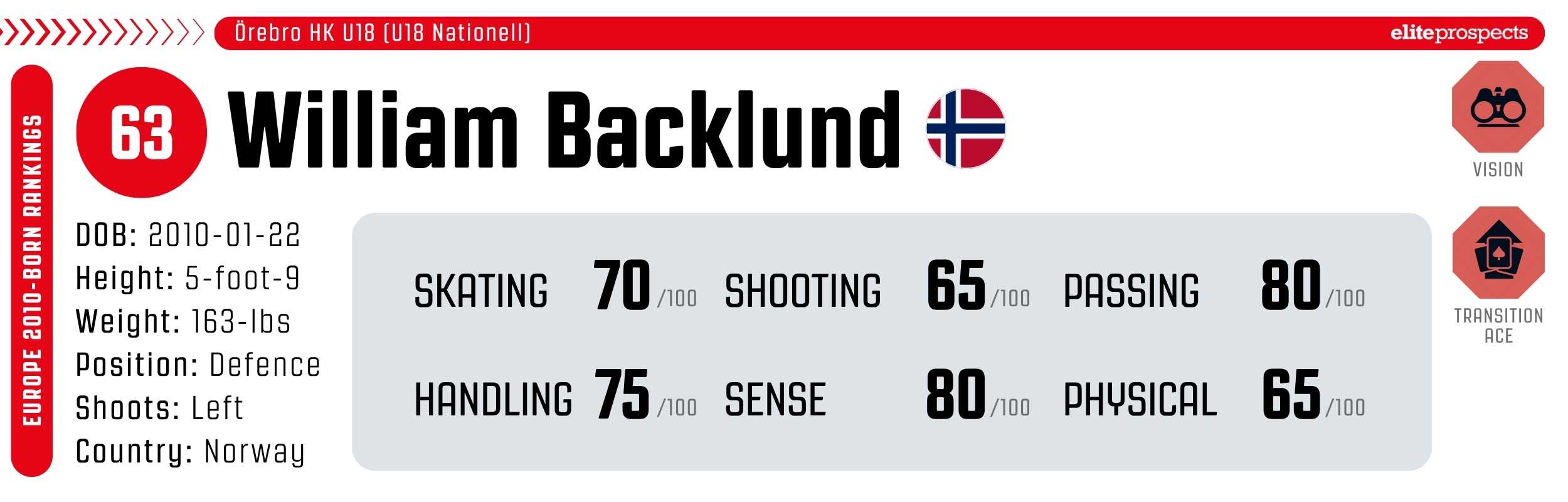
One of two Norwegian defencemen to suit up at the U18 Worlds, William Backlund stands out as one of the top transition players in this ranking. After a strong U18 season with Örebro, he’s set to join Rögle next year, where his precise breakout passing and sense for the game should continue to shine. Backlund plays with real composure and attention to detail, always planning ahead and rarely rushed. His physical grade is a bit lower, but that’s more about size than willingness to engage. With his skill set, Backlund projects as a standout offensive blueliner in Swedish junior hockey over the coming years.
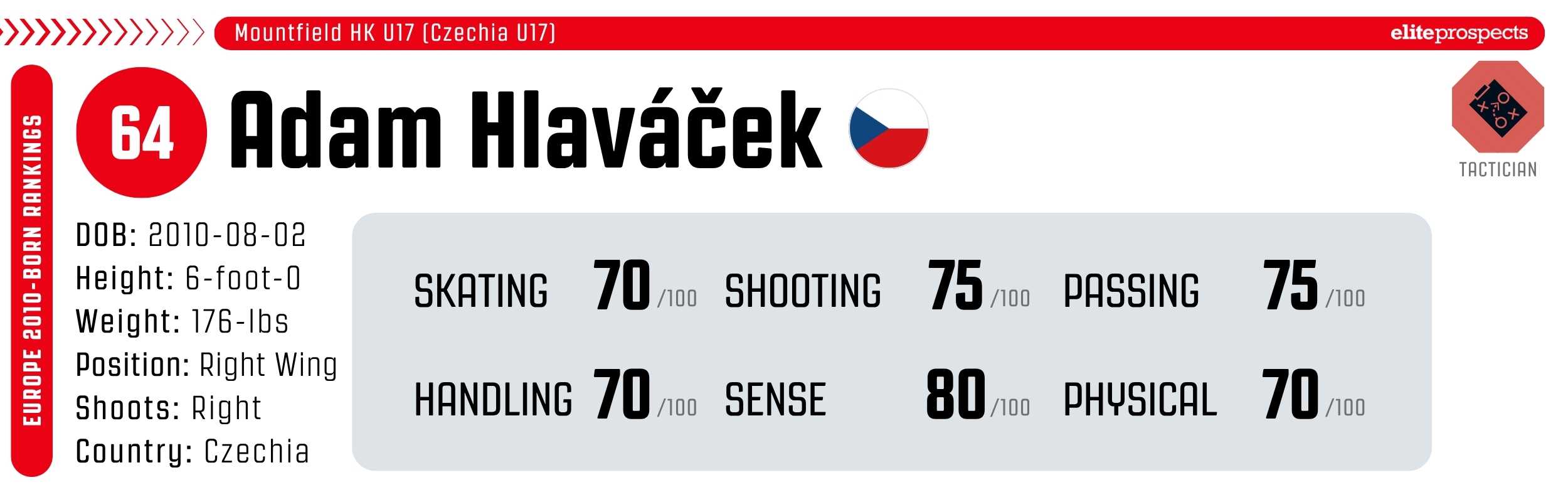
Adam Hlaváček didn't wow us in many of our in-person or video viewings this season, but he finished strong: Six points in four relegation games with Hradec Králové's U20 team and three in three at the April Five Nations tournament. His game may need a bit more attention to fully appreciate, as it's strongly built on high-level sense rather than flashy tools, but he ultimately showed us enough to rank in the middle portion of this list.
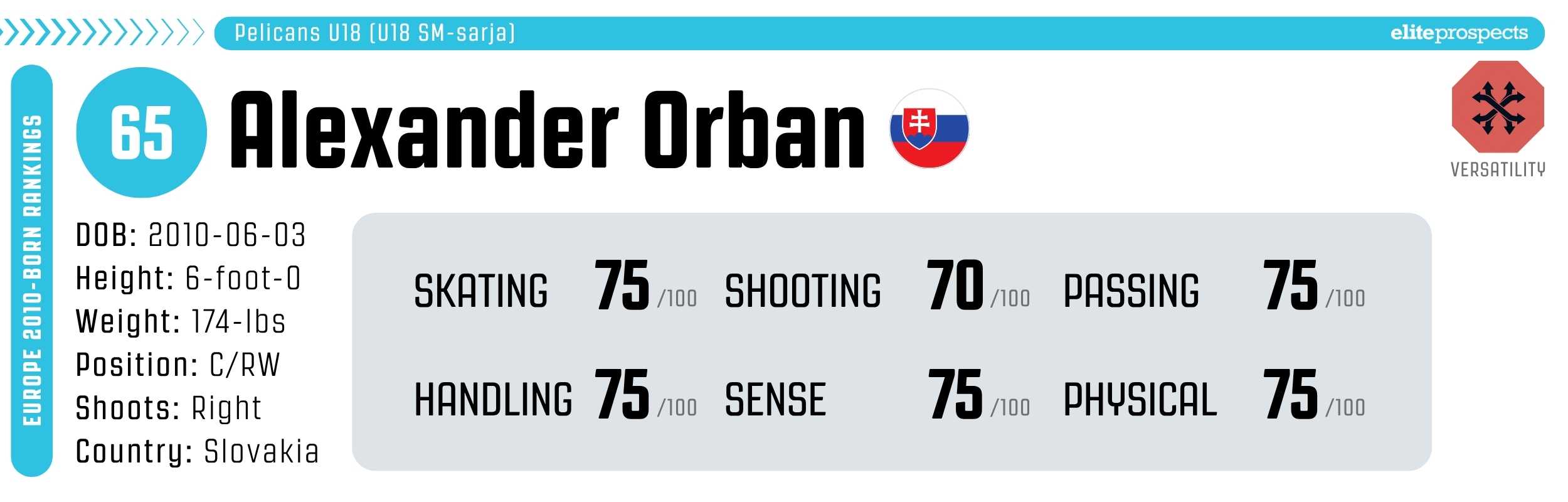
Alexander Orban only appeared in a single event for Slovakia's U16 squad, but his league play at the Finnish U18 level was consistently impressive. A well-rounded forward, he has the off-puck smarts to put himself in favourable positions to score, but can also create for himself through his 1-on-1 skill and swarm defenders on the forecheck. There's a lack of a clear standout element, but this ranking reflects the fact that he does everything well and plays the game in a translatable fashion.
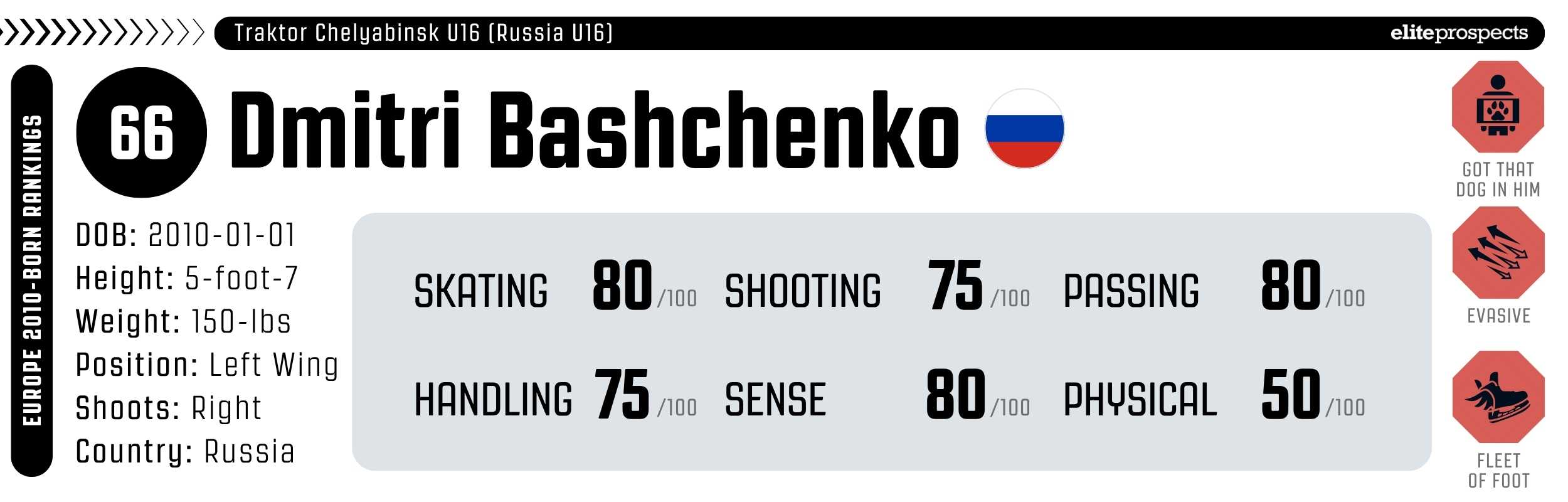
Dmitri Bashchenko is one of the smallest players on this list, but he also boasts some of the most impressive offensive numbers, having scored 33 goals and 73 points in 41 games with Chelyabinsk's U16 squad this season. He's small but fearless, with good skating mechanics and high-level playmaking skill. The pro projection is very tricky, but he should find success as he moves up junior levels in Russia.
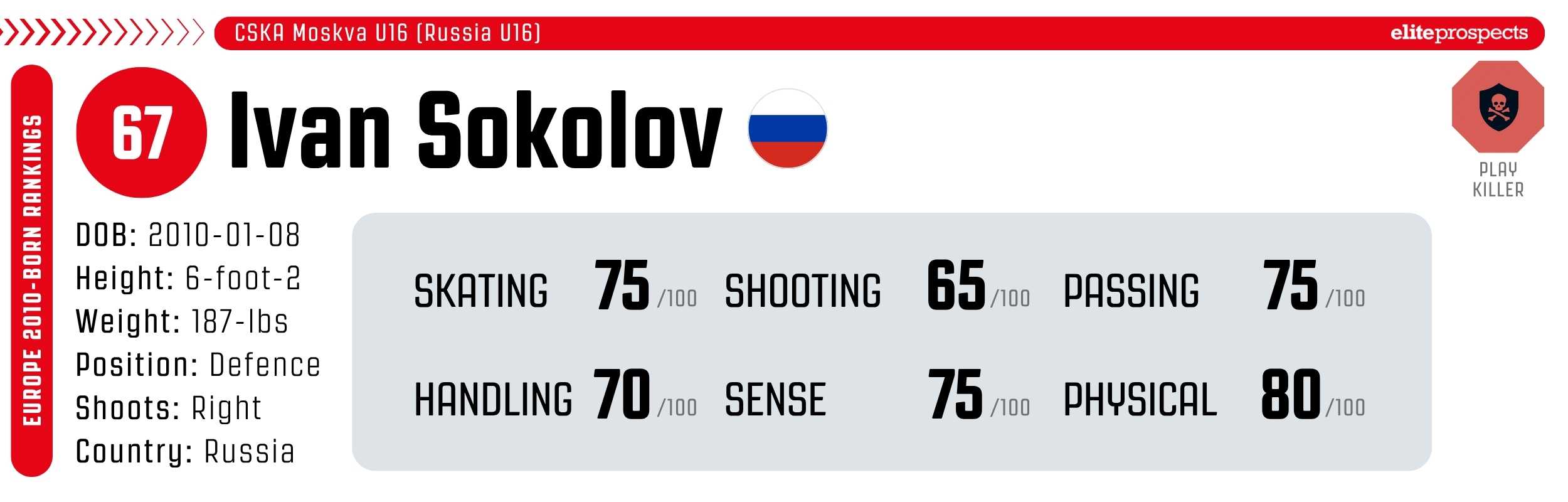
Ivan Sokolov is a defenceman with good size and mobility, playing in a top organization in Russia. He had a solid year representing CSKA's U16, U17, and U18 teams, bringing a reliable defensive presence with flashes of two-way upside. Not the toolsiest or most dynamic player, but he plays a projectable game.
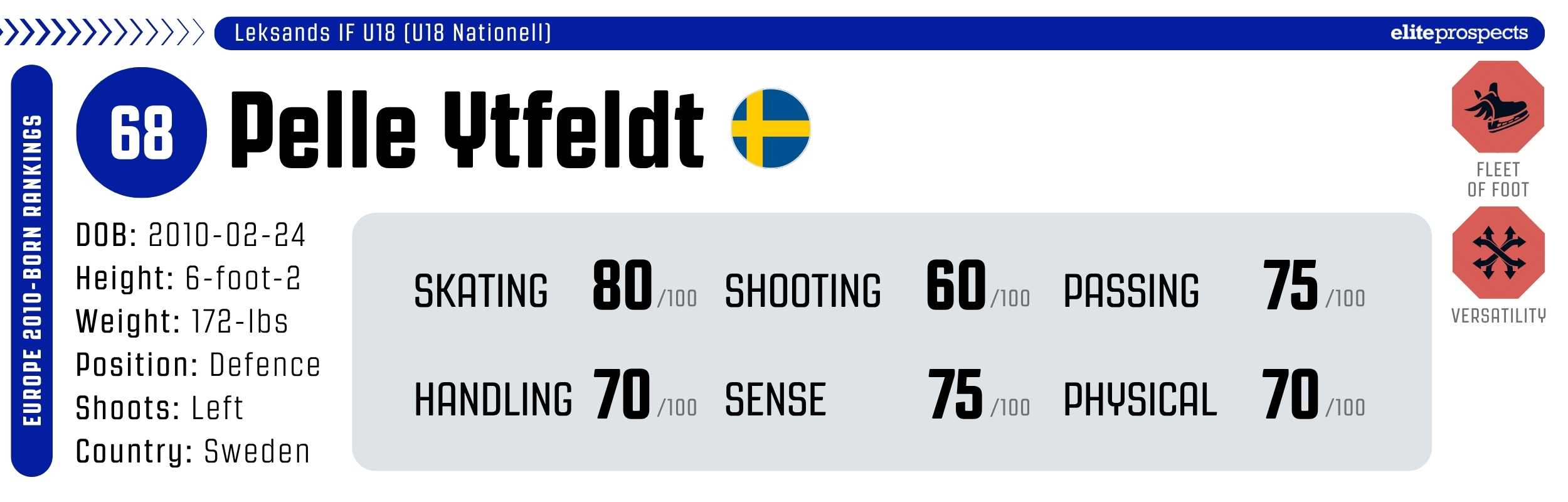
Another regular at U18 this season, including the playoffs, Pelle Ytfeldt played close to 60 games — among the leaders for 2010-born players. A stabilizing presence on Leksand’s blue line, he’s often solid and uses his speed and mobility to create advantages on both sides of the puck. He can move the puck up the ice and shake off opponents. Offensively, he brings tools with his movement, puck handling, and passing ability, and he handled those responsibilities well, though rarely in spectacular fashion. With his experience at this level, expectations are that he’ll step out strong next season and be a factor for his team.
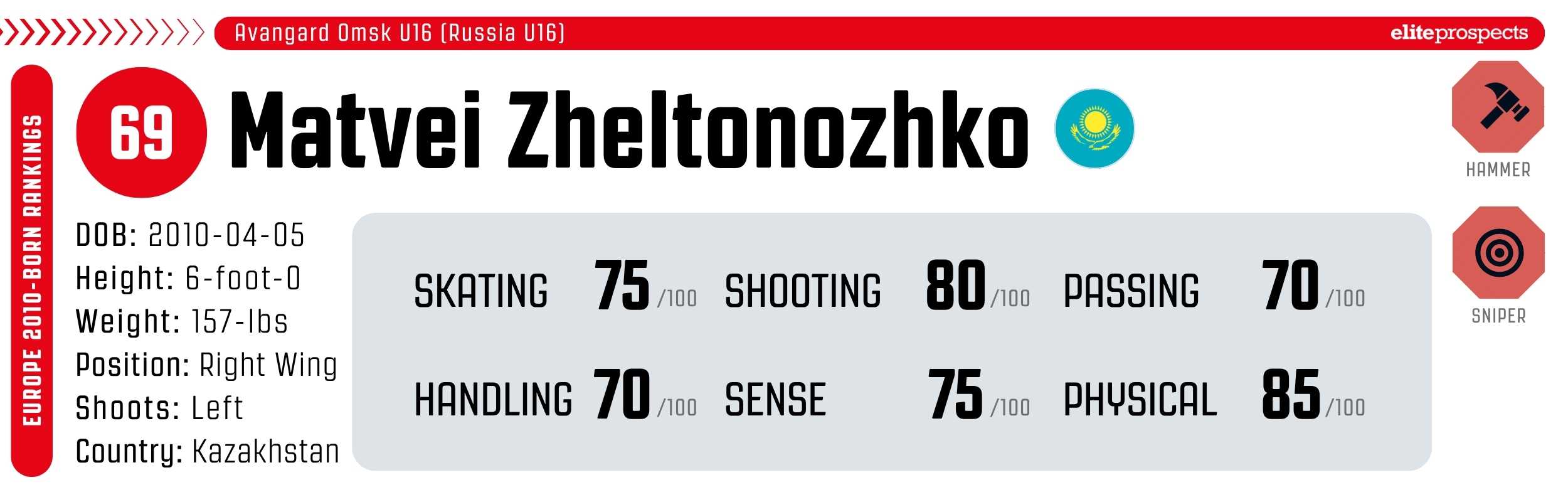
Our highest-ranked player from Kazakhstan is Matvei Zheltonozhko. Listed at 6-foot and 157 pounds, he's clearly grown much larger this season, and it's that physical edge that's allowed him to be an impact player with Omsk's U16 team throughout the season. A strong puck protector and shooter, he's at his best when making plays off the wall and out of the corners. The biggest question is how good his tools really are or if his success has been a result of physical maturity — he could climb with a strong season next year.
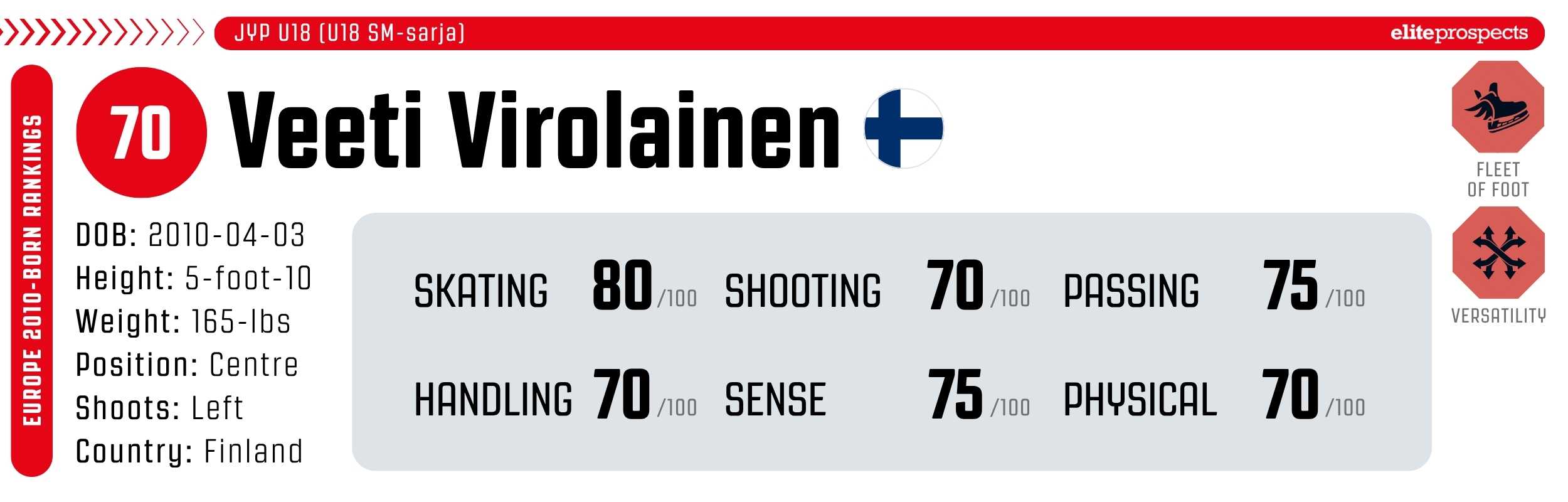
Veeti Virolainen shares many qualities with Jere Lassila, being another smaller centre from the JYP program whose all-around game makes him a trusted pivot in all situations wherever he plays. Skating is his most projectable tool, bolstering a stride with plenty of depth and flexion in the right places. Right now, we see him more as a connector than a higher-end creator, but adding a new layer of dynamism with the puck could take his projection to a whole new level.
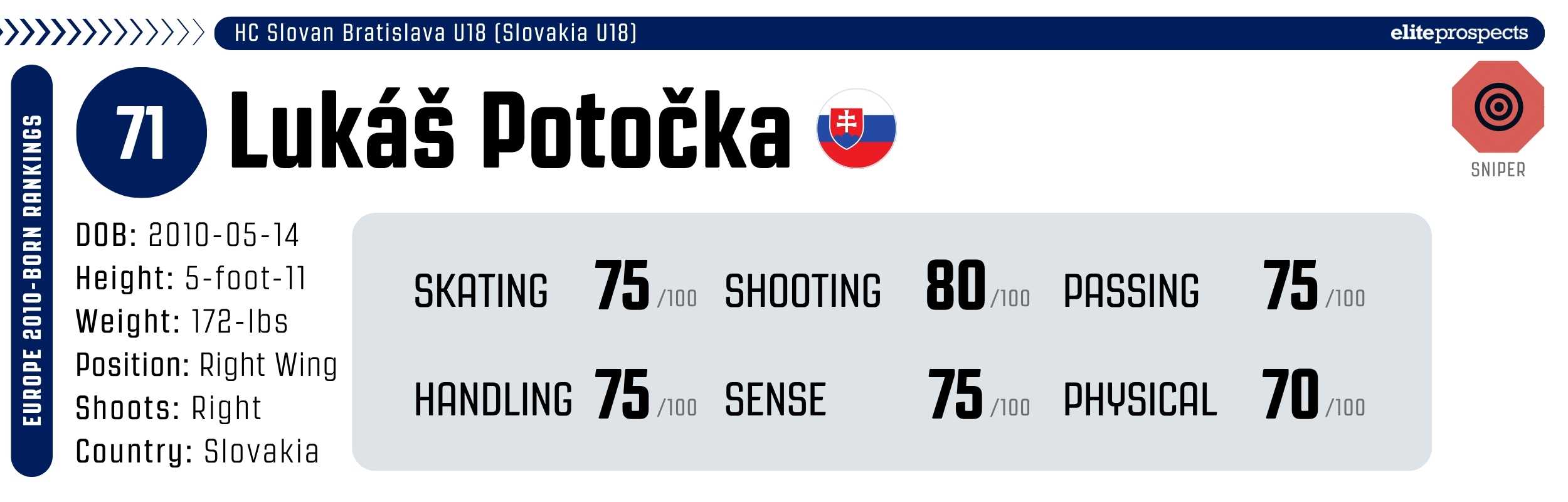
On a strong Slovak U16 team, Lukáš Potočka was one of the most consistent contributors. He doesn't wow you with elite tools, but he always ends up producing. His quick release is his biggest weapon. A very well-rounded player right now, he'll have to grow physically or add a more dynamic, high-end tool to his arsenal to develop into a higher-end pro prospect.
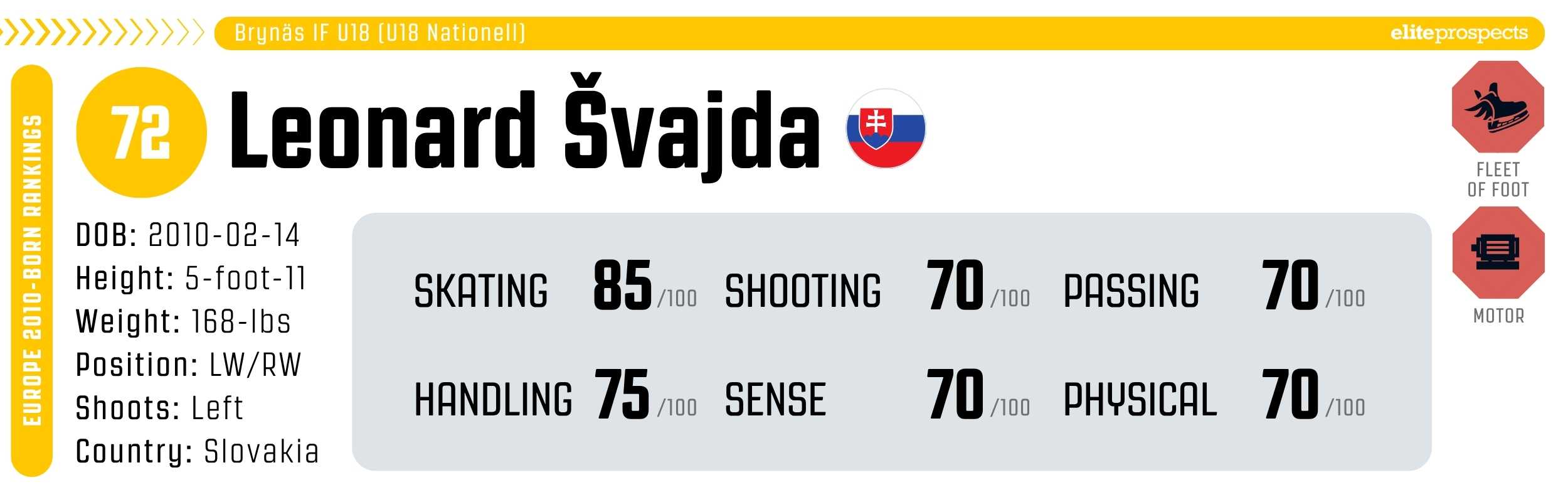
Leonard Švajda tore it up at the U16 level in Sweden with Brynäs, but it was after a strong finish to the season — highlighted by an impressive April tournament with the Slovak national team — that he cracked the top-100 list. He brings decent tools across the board, but it’s his skating that truly stands out, using it to gain advantages all over the ice. A major transition threat with his acceleration, he also brings relentless pressure on the forecheck. He could become a middle-six player at higher levels, but with his standout traits, he projects to be a difference-maker in U18 Sweden next season.
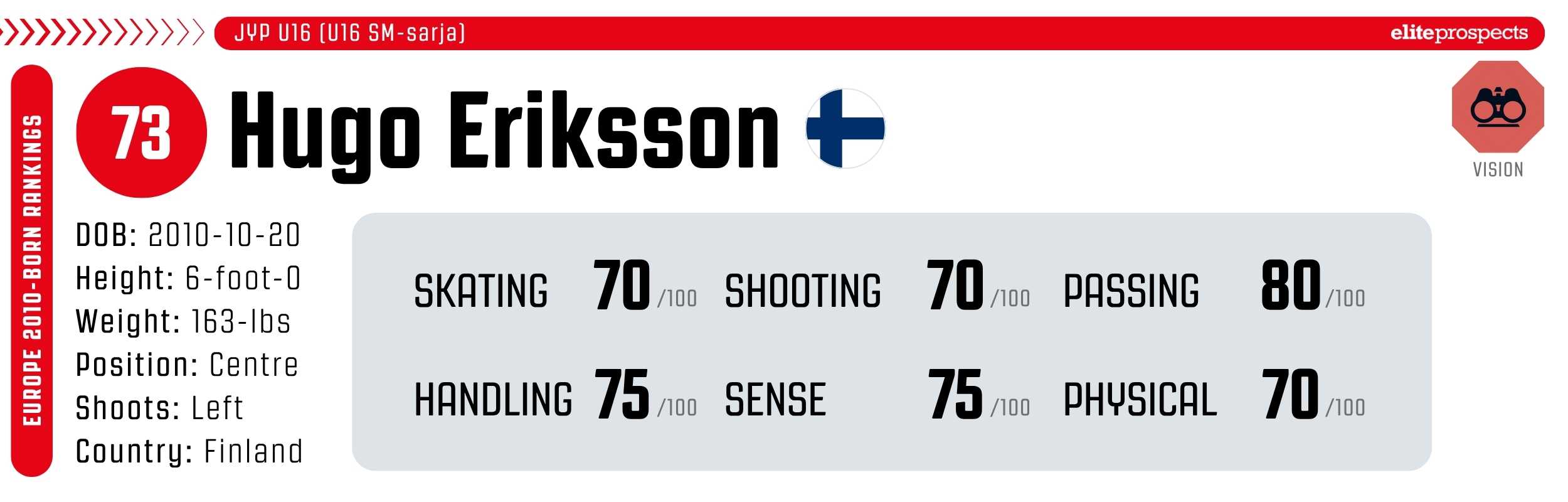
Hugo Eriksson was a bit of a revelation for us at April's U16 event. Not having played any international games before, he immediately became Finland's No. 1 centre at the final tournament of the season, and looked good while doing so. The passing vision stood out the most, but he also showed some dynamic skill and a solid motor to boot. There's some uncertainty around this placement, but the long-term potential seemed enticing to say the least.
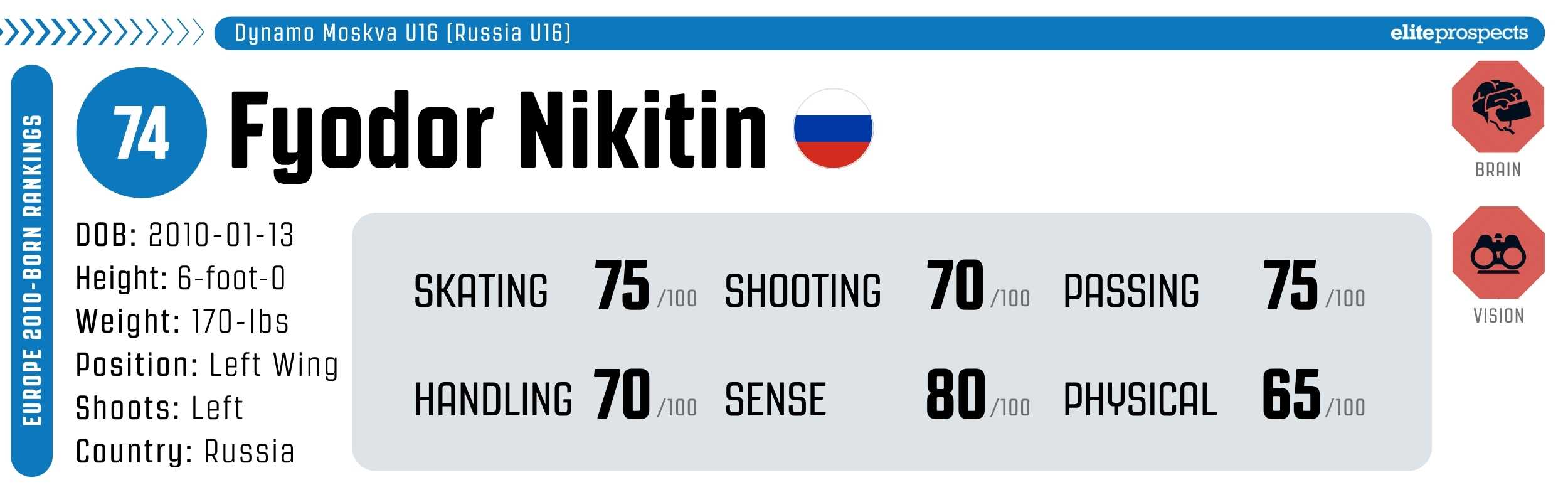
Based on the high end of his flashes, Fyodor Nikitin could have been ranked much higher than this. At his best, he showed legitimate playmaking vision and passing skill, able to find teammates with passes in a variety of situations. Looking at the full season, those high-end flashes came a little too inconsistently. Still, he's a promising prospect who could rise if he starts putting it together on a game-by-game basis.
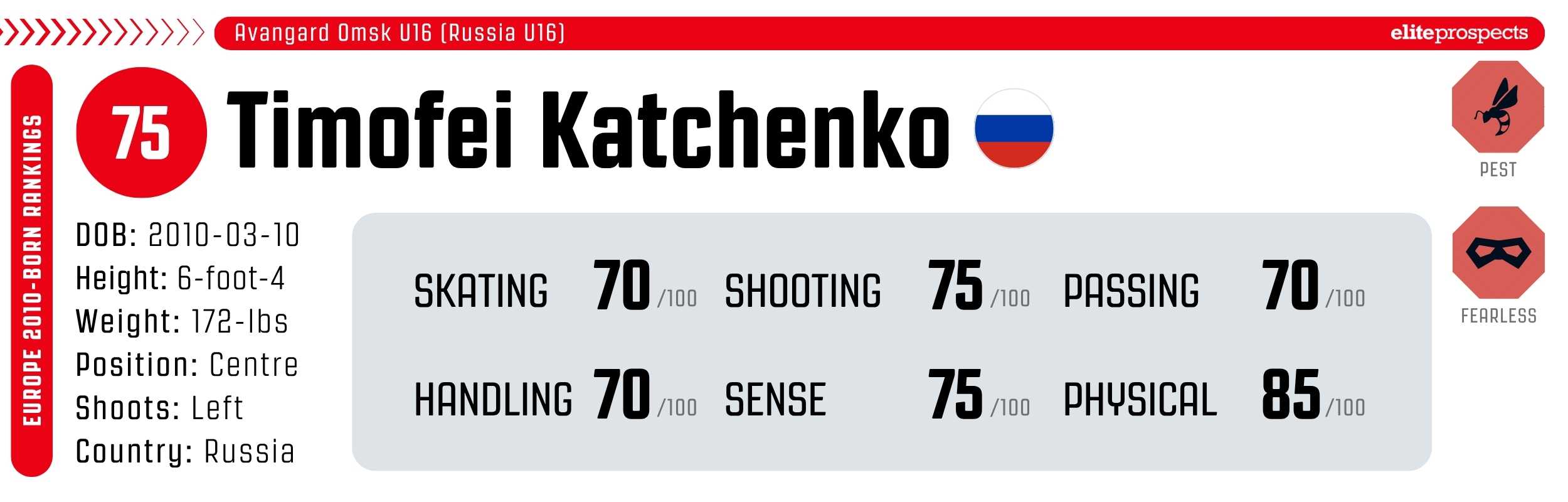
Similar to teammate Zheltonozhko, Timofei Katchenko is a big, strong forward without high-end offensive tools, who still showed enough flashes to bet on his upside. He works hard both ways and has flashed real power forward upside, and he's got a bit of a mean streak. Further developing his puck skills would raise his pro ceiling beyond a physical bottom-six contributor.
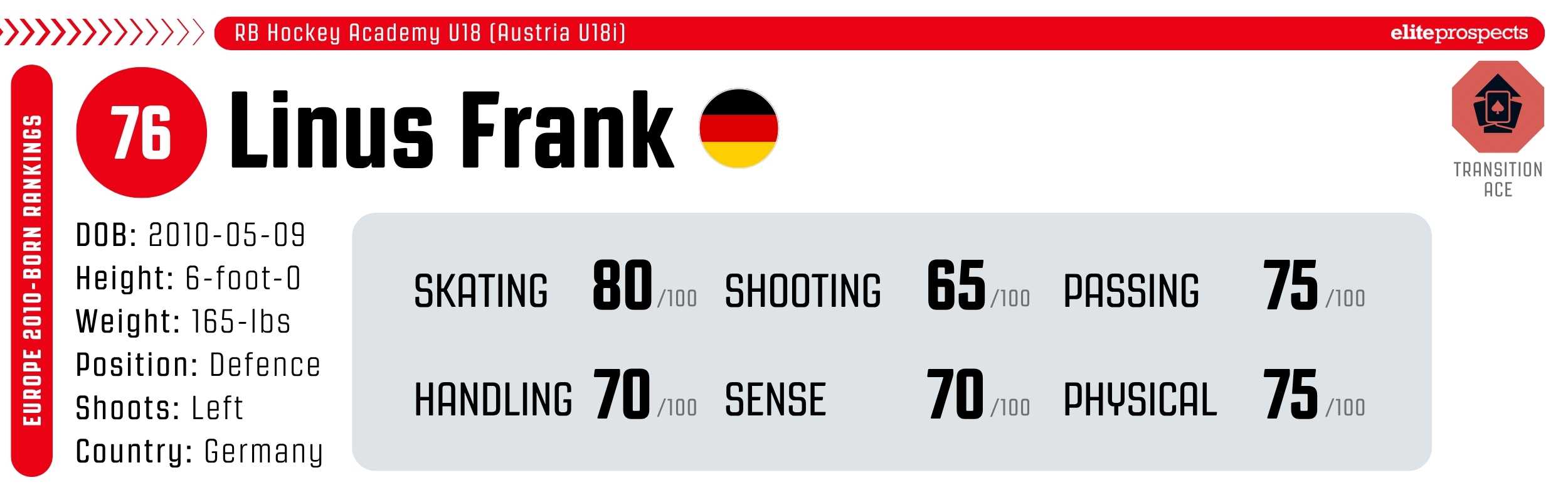
Coming in at 76 is our highest-ranked German player, defenceman Linus Frank, who was deservedly named the top 2010 defenceman in Germany this year. The 6-foot D is a quick, mobile skater who excels in transition. A solid two-way contributor who can impact the game in all three zones, a couple of inches on his frame would do wonders for his pro projection, as would developing more offensive dynamism.
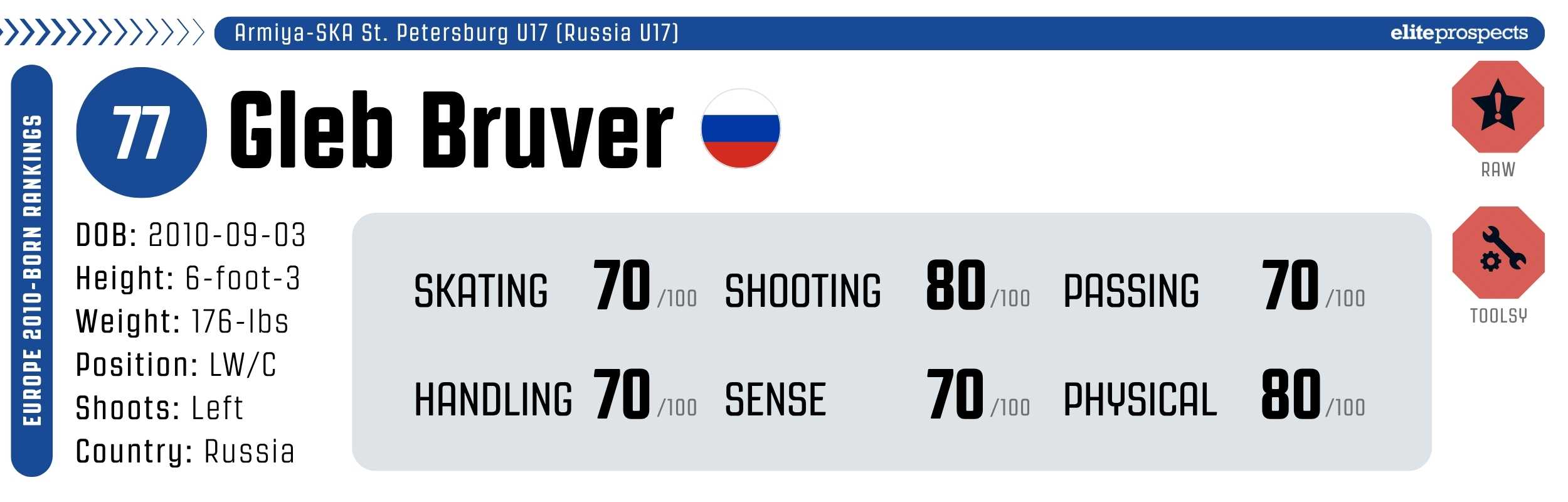
A 6-foot-3 winger, Gleb Bruver's physical maturity has allowed him to spend a large chunk of the season with Armiya-SKA's U17 team. It's that size and a powerful shot that give him upside, especially if he can develop a bit more aggressiveness and consistent net drive. He's flashed some quickness and dynamic handling moments to get to the inside at the U16 level — doing that more consistently and further developing his tools will help him reach the next level.
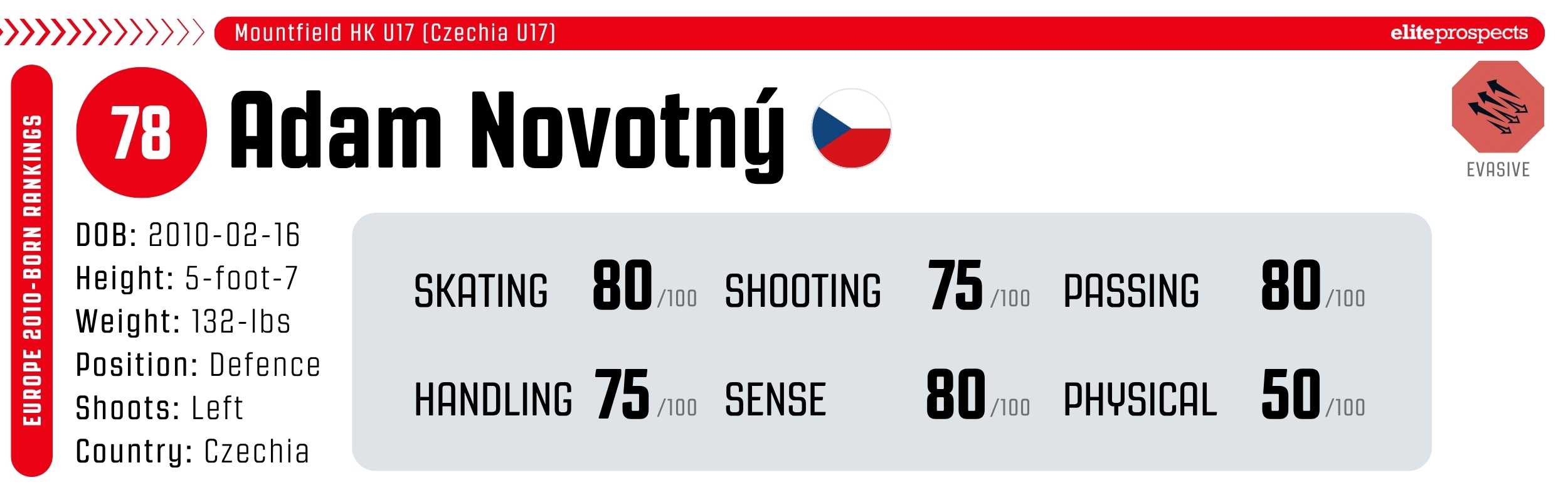
Like all smaller players ranked before him, Adam Novotný was difficult to place on this list. He was excellent in some of our viewings with the Czech U16 team, as a quick, dynamic mover and puck handler who can provide offence from the backend while still being a reliable defensive presence. That two-way success will become much harder to achieve at higher levels unless he hits a major growth spurt, but we wanted to respect his current abilities. A very good player in his age group.
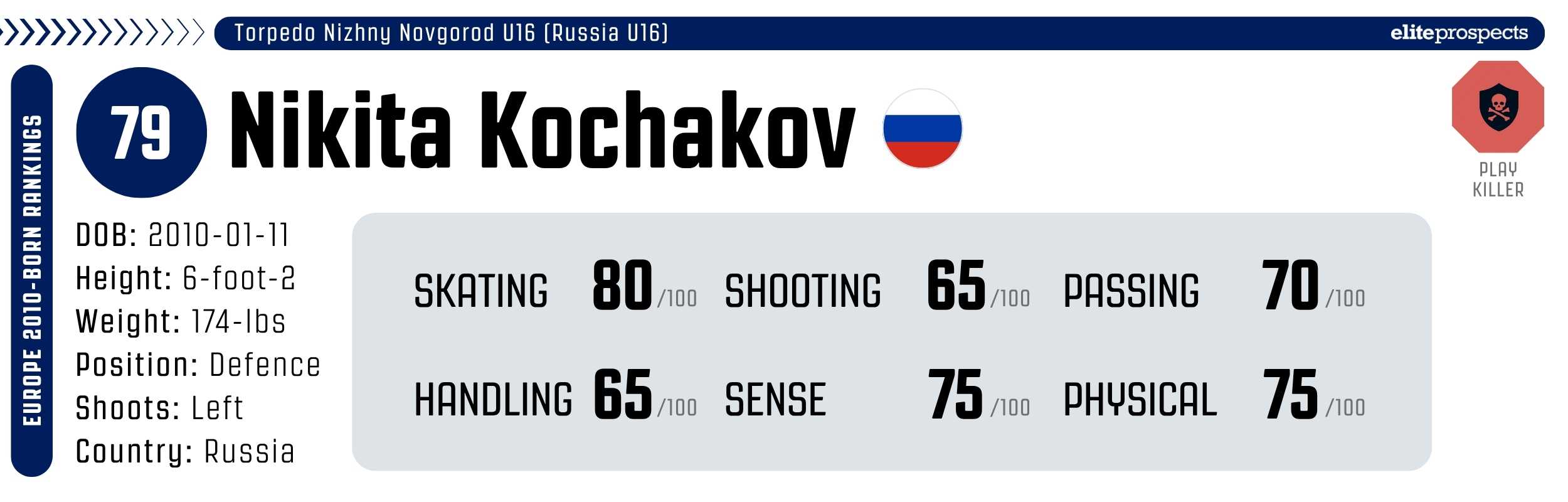
Nikita Kochakov has a rather simple profile and clear, simple projection: He's a play killer, a reliable shutdown defenceman. He combines pro size with strong skating ability. Not the most physical player, but he can use smart reads, mobility, and a strong defensive stick to disrupt attacks and turn the play the other way. Some puck-moving flashes, but more of a shutdown projection long-term.
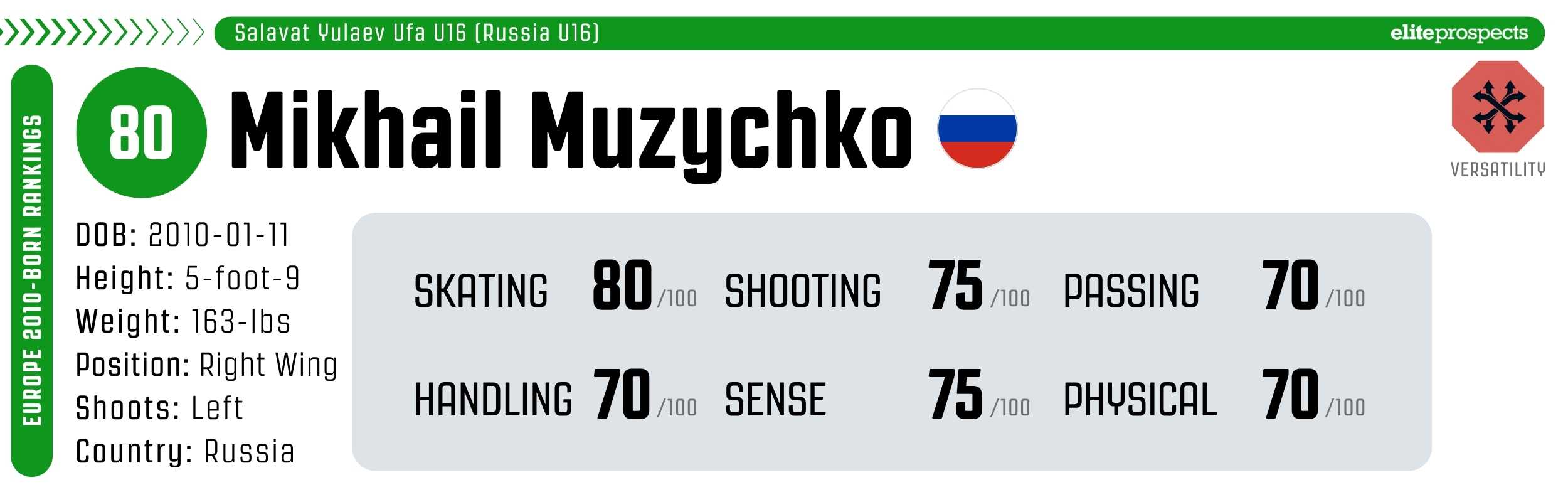
If you only watch Mikhail Muzychko's highlights, you might wonder why he isn't ranked in the top 20 here. In his best moments, he's truly explosive and dynamic with the puck. He can play with power or finesse, set up plays for his teammates or create for himself, deliver accurate passes or snipe shots past the goalie. However, he was very inconsistent in our viewings, both shift to shift and game to game. Has the potential to rise significantly if he can add consistency next season.
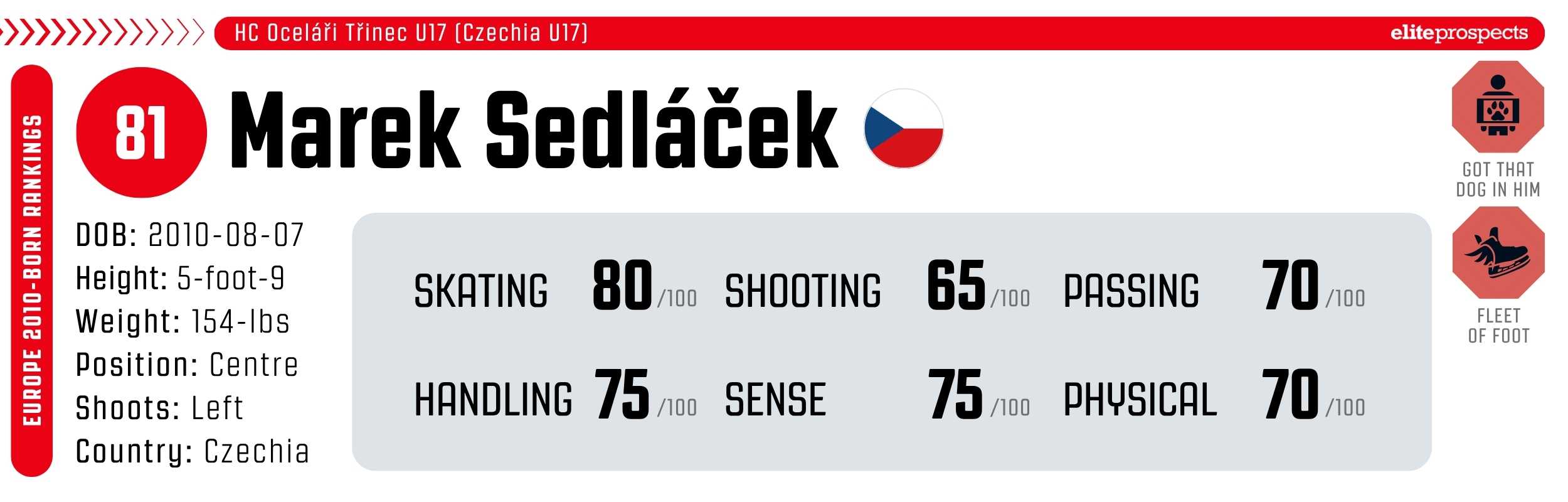
Marek Sedláček is small, but he's among the most deserving of our "Got that dog in him" badge. He's a very quick skater with no fear in his game. Constantly keeps his feet moving, his motor revving for the full 60. Consistently wins foot races, battles it out in the corners and in front of the net, and does what it takes to make plays. Some very promising handling moments, crafty playmaking sequences, and overall offensive upside, though it will be interesting to see how much of that he's able to translate to higher levels as opponents get bigger and stronger.
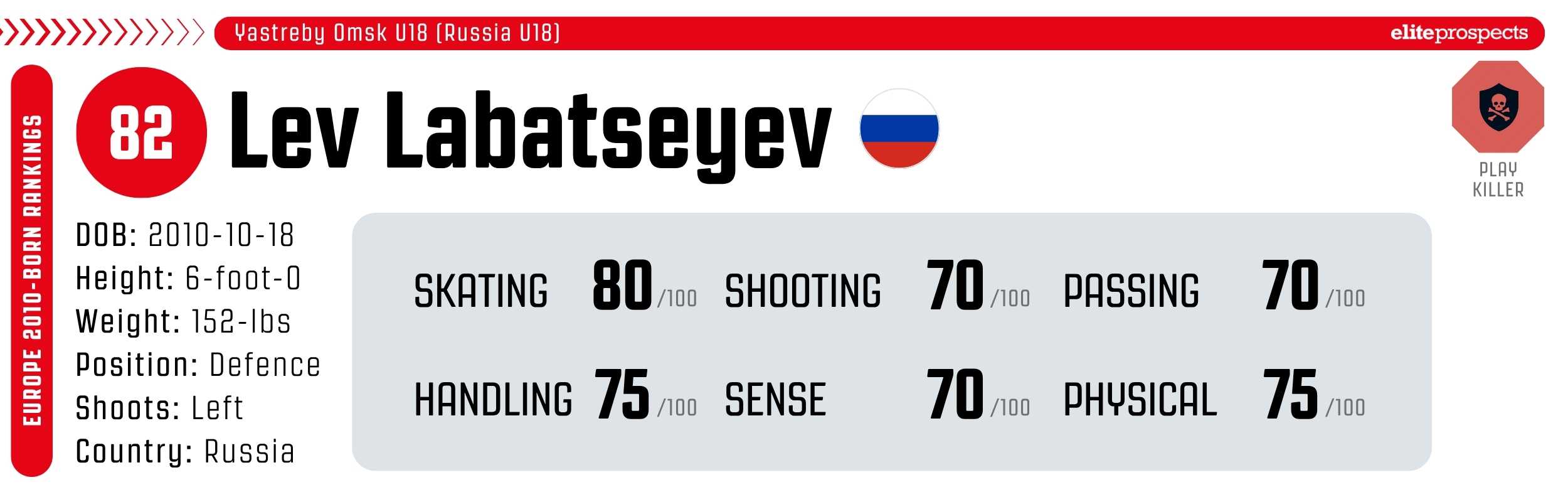
Lev Labatseyev is a promising two-way defenceman in the Omsk organization. He possesses strong four-way mobility, which he uses to his advantage with and without the puck. Steps up aggressively in the neutral zone, plays tight gaps, and doesn't get fooled by fancy dangles when defending the rush. He's got some upside with the puck too, with his breakout game built around his skating more than his puck skills, though he has shown us higher-end handling and passing flashes too.
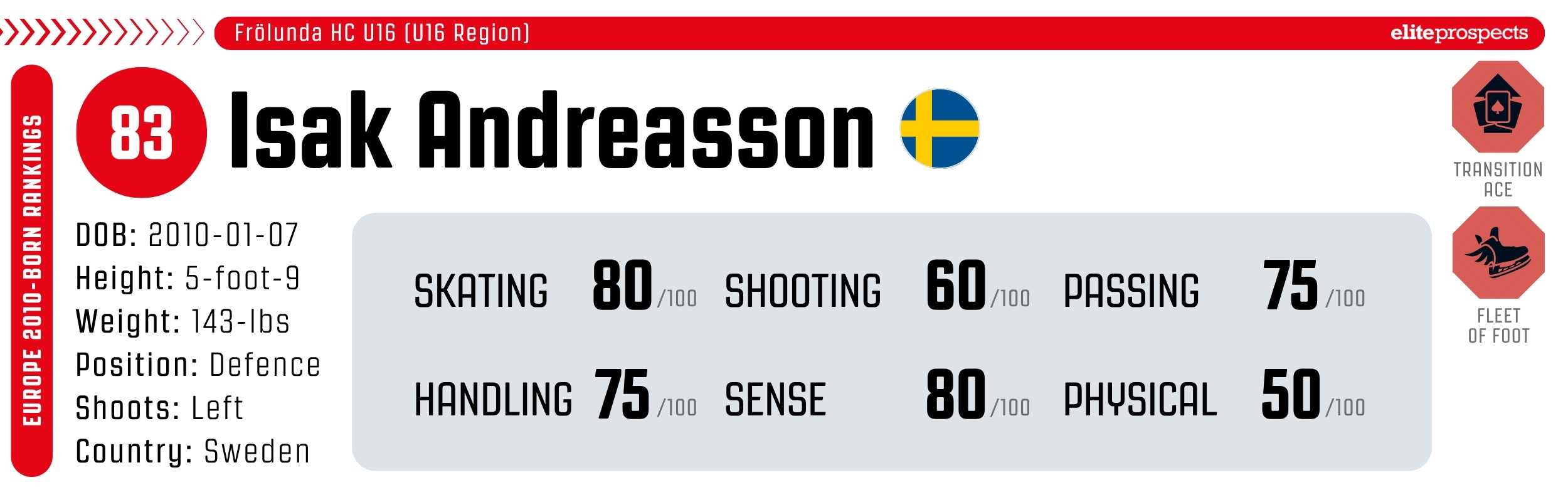
A skilled, mobile defenceman with a smaller stature, Isak Andreasson earned more and more ice time with Frölunda U18 as the season progressed. Comparing the start and end of his year, he’s taken massive steps, playing with confidence and breaking out with both his passing and carrying skills. He didn’t get a shot with the national team this season, but if his development continues at this pace, it wouldn’t be surprising to see him push for a spot next year. Projects as a play-driving defenceman at the U18 level.
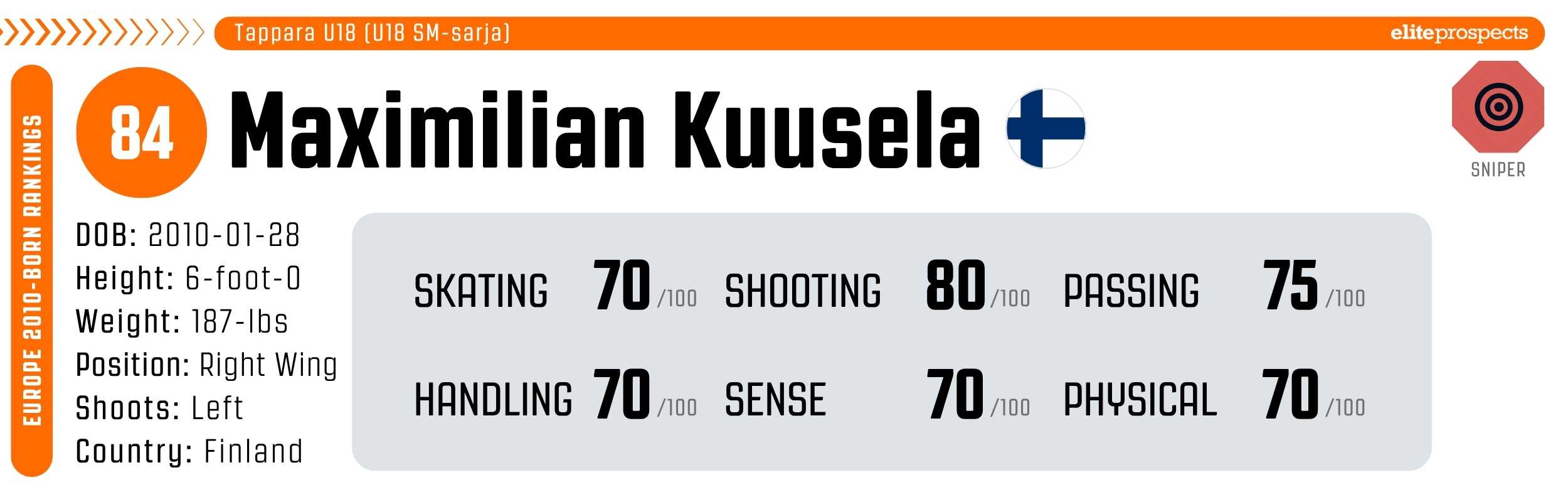
Maximilian Kuusela's shot is a weapon, and he's not afraid to use it, either. With his game built around the release and getting opportunities to use it, he became a key power play operator for Finland internationally, in addition to tearing through the U16 ranks on the scoresheet. Also flashing intriguing playmaking chops from time to time — even if his shoot-first mindset sometimes got the better of him —, the talent level is evident, even if he has ways to go in rounding out his game.
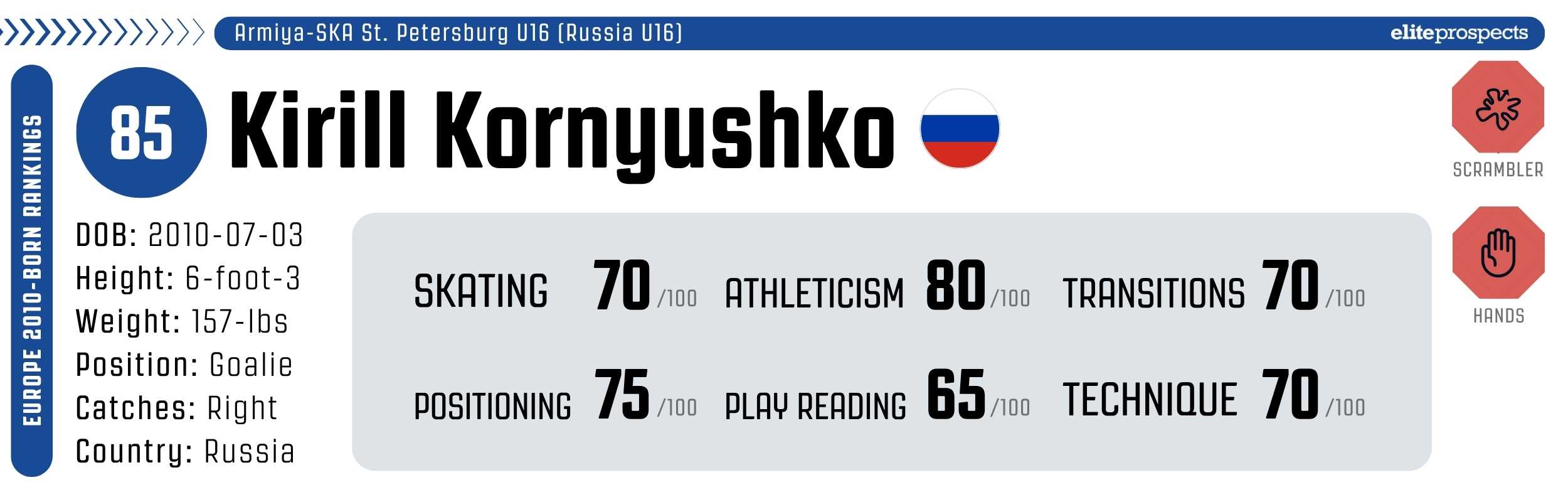
Kirill Kornyushko completes our group of goaltenders to make the top 100. The Armiya-SKA goalie combines pro size with high-level athleticism, quick reactions, sound positioning, and good hands. He can string multiple saves together already, but will need to improve his play reading and overall technique. A fairly raw prospect with high upside.
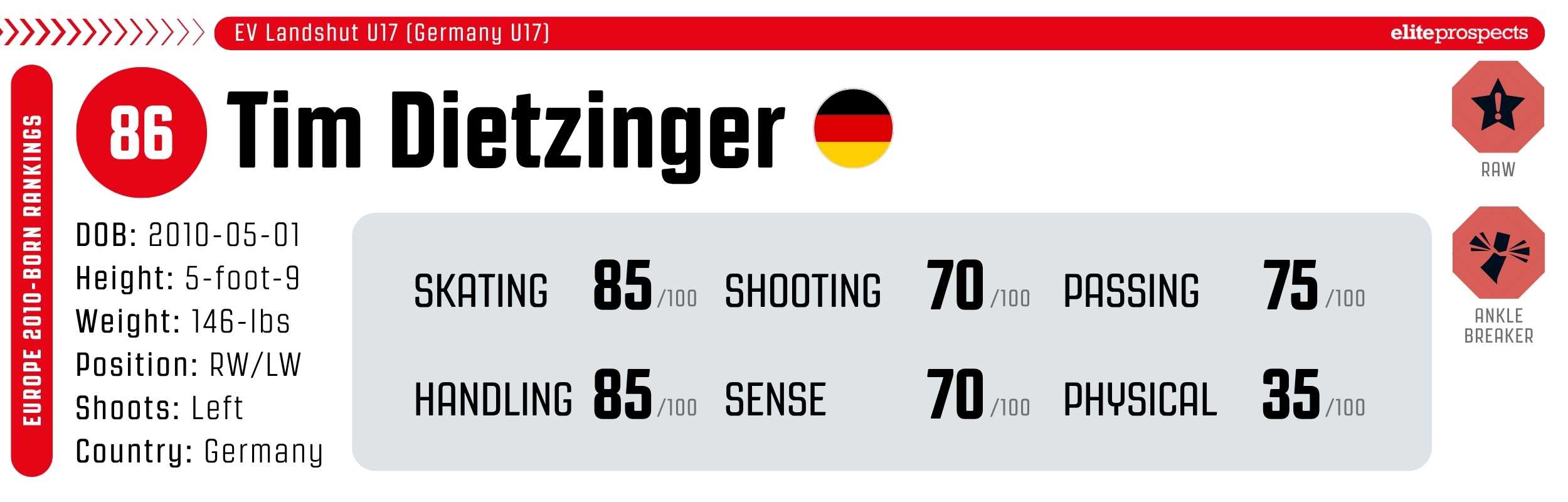
Tim Dietzinger is the German equivalent of 44th-ranked Andrejko. A very small winger who put up an insane 51 goals in 36 games in the German U17 league this season, he possesses high-level skating ability and puck skills, but will need to learn to play a simpler, more effective game to find success at higher levels. Moving to Mora IK in Sweden for next season should be good for his development.
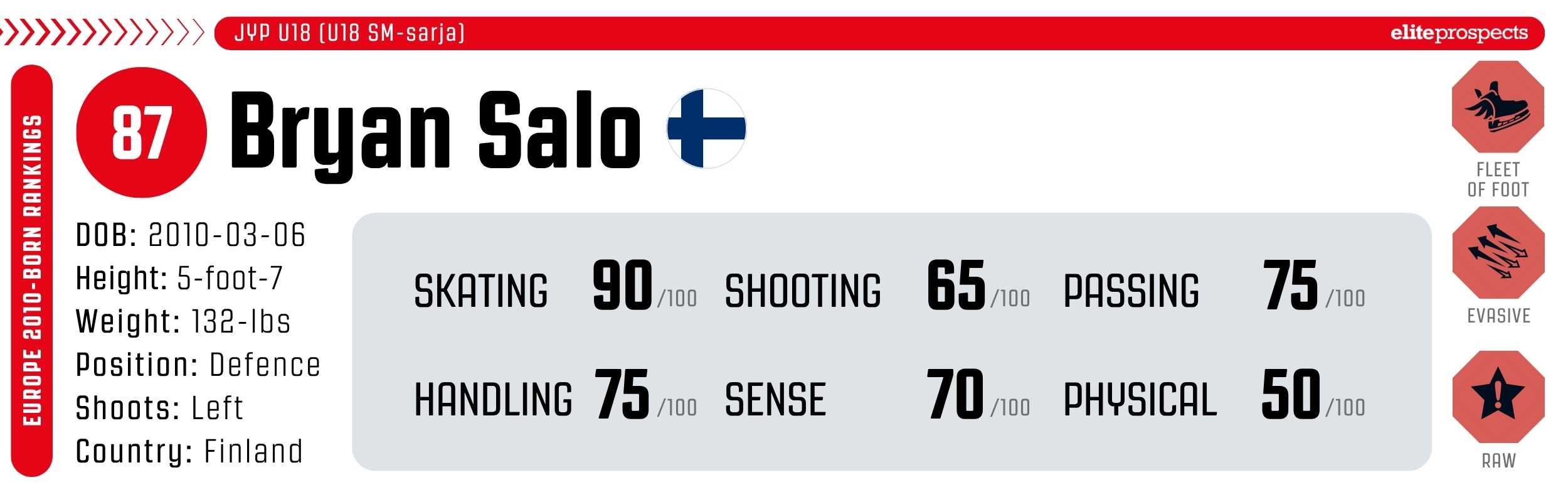
As the grade would suggest, Bryan Salo is among the very best skaters in the 2010-born class in Europe. Playing big minutes for Finland's U16 team this season, the tiny defenceman already moves with such grace and has top-tier edges and notable quickness going for him — there's a good chance he ends up projecting as a higher-end skater even for the NHL level in two years, especially as he's currently highly underdeveloped physically. He's not afraid to leverage his feet, either, playing a chaotic, highly involved hockey that includes high highs but also low lows. His development could go in a variety of directions, but the upside — at least for the European professional ranks — seems mouth-watering.
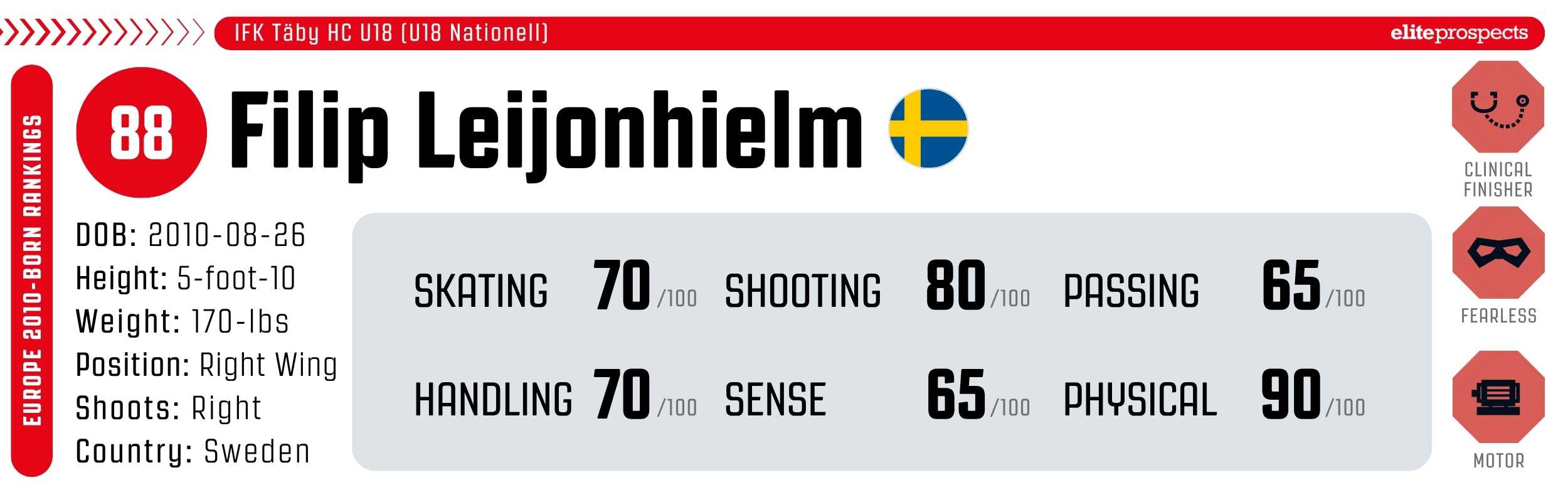
Filip Leijonhielm brings a standout quality not often found among Swedish players in this group. With his relentless net drives, strength, and physical skill, he can make a difference when games are on the line. At the club level, he was a star given the space and time to operate, often playing more on the perimeter with extra time on the puck. Going forward, and for his projection, he’ll need to leverage his strengths as a net-front scorer.
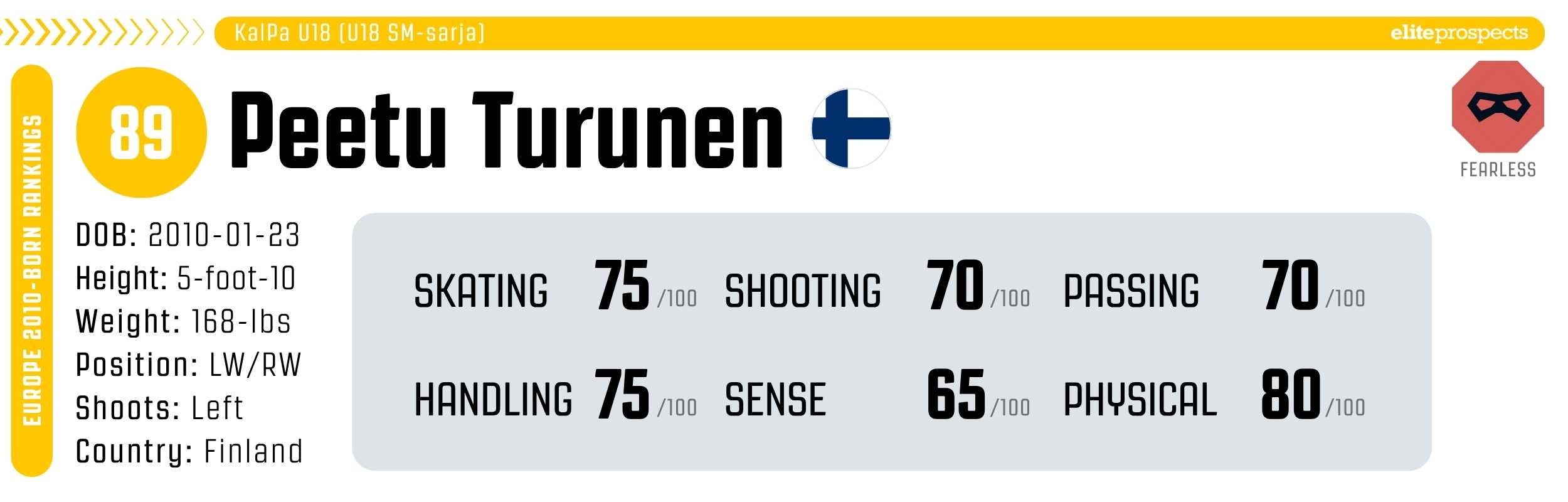
Peetu Turunen's skating and physical skills allowed him to be one of the most consistent performers on Finland's U16 squad last season, even if he often played lower in the lineup. He's not big by any means, but has such a sturdy base and strong contact skills that he's able to regularly bully his way through checks and bounce defenders off him — it's not a surprise he shone in a checking-focused role. While his feel for creating offence isn't on par with the Finns ranked above him, there's still some offensive upside through his power game and occasional playmaking flashes, too.
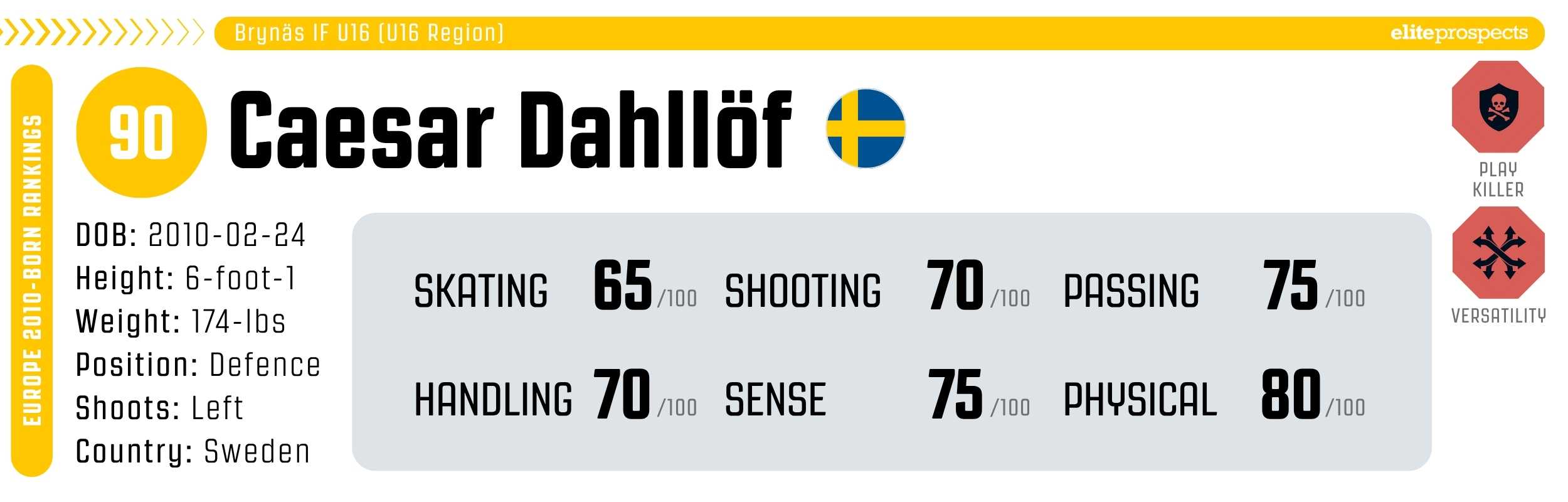
Caesar Dahllöf isn’t the flashiest defenceman, but he knows exactly what he brings. With a big frame and long reach, he thrives in tough spots — winning battles along the wall, shutting down rushes, and taking pride in killing penalties. He’s steady, rarely rattled, and does the simple things right, but now and then he flashes breakout skills, finding teammates with soft passes into the middle. His performance at the April tournament with Sweden Team 16 was really solid, but he’ll need to develop some kind of separating factor to stand out from the crowd.
.jpg)
Behind fourth-ranked Dedial, the Swiss 2010-born group has many interesting forwards, though nobody has truly separated himself from the pack yet. In the end, Aeneas Orlandi managed to sneak into our top 100. While his frame is average and he lacks true high-end tools, his well-roundedness and high motor give him lots of upside at the junior level, and perhaps beyond. In his best moments, he drew comparisons to 2026 NHL Draft prospect Lars Steiner.
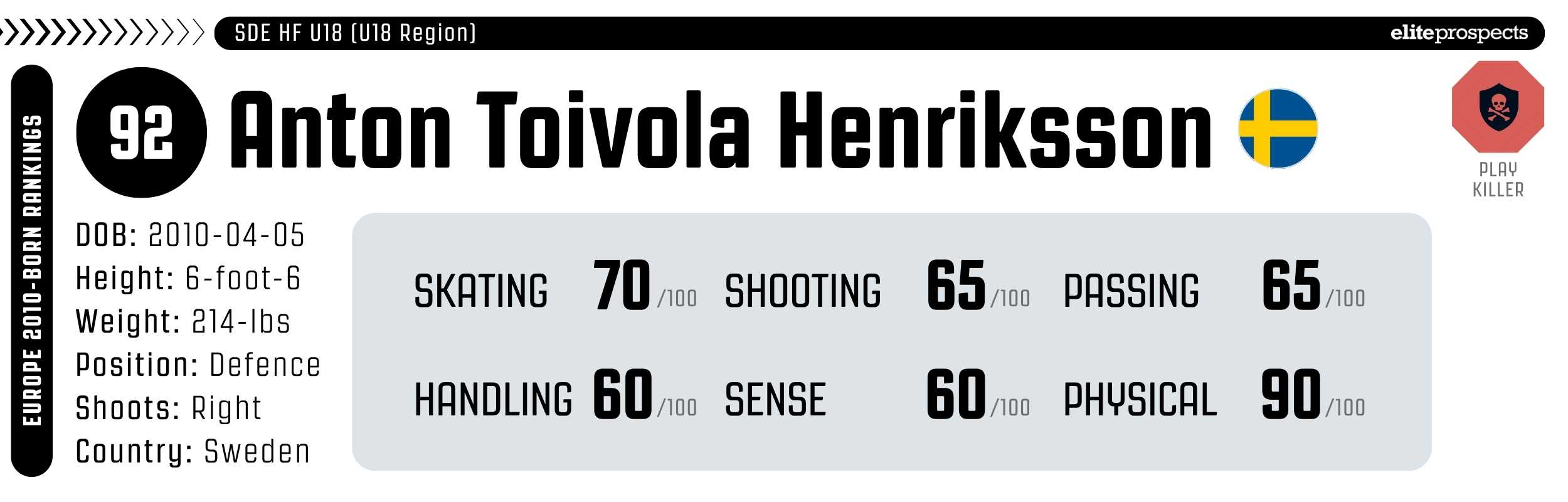
It’s impossible to ignore Anton Toivola Henriksson's size — listed at 6-foot-6 as a 15-year-old already in October, and there’s a good chance he’s grown since. His frame is what jumps off the page, while the rest of his toolkit is still catching up. For a player his size, his skating is serviceable: decent mobility, okay pace, and enough agility to get around, even if he’s not especially explosive. The reach makes up for a lot. The next season and onwards, he’ll get his education at HV71, and if he can add more detail to his puck game and learn to leverage his physical gifts, there’s real upside with Toivola Henriksson.
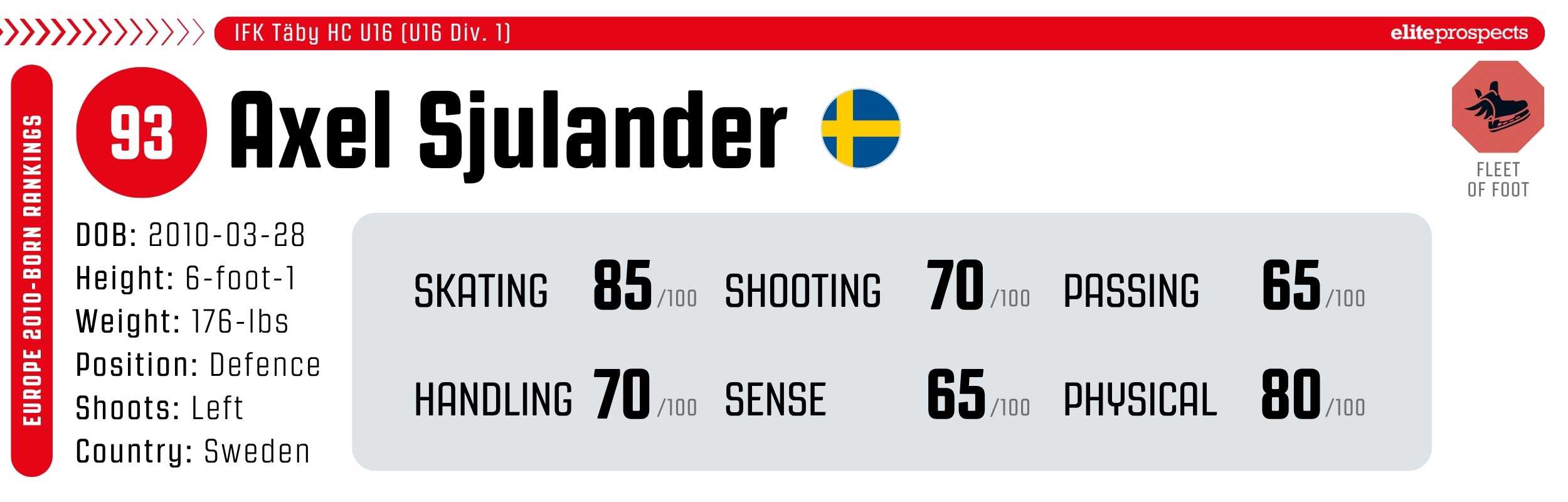
Axel Sjulander is set to join Brynäs next season, bringing with him some of the most eye-catching skating in this group. He stands out for his ability to break out with speed, generating high pace and jumping into rushes, yet always having the wheels to recover if a play breaks down. In his new environment, Sjulander will have every opportunity to add new layers to his game. What makes him especially intriguing is the combination of size and mobility — a rare blend that gives him a real shot at separating himself from his peers on the blue line. If he can harness that skating and round out his overall game, Sjulander could quickly become a key piece for Brynäs and put himself firmly in the mix for the U17 national team.
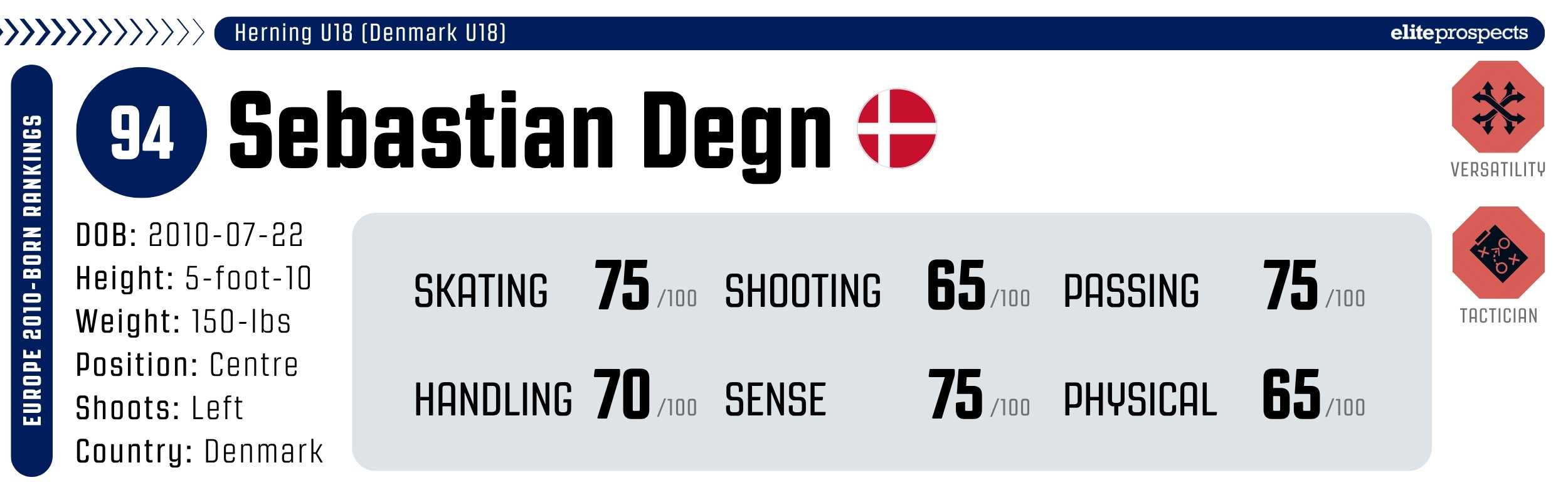
Playing in the Danish hockey system, Sebastian Degn flew a bit under the radar. With 32 points in Danish U18, he recorded the second-best scoring season ever by a U16 player, but it was above all his presence and performance at the U18 Worlds that earned him a spot on this list. A mobile, fairly quick centre, he showed flashes of skill with his handling and passing — something even more evident in his domestic club environment, where he displayed creative playmaking. Where he chooses to play next season will be interesting to follow, as Danish prospects often opt to leave their home country.
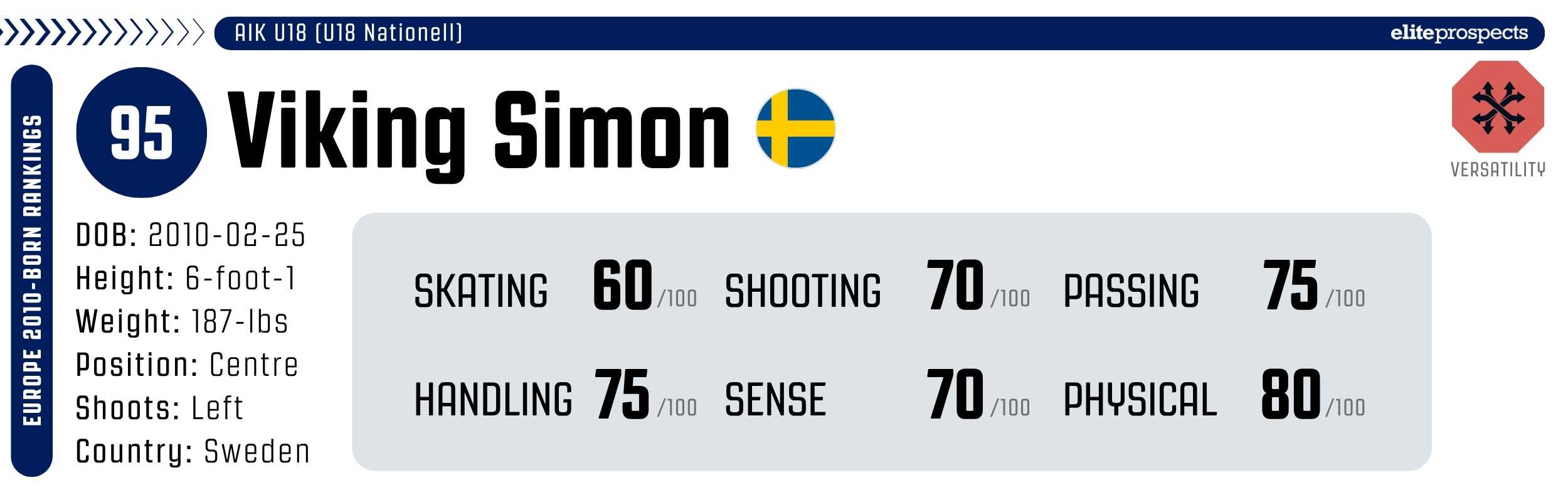
A steady point producer in U18 with AIK and for the national team during his six appearances, Viking Simon also brings size to the centre position. He’s shown plenty of offensive flashes, using his sense and hands to beat his man, and there’s a quick release on his shot. Skating is currently rated a bit lower, both because he needs to grow into his frame and because of a lack of intensity. As a big-frame centre, his role shifts slightly when stepping up a level – at the national team level, his physical presence becomes more pronounced, using his size and strength to win pucks and take opponents out of the play. Projects to be an impactful player for his U18 team next season.
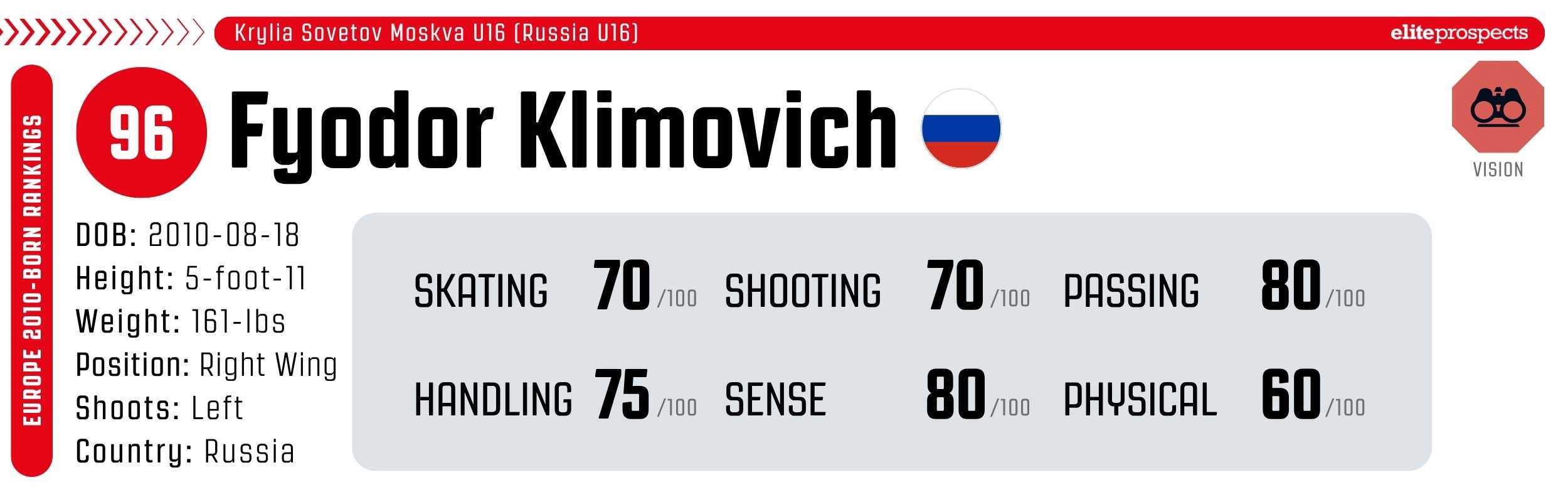
Fyodor Klimovich ended up taking the top spot for total points scored throughout the Russia Cup. A smart player with and without the puck, he consistently puts himself in positions to make plays, setting up chances for his teammates or burying pucks himself. With average size, okay skating and pace, and average physical skills, it's more of an MHL projection right now, but a couple of strong development years could allow him to rise on the board.
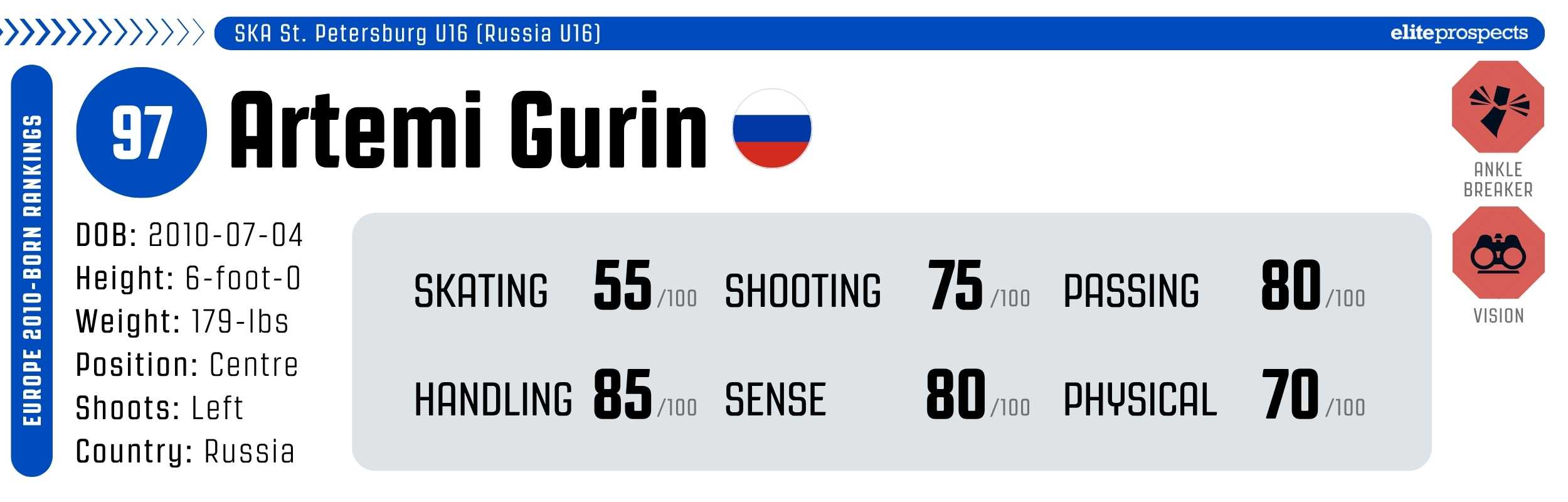
Artemi Gurin's tool grades are a rare sight this low on the list — his 85 handling grade gives him a true high-end tool, and his vision and passing skill are strong as well. What's holding him back from ranking much higher on this list is his pace, or rather, a lack thereof. In flashes, his skating is fine mechanically, but Gurin prefers to play in a glide, constantly stopping to move his feet, usually operating at a low pace. With that, he's drawn comparisons to 2026 NHL Draft prospect Lavr Gashilov — a high-end MHL producer who didn't make the cut for our NHL Draft board.
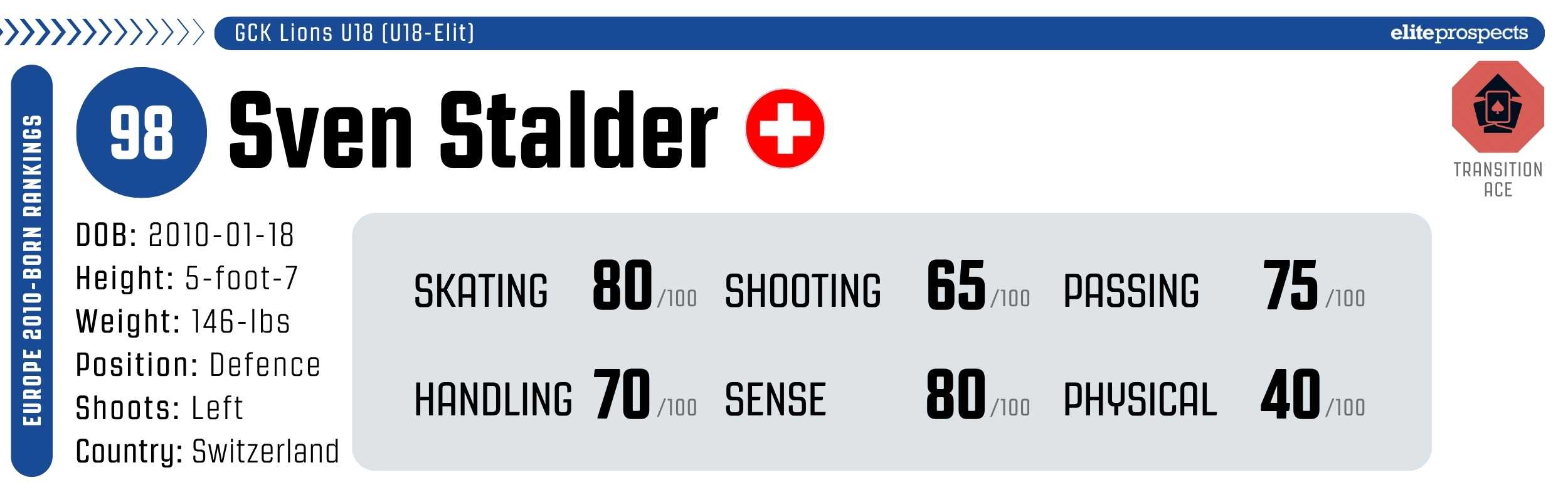
Sven Stalder is the last of a few undersized defencemen on our list. Both in person and on video, he's looked extremely small in our viewings, even compared to his same-aged peers. While that will hurt the pro projection, it makes his achievements to this point even more impressive. The top D for Switzerland's U16 team, he was roughly a point-per-game producer in the U17 league, and appeared in 13 games with Zurich's U21 team, where he put up eight assists. The tools might ultimately not be quite good enough to be a dynamic offensive player at the highest level, but Stalder has already proven he can impact the game at the Swiss junior level against players up to five years older than him.
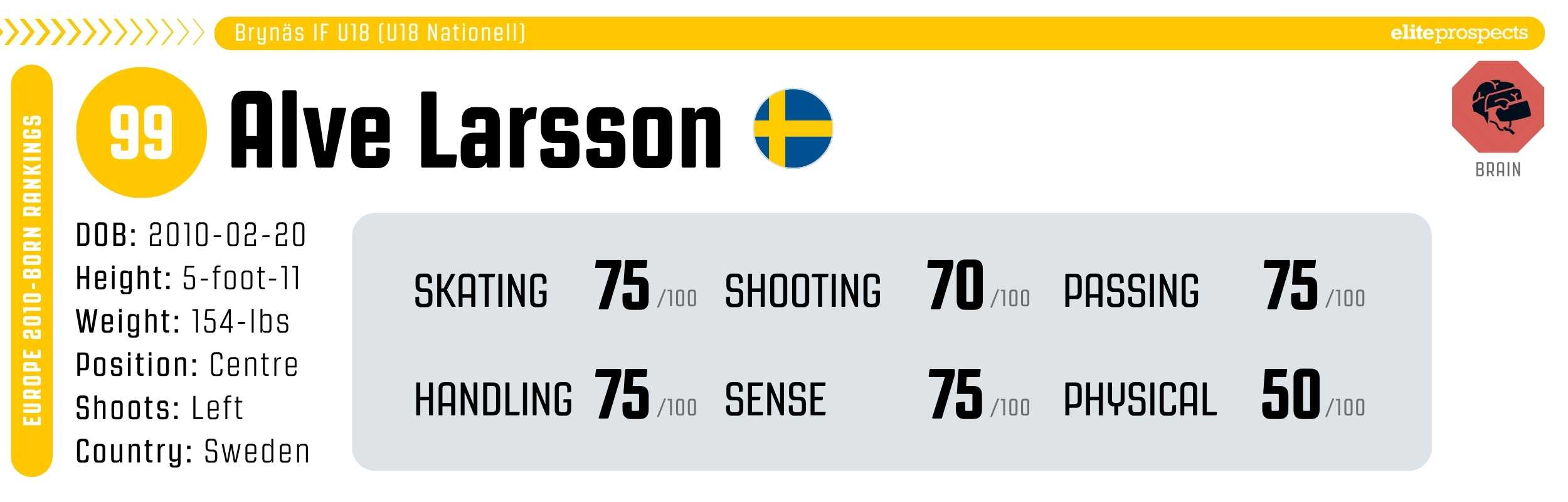
Smart and technically skilled, with soft hands and good vision, Alve Larsson brings plenty to like — all backed up by a mature two-way game. The centre piled up points with Brynäs U16, played over 30 games at the U18 level, and even got a taste of Team 16 Sweden, showing promising flashes. At the highest level, however, his smaller stature sometimes leaves him marginalized to the perimeter. The forecast is that he’ll take big steps forward next season, but continued physical development will be key for long-term projection.
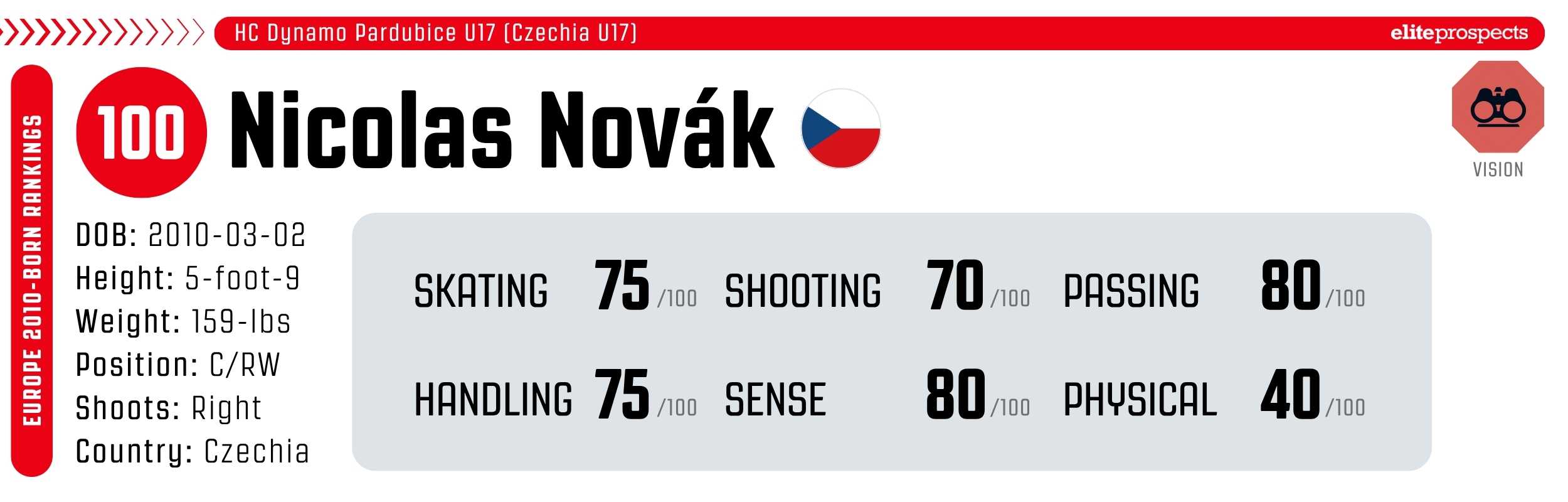
Rounding out our top 100 is Nicolas Novák. The highest-scoring player in Czechia's U15 league last year (35 goals, 93 points in 33 games) and a consistent offensive contributor with Pardubice's U17 team this season, his abilities are hard to deny. He's smart with and without the puck and does a great job setting up teammates for success. However, as a 5-foot-9 winger without high-end skating ability and limited physical skill, he will have to find creative ways to hang on at higher levels.
Honourable Mentions
Adam Šinkovský, RW, Kärpät U16 (U16 SM-sarja)
Alexander Krasnik, C, Salavat Yulaev Ufa U17 (Russia U17)
Bela Boos, C, Düsseldorfer EG U17 (Germany U17)
Bogdan Bezukhov, RW, CSKA Moskva U16 (Russia U16)
Eric Larsson, C, Djurgårdens IF U16 (U16 Div. 1)
German Gromov, G, Lokomotiv-2004 Yaroslavl U16 (Russia U16)
Igor Nikulin, D, Dynamo Moskva U16 (Russia U16)
Kaapo Honkaheimo, D, Lukko U18 (U18 SM-sarja)
Jacob Tjernqvist, D, Leksands IF U18 (U18 Nationell)
Jimi Kivinen, C, Jokerit U18 (U18 SM-sarja)
Leo Kinnersjö, F, Färjestad U18 (U18 Nationell)
Leon Irani, D, HV71 U16 (U16 Region)
Lucas Fritz, G, Lukko U18 (U18 SM-sarja)
Marlon Zanoli, C, Genève Future Hockey U18 (U18-Elit)
Matyáš Čutta, LW, Bílí Tygři Liberec U17 (Czechia U17)
Melker Wersäll, C, Djurgårdens IF U16 (U16 Div. 1)
Simon Wilsell, F, Malmö Redhawks U16 (U16 Region)
Sixten Nilson, F, IFK Täby U16 (U16 Div. 1)
Tomáš Holý, LW, HC Vítkovice U17 (Czechia U17)
Tomas Kohút, D, Tappara U18 (U18 SM-sarja)
Valtti Mäenpää, LW, Jokerit U18 (U18 SM-sarja)
Yegor Ageyev, G, Spartak Moskva U16 (Russia U16)
Our Team
Janik Beichler, Dir. of European Scouting
Lassi Alanen, Dir. of European Scouting
Sebastian Orre, Sweden Regional & Crossover Scout
Dylan Griffing, Eastern Europe Regional Scout
Honza Zoufal, Central Europe Regional Scout
Victor Svensson, Sweden Regional Scout
David Phillips, Goalie Scout